
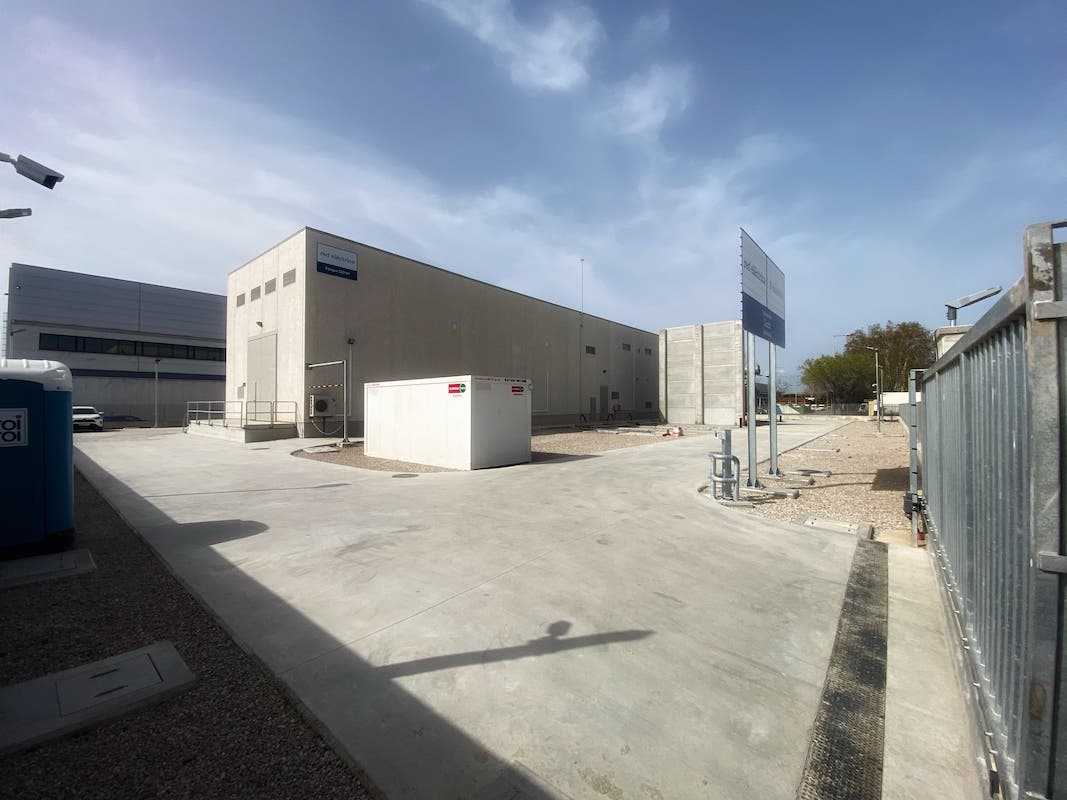
The Zona Franca has a new industrial building that, from the outside, could well look like a warehouse, a distribution platform, or any type of logistics infrastructure. Few would guess what it houses, and even fewer what it is for. It is the new Cerdà electrical substation, which goes unnoticed inside a building from which it will supply the La Marina neighborhood, the Zona Franca, and the Port of Barcelona.
This new infrastructure will, in fact, be the one that will facilitate the transition of the port enclave towards electrification, the one that will bring energy to the 12,000 new homes planned in La Marina, and the one that will allow increasing the industrial development of the Zona Franca in the future. In this way, the new substation aims to be key for boosting the ecological transition of Barcelona and its surroundings, as well as its economic and industrial development.
The substation, launched by Redeia's subsidiary Red Eléctrica, was initially designed to respond to the anticipated growth in the La Marina neighborhood and the areas surrounding the Zona Franca, as part of a Council of Ministers plan for the 2015-2020 period. Construction of the facility began in 2019 and, after a year and a half of work, it has recently entered service, as explained by Redeia's delegate in Catalonia, José Ignacio Lallana, during a visit to the substation.
Three electrical lines from existing substations in L'Hospitalet, the Airport, and Motors, also in the Zona Franca, converge there. The substation acts as an electrical distribution node, and its commissioning has required 36 million euros. This investment has included the work to bring the thick cables that transport energy from the other substations to the industrial building, whose building cost eight million out of the total of 36.
Like rivers converging in a reservoir, the newly opened facility functions as an energy reception point for the three lines, and then distributes the electricity. Like the rest of the electrical substations, it acts as an energy supply hub that, in this case, will facilitate the future development of this Barcelona area and the electrification of the port, within its strategy to advance sustainability.
In addition to supplying energy to these areas, the new substation also reinforces the three it has connected, as it can cover the energy of any of the other points if they register an incident. The installation, moreover, is expandable and can add three more lines, which join the three existing ones from L'Hospitalet, Motors, and the Airport.
The energy from these three installations travels through underground cables so thick they wouldn't fit through the neck of a bottle. Three large cables from each point of origin converge in the subsoil of the installation, in a room where the white of the walls contrasts with the black of the cables, both the large ones that transfer energy from the other substations, and the thousands of cables that serve to control what happens with the system.
These countless cables are responsible for monitoring and preventing incidents and for tripping the differential in case they occur and are necessary. As happens with a domestic installation, but on a large scale, and multiplying the power by a thousand. The control and signaling cables allow for the telematic management of the installation, so its operation does not require the usual presence of any worker.
This substation is one of many that are scattered throughout Barcelona and often go unnoticed by citizens, such as those located on Paseo Maragall, inside a building, or in Trinitat, outdoors. In Catalonia there are about 90 substations, most of them outdoors, contrary to what happens in Barcelona, due to the need to locate them in urban areas. Indoor installations are more compact than outdoor ones, but at the same time more expensive, with a required investment that more than doubles that of outdoor installations.
Now, among the network improvements that Red Eléctrica is working on are the remodeling and improvement of the Abrera substation, which will facilitate the electrification process of Seat and increase the supply to nearby industrial estates, and the replacement of existing lines with higher power lines, with the aim of contributing to industrial and business development, according to Lallana: "We are generators of economy."
Add The New Barcelona Post as your preferred Google source for free
Stay informed with the latest news.
