
The management team of the Vicens Vives publishing house, led by Pere and Jaume Vicens, closely observes one of the latest novelties exhibited at the stand of OPQ Systems, a Barcelona-based distributor of bookbinding machines. They thus take advantage of the coincidence of two trade shows at Fira Gran Via: Liber, the international Spanish-language book fair, and Graphispag, the graphic industry and visual communication show.
From Tuesday until this Thursday, Liber and Graphispag share a pavilion for the first time at the L'Hospitalet de Llobregat venue, separated only by the central aisle, with the aim of bringing together two sectors that depend on each other. After the threat of the ebook came to nothing, the paper book continues to represent 95% of the business, and any novelty in printing techniques interests publishers, especially those that allow for sustainable small runs of slow-moving books. "The emergence of new technologies that are evolving rapidly and clearly is consolidating. This implies that we are on the path to changing the way books are printed," values the president of Liber, Daniel Fernández.
Two close but very different worlds, between the tranquility that permeates Liber, with its attendees constantly leafing through books, and the hustle and bustle that predominates in Graphispag, with printers running at full speed. Beyond the foray of Vicens Vives, it is difficult to find stands with proposals for the book industry, as evidenced by the few Liber accreditations seen among those walking among machines.
If in Graphispag innovations are the order of the day, with printers that use any imaginable support as a printing medium and with surprising packaging solutions, it must be said that in Liber things are not like that. There are inventions that, once conceived, cannot be improved further. For centuries, no one has surpassed the formula of a cover and many pages, as Irene Vallejo well defends in El infinito en un junco (Siruela). Booktubers and whatever else one wants will appear, but no one has yet dared to say that turning pages is for boomers.
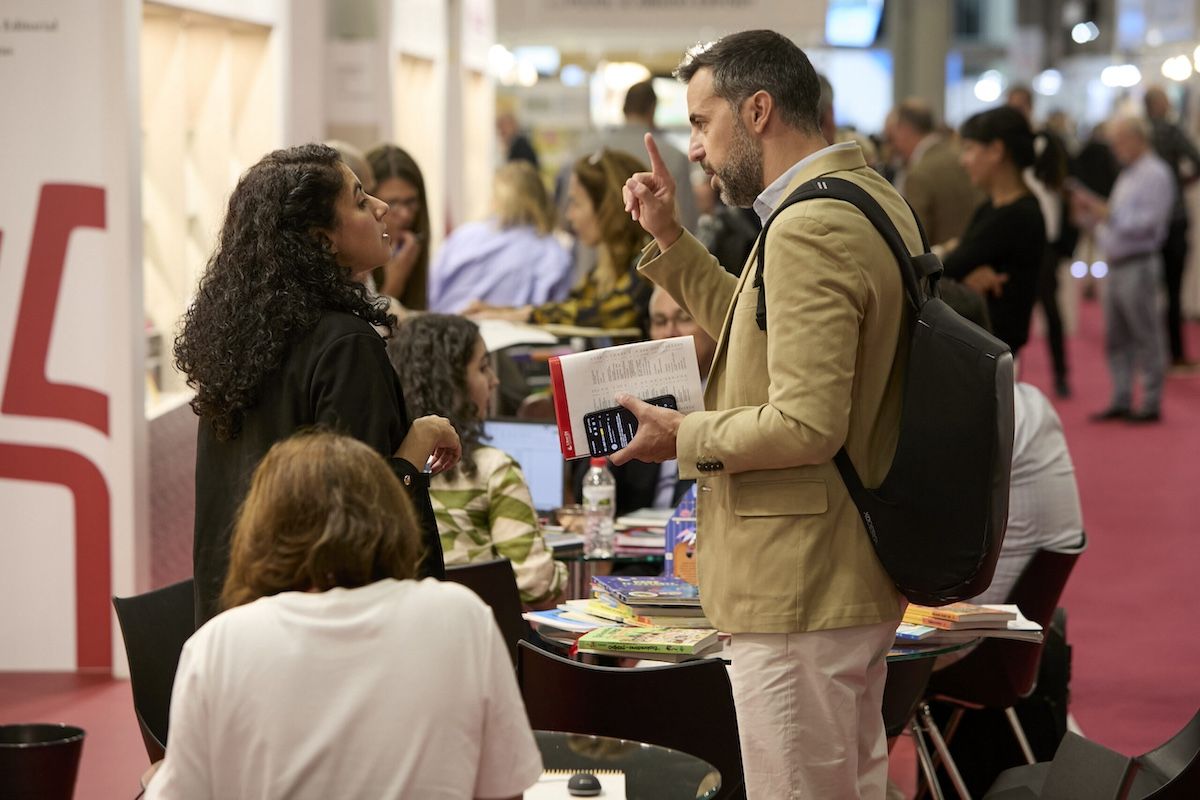
"The book has to be touched," remarks the editorial director of the Anaya group, Luisa Gutiérrez, surrounded by copies from Alianza Editorial, Cátedra, ADN, Larousse, and Bruño. This is how it's done at Liber, a large bookstore where, beyond discovering the latest releases, deals are closed. A third of the Spanish publishing sector's exports are signed at the fair. "Business develops all year, but meeting in person is still very important," defends Gutiérrez. Distributors and libraries from other countries attend the congress, especially from Latin America, with whom conversations are always ongoing, but until a meal is shared, everything isn't seen more clearly. In this edition, more than 3,500 business meetings are expected among the 7,000 professionals who will attend the fairgrounds, 40% of whom will be international.
With artificial intelligence hovering over conversations, Liber represents an international showcase for large publishers, but also for small ones. This is defended by bookseller Rafa Gutiérrez, from La Buena Letra in Gijón, who has participated for years representing Asturian publishers and, despite working with them day to day, it is here that he confirms the impact they have on the sector, beyond their borders. This is where, for example, Hoja de Lata comes into action, a small independent publisher based in Gijón that has been responsible for rescuing the Madrid writer Luisa Carnés from oblivion with Tea Room, Rosalía, and Juan Caballero. "They are not recognized as much in Asturias as outside," emphasizes Gutiérrez.
"The book has to be touched"A door to the world that the centenary Barcelona-based publisher does not hesitate to take advantage ofJoventut, to whom we must thank for bringing Tintin's adventures locally and participates every year in Liber. He does so both to reconnect with his regular clients and to attract new ones, according to his co-editor, Mar Zendrera. "It's a great opportunity," she says, knowing that many of the encounters end with orders, especially for publishers dedicated to children's and young adult literature, which has been performing best in recent years, not only in exports but also domestically, Zendrera emphasizes.
A leadership that children's and young adult literature, surprisingly, shares in Liber with religious imprints, who are betting on new business lines such as self-help books. This is the case of Paulinas, a publishing house based in Madrid. "They have quite a run," says its editorial director, Ester Marco. This year they present Si no lo buscas no lo encuentras (If you don't look for it, you won't find it) or Lo que tu eres para mí (What you are to me), as well as an easy guide on what to do at mass.
Add The New Barcelona Post as your preferred Google source for free
Stay informed with the latest news.
