[dropcap letter="U"]
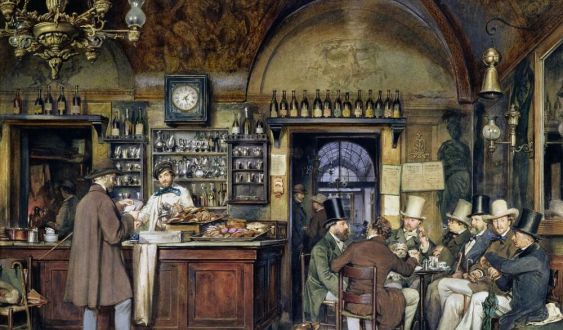
A long and narrow corridor with small, round tables of dark marble and upholstered chairs, of a solemn red, and a waiter in a tailcoat, stiff as a candle, elegantly strolling with a tray in hand. This is the first thing the occasional customer sees when they set foot in Rome's Caffè Greco. Contrary to what it might seem, this is not an anodyne picture. They have barely left behind the hustle and bustle of Piazza di Spagna, with those pompous steps that every day mechanically climb a hornet's nest of tourists, without quite knowing why. The café acts as an oasis. The smallness of the tables is an invitation to seek refuge. This is probably what has not changed in the house's more than 250 years of history. It is fair to call it a house because this is the condition it has exercised throughout the time that artists, writers, musicians, and intellectuals, largely foreigners, have found a refuge to socialize, take notes, recover from the Roman chaos, or simply pass the hours. Like whom? The list is endless, and as one walks through the corridor and rooms of Caffè Greco —originally Antico Caffè Greco— one becomes aware of the quantity of traces, conversations, tastes, and artistic possibilities it has sheltered. Now the house is replete —full, in a fully baroque sense— with paintings, sculptures, manuscripts, dedications, photographs, engravings, letters that treasure the type of clientele it has had.
From Goethe to Andersen, from Mendelsson to Wagner, from Leopardi to Stendhal, from Gogol to Orson Welles, from Josep Pla to María Zambrano. Extensive lists circulate —one might say ever-growing— of personalities who have passed through the Greco, as if fulfilling an ineffable desire to enlarge its legend. The truth is that top international artists came to sample the delights of its coffee or its whiskey.
The more artists and intellectuals frequented it, the more they filled its walls with artistic pieces, which makes one think of the kind of atmosphere known by the tenants of the first half of the 20th century
Prices aside—a cortado, nine euros; an Irish coffee, eighteen—, the current menu informs that one of the first references to Greco appears in Casanova's memoirs, who recounts that in 1779 he visited a café on Via Condotti. I don't know for sure if the street Casanova knew already had the commercial appeal it has now, because it is undeniable that today it occupies a prominent place in the list of major city axes dedicated to luxury clothing and garments. Goethe, author of the seminal Journey to Italy, was a regular at Greco, which, over the years, became an unmistakable meeting point for foreigners in Rome. Encouraged by the growth of hotel accommodations around it, it was a preeminent place for English and Germans, also for Nordics—Hans Christian Andersen rented a room above the café—, and also for Catalans. The more artists and intellectuals frequented it, the more they filled its walls with artistic pieces, which suggests that the atmosphere known by the tenants of the first half of the 20th century must have been very different from that of now.
Let's enter arm in arm with Josep Pla. It's after lunch and the writer from Empordà must choose between going to work in the library of the Spanish embassy, which is nearby, or the Café Greco. Ineffably, he prefers the café, which he will recognize as his café in Rome. "It is a peaceful, secluded café, with a clientele—especially at certain hours—accustomed to making as little noise as possible. In this sense, it seems like a café in northern Europe, and if it were possible to see the rain dripping on the street windows more often, the illusion would be perfect. But the Rome of fresh watercolors is not common. Piranesis abound more." The Pla who grumbles about one thing or another finds in this café the ideal place to practice one of the exercises for which he was best endowed: conversation. He finds it the first time he went, in 1922, and years later, during the civil war, when, according to Professor Rossend Arqués, a Catalan tertulia was established. Messrs. Soldevila, Manuel Brunet, J.B. Solervicens, the Count of Logotete, Salvio Valenti, and other sporadic participants, such as Pere Rahola, Dr. Vilardell, Ramon d'Abadal, and the Alghero natives Simón Mossa, Manca, and Ferigno, take part in it. A few decades later, the writer, already old but equally sarcastic, would call it the Catalan-Sardinian-clerical tertulia. And he would recall how the owner of the café, Mrs. Antonella Gullinelli, widow of Grimaldi, had assured him that from Goethe's years until then, that group of Catalans was the one who had spent the most hours in the house.
Following the tradition of the great European cafés that have become cultural epicenters, this café, the oldest in Rome, has for years embodied an idea of civilization, the possibility of saving oneself and growing in conversation, of recognizing oneself. Now it has more the air of a museum piece, of Instagram filter cannon fodder. Surely, as Pla would say, "tot això ja ha passat avall" (all that has already gone downhill).
Add The New Barcelona Post as your preferred Google source for free
Stay informed with the latest news.