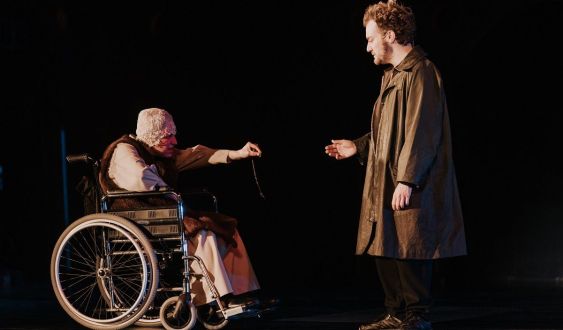
In a time of painful and stressful current events, with humanity digesting how the rapid transition from Covidian confinement to the frenzy of war can happen, we must thank the Teatre Lliure for the temerity of programming such a venerable (and Russian!) text as Crime and Punishment in a theatrical spectacle lasting more than four hours. I applaud the courage of Pau Carrió and company in tackling a mammoth bible that overwhelms the reader not only by its delirious verbosity (psalmodies that not even the most perfect computer would be able to memorize and that tempt the retention of any actor), but by how Dostoevsky uses the discourse and ethics of philosophical modernity in order to make the spectator feel empathy for the reasons of a criminal. I was very curious about how Carrió, a very intelligent reader of theater, would approach the text so well translated by Miquel Cabal, and I was even more eager seeing the initial portico of the proposal, of an oratorical nakedness, with all the actors of the company chorally declaiming the episode in which Raskolnikov witnesses the indiscriminate murder of a sad, poor, and unfortunate mare.
This dead animal (the same creature that Nietzsche compassionately embraces before going mad, assuming the weight of human absurdity; re-watch Béla Tarr's The Turin Horse) is the perfect figure to enter Dostoevsky's mental framework, the transcriber of a pre-industrial society of humiliated, offended, and starving people who clumsily survive in an empire that is beginning to dissolve, doomed to a bureaucracy so brutal that it becomes laughable. It is in this environment, of minimal epic and in a framework of baseless law, where Raskolnikov survives with the only moral escape that allows him to assume the twilight of order: by killing an old pawnbroker and the poor collateral victim who happened to be there. Crime and Punishment hurts because Dostoevsky brilliantly describes a world in which moral responsibility has vanished, where men who believe themselves extraordinary must sin to survive a decadent but increasingly intrusive power, and in which precarized classes must purge their frustration on animalized scapegoats. If anyone is looking for clues to understand the war in Ukraine, they already know which text to turn to.
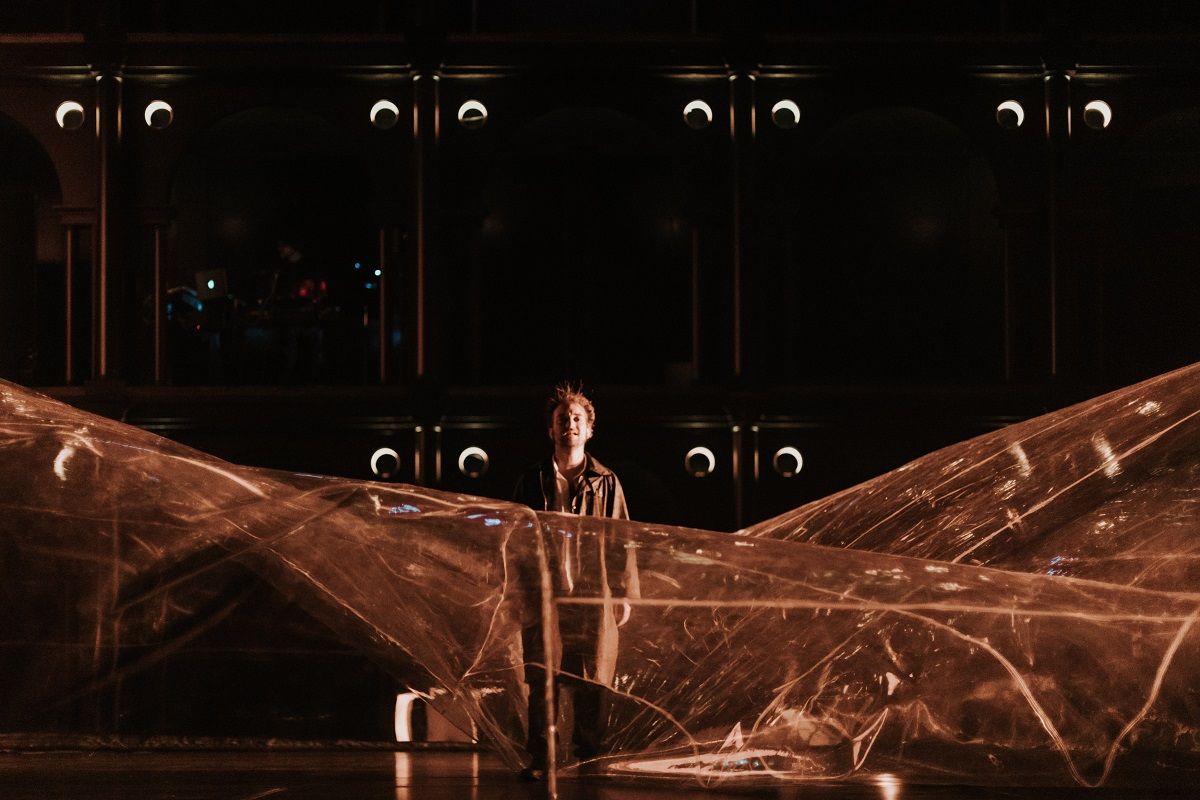
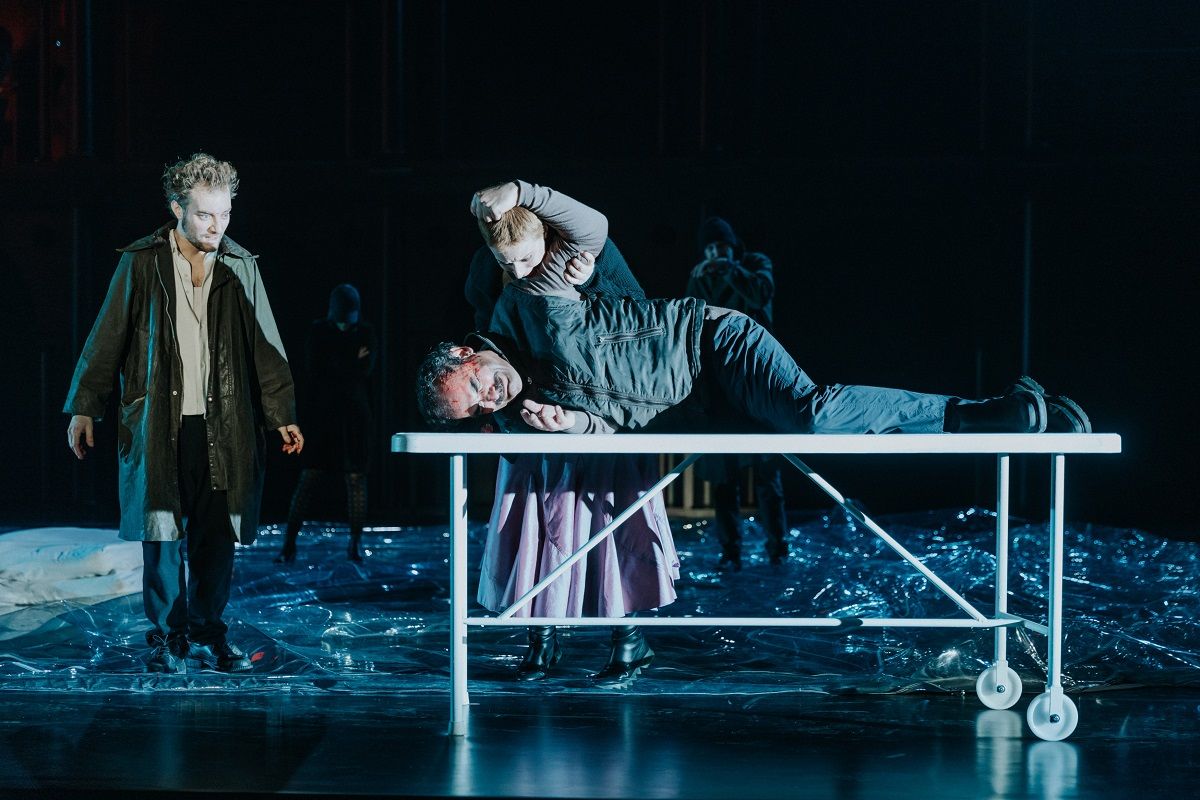
The proposal still promised more with the contribution of Sebastià Brosa's beautiful stage space, a plastic bubble that hangs from la Fabià and perfectly embodies the protagonist's isolation (the sphere and its material can also be thought of in terms of sanitary immunity: Raskolnikov is a feverish patient who absorbs the exterior sordidness as if Crime and Punishment were a product of his unrestrained reason, of a strange viral fever, and all the characters embodied a hologram), a spherical architecture from which we wake up with the weight of a mattress that falls like a slab and leaves us in the fog while the protagonist, paradoxically, does what he can to sleep. This illusion of immunity, of thoughtful isolation, is only penetrated by a reality that admits no nuances; the blood of the corpses that seeps into the final scene after Raskolnikov's pseudo-confession, precious and deformed like a Lucian Freud postcard. Often the sculpture makes it difficult for the actors to pass, it is true, but before an artist who makes us think and honors the name of the Lliure's main hall, it is necessary to take off one's hat.
Everything was going well and I was opening my tired eyes to attend an anthology show... until, and I miss the reasons, Carrió decides to squander all the papers he has on his study table to lighten the marathon, turning Dostoevsky's reality into a vaudeville piece with deformed characters and burying his Raskolnikov in a kind of laughable buffoon with brief bursts of clairvoyance. Crime and Punishment has many delirious moments in which injustice and pain are funny; but this hilarity is based on the path of a character who uses his desire for bonhomie and his prodigious capacity for argumentation to explain to us that liberation can only be achieved through the death of cretins. If we want to enjoy this text, we must believe in Raskolnikov, contemplate ourselves thinking that he is right and vomit all our frustration into his own axe. If the easy option of caricature is chosen, all this identificatory process disappears and the bible in question ends in shipwreck. I would honestly like to know the moment when Carrió decided to throw in the towel and go for the easy way.
Everything was going well and I was opening my tired eyes to attend an anthological show... until, and the reasons escape me, Carrió decides to squander all the papers he has on the study table to lighten the marathon.Theater is not metaphysics and, in this gradual fall of ambition, a protagonist who ends up playing the card of the "flipado" (freaked out) interpreted by an actor who weaves and survives in his own shortcomings, made of recurring tricks that would be optimal for a performance at the Borràs, and with a more than creative relationship with Catalan phonetics (since the Punyalada we intone a requiem for the silent 's' and the simple 'r', main victims of a limitless murder shared by Zamétov and Lutin), does not help. It is a pity that the periscope of caricature also ends up blurring the work of a brilliant actor like Albert Prat, who would have gained much more composure with a Razumikhin in whom ingenuity was not perverted by an infantilism of little jumps.Fortunately, there is Míriam Iscla; apart from giving us an interpretive lesson and establishing herself as one of the best actresses in the country, she embodies the only spark of the initial hope of the production.Also the craft of Roser Batalla, Carlota Olcina, Oriol Guinart and a surprisingly phlegmatic Òscar Rabadán; but the lack of temper in the reading ends up practically wasting all its strength.
So much for the facts, and now we enter the dangerous space of symptomatology. I would dare to say that this Crime and Punishment has become liquid due to something as hazy as its environment. Theater is philosophy, flesh on stage... but it is also woven in a very specific context, and it does not seem like a coincidence to me that Carrió's proposal, instead of embracing Dostoevsky's complexity, has fallen victim to a portrait of our present, and when I write the preceding phrase I refer to the reality of the tribe. Thanks to Dostoevsky, Raskolnikov and company are heartbreaking and cathartic to us because, despite the decadence, their archetypes maintain a certain ethical dignity, at least for the persistence with which they defend their respective suicide and the delirium that justifies them. In a world where truth and lies vanish, Dostoevsky's map still grants dignity to his characters; this is not the case in our current Catalonia, an environment copied in terms of delirium, but where the individual suffers from mystical nullity. It is because of this deadlock, I would say, that Pau Carrió has decided to abandon Dostoevsky and opt for making the godmother laugh a little.
The director can tell me to go to hell and he will do so saintly after the pencada that he and his troupe have put in for weeks to pull off this recklessness. But, regrettably, I would say I am right (apart from, and unlike most theater critics in the country, I have had the delicacy of having read the work). If I were to anger him, I would recommend that he take advantage of all the initial energy of this production to abuse his actors and recover their spirit from the first scene in a new version. The theatrical space he has is overwhelmingly powerful, among his performers there is some of the best of our theatrical heritage and, after all, Catalan phonetics courses are affordable for any budget (the commissioner can do it, if they need an immaculate Catalan model). That said, rush to the Lliure and fill it, even if it's just to contemplate, in the worst sense of the title, a Crime and Punishment Catalan style.
Add The New Barcelona Post as your preferred Google source for free
Stay informed with the latest news.
