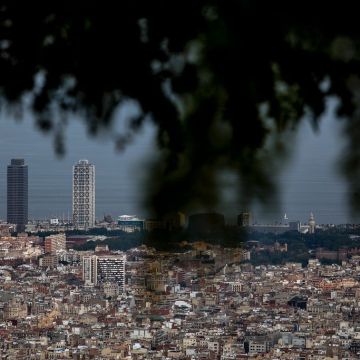
September is the month of return: the return home, to routine, to work. After the summer exodus, working Barcelona is easing into a new season with 1.27 million people registered with Social Security, an unemployment rate of 7.7% and more than 24,000 jobs to fill, according to data from Barcelona Activa. So, what does Barcelona at work look like as it returns to the office this week?
Start with the headline number: Barcelona city logged 1,272,677 registrations to Social Security in June 2026, 0.9% less than the previous month. Of those, 1,138,518 were employees and 134,159 were self-employed workers. So, approximately one in ten workers is self-employed.
The number of registrations, however, is not exactly the same as the number of people employed, since one person can hold more than one registration. To find out how many people are effectively employed in the city, you need to look at the Labor Force Survey. According to the latest available data from the Barcelona City Council, in the first quarter of 2026, there were 862,000 employed people in the city, out of a total of 913,000 economically active residents (people of working age who are in work or job-hunting). Looking at the province of Barcelona, the EPA identifies 3.18 million economically active people, of whom 2.94 million are employed.
Unemployment in Barcelona city sits at 7.7% (second-quarter 2026 figures) — virtually identical to the provincial rate, also 7.7%, and just below Catalonia's 7.9%. Zooming out, we see that Barcelona's unemployment rate is lower than that of Spain as a whole (9.9%), identical to that of Madrid (7.7%) and still quite above the European average, which is 6% in the European Union and 6.3% in the Eurozone.
The 7.7% figure is a number that invites optimism but hides inequalities. For example, unemployment is much higher among young people, with an unemployment rate for under-25s of 16.05%, more than double the average in Catalonia.
And there are also gender differences, but that doesn't necessarily mean a higher female unemployment rate. In Barcelona, women accounted for 56% of registered unemployment in June 2026, with 34,322 unemployed women compared to 26,851 men. And the difference is more visible when we look at long-term unemployment: according to Barcelona Activa, women account for almost 61% of the very long-term unemployed.

However, despite this difference, hiring figures paint a more balanced outlook: in June 2026, 39,304 contracts were signed by women and 40,022 by men. But if we cross-reference gender with the type of working day in these new labor contracts, a significant imbalance becomes evident again. Figures from the City Council's Municipal Data Office show that almost 65% of contracts signed by men from January to June 2026 were full-time, while that figure drops to 52.1% for women. By contrast, nearly four in ten contracts signed by women were part-time (39.4%), against 28% for men.
So, women still dominate part-time and intermittent-permanent contracts (59% and 54.5% of the total respectively), while men make up the majority of full-time roles, at 54.8%.
"Digital talent represents 6.5% of the city's total employment"
Working Barcelona is, above all, a Barcelona of services. In June 2026, 1,153,114 Social Security registrations were in the services sector, compared to 72,856 in industry and 38,309 in construction. Agriculture, with 830 registrations, plays a much smaller role in the city's labor market.
Increasingly, though, services and industry alike are being reshaped by tech, innovation and higher-value work — and it's here, at the crossroads of technology and the wider economy, that Barcelona is pulling ahead. The city's digital workforce has grown to 135,890 professionals, who now make up 6.5% of total employment, according to the eighth edition of the Digital Talent Overview 2026 from Mobile World Capital Barcelona.

And the growth rate is particularly significant: employment in the digital sector is growing 3.6 times faster than the overall Barcelona labor market. While the number of digital professionals expanded by 4.85% in 2025, the city's total employment grew by 1.34%. Barcelona, therefore, not only has more digital talent than a year ago, but the technology sector is growing at a clearly higher rate than employment in general.
And if there is one area that is accelerating this transformation even more, it is artificial intelligence. Adobe's AI City Index ranks Barcelona as Spain's best-adapted city to artificial intelligence, scoring 94.24 out of 100, ahead of Madrid (89.29) and Valencia (70.66).
Barcelona also leads the ranking in AI-related job offers per million inhabitants, with 93.39, and obtains the highest score in the index of occupations linked to this technology, with 50 points.
All of this paints a picture of a working Barcelona that is changing: more digital, more technological, and with a growing demand for specialized profiles. But at the end of the day — or more accurately, the end of the month — it all comes down to the pay cheque: an average gross salary of around €36,466 a year, according to the City Council's Continuous Working Lives Sample for 2024. That's 3% more than the previous year, although, once adjusted for inflation, the gain in purchasing power is practically imperceptible: only 0.1%.
And behind this average there are significant differences depending on where one lives. Sarrià-Sant Gervasi has the highest average salary in the city, with €61,030 annually, 67% above the Barcelona average. At the other extreme is Nou Barris, with €26,909.
"Sarrià-Sant Gervasi has the highest average salary in the city, with €61,030 annually"
And, of course, there's the gender pay gap. The average salary for female residents in Barcelona was €33,349 in 2024, 15.8% less than the pay of male residents, which was €39,602 on average. The trend, however, is encouraging — since 2010, the wage gap has been reduced by more than nine percentage points.
Barcelona returns to work, therefore, with some pending tasks, but also with many reasons to look forward to these last four months of the year: more employment, more talent, and an economy increasingly prepared for the future.
Add The New Barcelona Post as your preferred Google source for free
Stay informed with the latest news.