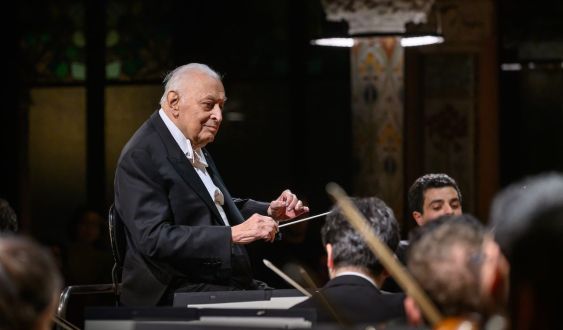
At almost 90 years old, Zubin Mehta continues to take the podium. The question that immediately arises is evident: what drives him to continue conducting at this point? Neither crowning the upcoming anniversary ---he was born in Bombay on April 29, 1936--- nor reaffirming his career seem to be weighty reasons; it is simpler to think that he is motivated by the challenge of maintaining the interpretive quality of a demanding repertoire, the possibility of observing how, in the hands of young musicians, music is still built with passion and in real time. Curious time, that of interpretation: a fluctuation that at times also transfigures space, opening a kind of parallel reality, subject to other types of physical laws.
It is undeniable that Mehta needed assistants not only to get onto the podium stool with difficulty ---suffering and admiration in equal parts, among spectators--- on the two dates scheduled in Barcelona. We imagine something comparable in the preparation of rehearsals, as indeed most great conductors do. And, with all that, the sound he promoted in the ensemble of excellent musicians that make up the West-Eastern Divan Orchestra was absolutely recognizable, aligned with the musical ideas that Mehta has deployed throughout his career, and which at this point ---almost as a legacy--- he seems determined to share with present and future generations.
Both at the concert organized by BCN Clàssics at L'Auditori and at the Palau 100 concert, programmed in the modernist temple, mutual attention was a constant: a perfectly educated and yet rapturous orchestra, of course without the need for the conductor to mark entrances or demand greater expressiveness in attacks. A musician from the Berlin Philharmonic confessed in a documentary ---this was several decades ago--- that when Wilhelm Furtwängler entered the room while they were rehearsing, the sound surprisingly changed, implying the magnetism he exerted without gestures or words. The anecdote ---obviously tinged with mysticism, the reality could be cruder--- allows us to partly understand the reason why this communication between musicians of almost maximally distant generations could feel so subtle and, nevertheless, effective. In the main hall of L'Auditori, the orchestra showed its power from the start, with the performance of Wagner's overture to Rienzi: expansive, firm in its inflections and contagious in the most celebrated Italian rhythmic passages, the sound mass breathed with clarity and strength.
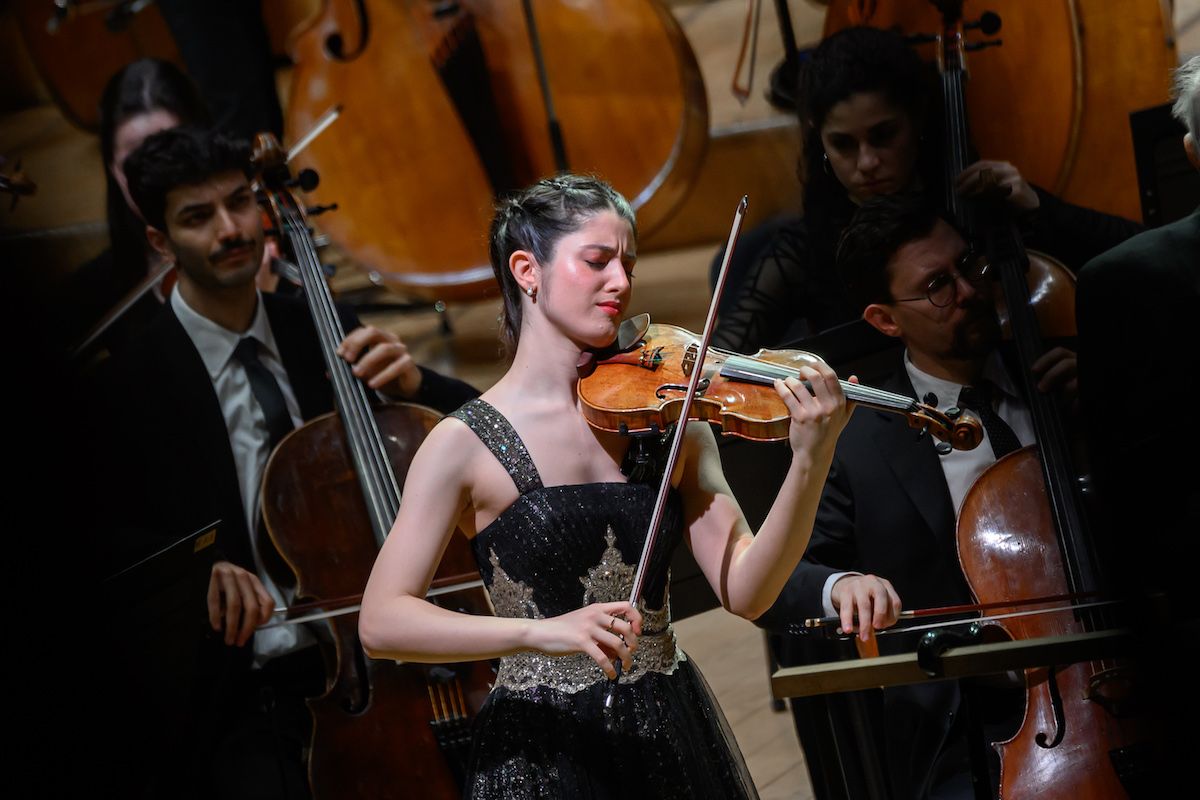
"Curious time, that of interpretation: a fluctuation that at times also transfigures space, opening a kind of parallel reality, subject to other types of physical laws"The most famous violin concerto by Max Bruch would follow, which in many ways became the emotional center of the program. María Dueñas, having just turned 23, once again demonstrated dazzling technique: clean articulation, impeccable intonation even in the most challenging passages, a confidence that led her to tackle the most virtuous passages without apparent effort. The first of the encores she offered ---Applemania, by Aleksey Igudesman--- sounded Paganinian in its multiple technical challenges; while the second ---which seemed unexpected even for her--- took place at the request of the maestro, to whom she addressed herself many times, offering a deeply familiar image of complicity and respect between top-level musicians. Musicians at very distant moments in their careers, but who acted in fruitful feedback, activating that cyclical temporality studied by Mircea Eliade—that of festive celebration, in this case based on art—which, if it does not manage to overcome the passage of time, at least leads us to accept it a little better.
Tchaikovsky's Symphony No. 4 stood as a challenge for the orchestra, which embraced it with similar conviction to that of the soloist, and a striking reliability in the brass section; manifestly protagonists in the first movement, with that solemn declamation ---suggesting a motif of destiny--- that interrupts the series of variations on a folk theme, providing resolution to the cycle with a control and dedication rarely seen in young ensembles. The performance reflected a balance between lyricism and expressive force, with interpretive autonomy and a sense of shared responsibility that was evident throughout the work, and beyond the first evening.
Because at the Palau, two days later, Beethoven's Leonora Overture No. 3 was presented with no less solidity or drama. Even his Symphony No. 8, often understood as a lighter work ---due to its uncomfortable position between the Seventh and Ninth--- sounded more robust than playful here. Irony and humor were present as an underground, almost rhythmic energy, driven by a powerful and compact string section, which allowed for an understanding of its shorter and seemingly lighthearted character, emphasizing its innovative accents and the vindication of its sonic musculature.
Schubert's Symphony No. 9, which occupied the second part of the concert at the Palau, demanded a different breath, worthy of the nickname ("the great") with which, not by chance, it is usually referred to: a martiality not devoid of lyricism and a notorious sense of epic, concentration in specific passages, but also a long-term vision. Beethoven did not hear his Ninth, although he conducted it at its premiere, while Schubert —who incorporates a quote-homage to Beethoven in the fourth movement— could not premiere it during his lifetime.

They are works imbued with pain and grandeur, laden with a transcendent truth, which require continuity until the end in the interpretative commitment. There was power, brilliance, and a sense of spectacular culmination in Schubert's final symphony. The arrangement of the woodwinds was striking, placed around Mehta's podium, a decision that seemed to respond to the desire to emphasize their prominence in the multiple dialogues that take place in the central movements. It cannot be said that the result radically transformed the overall sound, but it did evidence a personal reading, recognizable in its density, in its taste for sonic fullness.
"A combination of youth and daring that is not exclusive to this ensemble, and that manifests itself exemplarily as a willingness to take risks"And yet, there is a decisive element that ran through both evenings, and that is worth remembering: the youth of the orchestra, and the evident motivation that the musicians showed with their body language and —more importantly, but not completely unrelated to the above— with their sound performance. The way the musicians looked at each other, sought each other out, and even smiled in the midst of the demand, without losing concentration or minimizing their performances in intensity or precision, was striking. The concertino—on this occasion more relevant than ever— was in fact elevated on a small podium, to play a particularly active role: he marked entries, guided the rope and not only… pulling the group with an unequivocal gesture, reciprocated by his teammates.
That visible communication reinforced the feeling of a shared project, of energy circulating horizontally and not just from the baton. This coexistence of youth and daring—we said—is not exclusive to this ensemble, although not frequent either, and manifests itself exemplarily as a willingness to take risks. The audience perceives this vocation, a way of "having a good time" making music with seriousness and passion, which is inevitably contagious.
The orchestra as a metaphor for a better society
The project promoted by Daniel Barenboim and Edward Saïd materialized in the West-Eastern Divan Orchestra, originally composed largely of Israeli and Palestinian musicians, based in Seville. Avoiding a reductionist political interpretation, given the complexity of the situation, it is undeniable that the proposal offers powerful evidence: people with different histories, languages, and, in short, realities can work together for the same goal. Nor do differences have to be diluted in an orchestra, but rather articulated towards a common end, which in this case requires listening, dedication, and trust. The project functions as a concrete metaphor for something broader: the possibility of joining efforts to achieve what, deep down, we all desire and deserve—coexistence in harmony, a sense of belonging, or vital purpose—from a reciprocal responsibility and respect for the most elemental human values, for the inalienable dignity of all people.
Surely the reason Mehta remains active lies in his genuine passion for music; we want to believe that he still finds fertile ground there for a fullness —a degree of understanding and fruition— that knows no age, that is not even completely extinguished with the arrival of silence or darkness. Through interaction, mutual care, and concentration, musicians make decisions in real time, from individual gestures, but so that the ensemble is manifestly benefited. And also, as a consequence, themselves.
Although in an undemonstrable positive way, from our position as listeners and spectators, this artistic commitment compels us to assume the no less inevitable responsibility for the creation of meaning: first for ourselves, no doubt, but thinking beyond the particular case ----integrated, as we are, into a whole, whether we are more or less aware of it--- and thinking, also, about the possibility of beauty beyond our lifetime.
Add The New Barcelona Post as your preferred Google source for free
Stay informed with the latest news.
