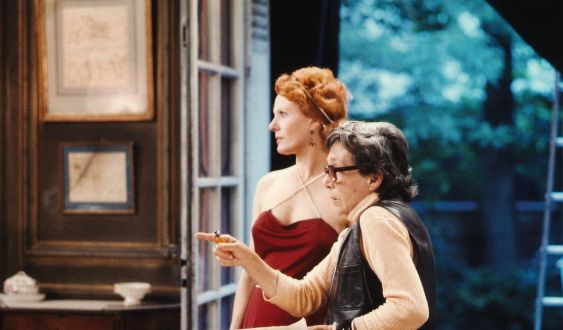
I came to Marguerite Duras on a winter Sunday, during one of my usual strolls through the Sant Antoni Sunday market. Through a small book published by Tusquets, Emily L., I delved into a personal universe that, like the fragments of a broken mirror, returned a fractured and sharp image that left a scar on me, and an intense desire to discover who that woman was whose words had resonated so deeply with me. And although a few years have passed since that Sunday, the day has finally arrived when a cultural space as important as La Virreina dedicates an essential—and more than necessary—exhibition to the author.
But who was Marguerite Duras? Although many tend to talk about the novels from the final stage of her life—such as The Lover (Tusquets), which brought her unexpected media and sales success at an advanced age—the ghosts of the characters from all her novels, plays, and films had been traveling with her for years.
This is what this exhibition seeks to reveal to us, structured into three major thematic blocks that, furthermore, is the first dedicated to the writer in Spain and the only museographic retrospective at an international level, which has gathered the entirety of her literary, film, and television work.
Valentín Roma, the exhibition's curator and the renewed director of La Virreina Centre de la Imatge last year, admits that "it is the exhibition I have pursued the most in my life." When I ask him where his interest comes from, he confesses that he has read Duras's complete works twice and is, although it is hard for him to admit it, one of the people who knows the most about her, and it is evident. In addition to a whole series of unreleased audiovisual material—gathered for the first time for an exhibition and subtitled—which allows us to delve into the Duras universe, and even watch some of her most relevant cinematographic works in a room set up as a cinema, the exhibition has the added value of someone who knows.
But let's go step by step. The first part of the exhibition introduces us to Marguerite Donnadieu, who was born in French Indochina in 1914 and died in Paris in 1996. Around 1932, she moved to Paris to study law, although she also studied mathematics and political science, and in 1943 she published her first work, La impudicia (also with Tusquets), which would open the way to more than twenty novels, film scripts, and dramatic texts. Her life and work are inseparable, and although some like to say that "scandals" accompanied her, very few of the things she did would seem scandalous to us today. As an example, one button, like her expulsion from the Communist Party in '55, for being "nymphomaniac, arrogant, and of loose morals." Although beyond this event, the writer would continue to define herself as a communist and anti-colonialist, and would stand against the Algerian war and, later, would march with the students in May 1968, playing a very active role.
"It's the exhibition I've pursued the most in my life," acknowledges curator Valentín RomaValentín Roma clarifies "each of those moments -of scandal-, establish turning points that are also reflected in her work." A breaking of limits that freed her from an invisible yoke marked by her condition as a woman, her relationship with men and alcohol, and that allowed her to develop her own language, already recognizable from her third novel published in 1950, A Dike Against the Pacific(Tusquets).
"Writing has always been the only thing that filled my life, the only thing that separated me from madness" she once said, and it was the irrepressible act of writing that allowed her to portray her life from intimate experience, from that place where shadow dwells, and to make the female figure the column on which that universe is sustained.
The exhibition at La Virreina continues in a second block showing us how in Duras's work there is no separation of fields: text and image go together. And this makes sense when we delve into the author's cinematography only to realize how close it is to her literature, to such an extent that her characters appear and reappear in different films, in plays or in novels.
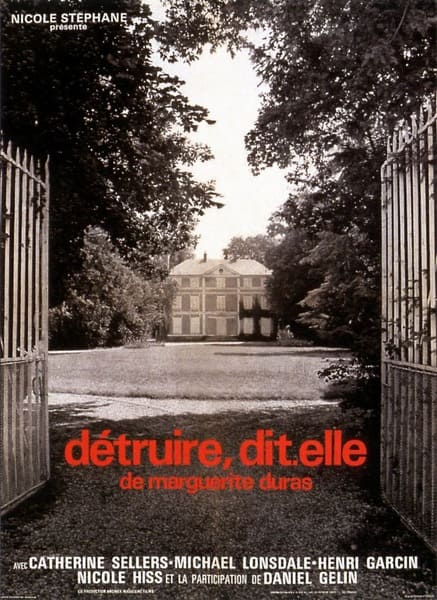
A series of films whose spark ignited a dispute with director Alain Resnais ---for whom she had written the screenplay for Hiroshima mon amour---, who later rejected a new screenplay that she would decide to film a few years later. "Destroy, she says. And this phrase resembles music, it always returns, it is the infinite variation on a theme, it is litany and celebration, control and abandon", a fragment from the 1969 film Détruire, dit-elle, an oracle of gems such as Nathalie Granger (1972), India Song (1975) or L'Homme Atlantique (1981), which would define Durasian cinema and which later influenced numerous filmmakers.
Her characters appear and reappear in different films, in plays or in novelsAt this point in the exhibition there is a special place to stop, to observe the copy she made for Cahiers du Cinémato which he calledGreen Eyes. A blank canvas that they offered her and she filled with her creation like a demiurge, talking about cinema, choosing images, reflecting on various topics. Material that seems in disarray but that tells us about her and her way of seeing and observing the world, and her creation.
We delve into the third part of the exhibition, fully dedicated to writing, and it is here that I surrender and, humbly, recognize that I do not know as much as I thought about Duras, when I discover the room dedicated to her theatrical texts, where the writer, focusing on the actors and reducing the set to the black screen, gives words a particular breadth.
Valentín Roma emphasizes that theater is the great unknown within the author's extensive work, but no less relevant and important for that. On the contrary. Suffice it to say that her first theatrical success was Des journées entières dans les arbres, performed at the Odéon in 1965 and which turned out to be the first play written by a woman to be performed in a Paris theater since 1900. And not only that, "she even incorporated texts into the repertoire of the Comédie Française, such as Le Square or La Shaga," notes the curator. The last performance in Barcelona of a Duras text was in 2019 at the TNC, by the hand of a magnificent Ariadna Gil staging El dolor.
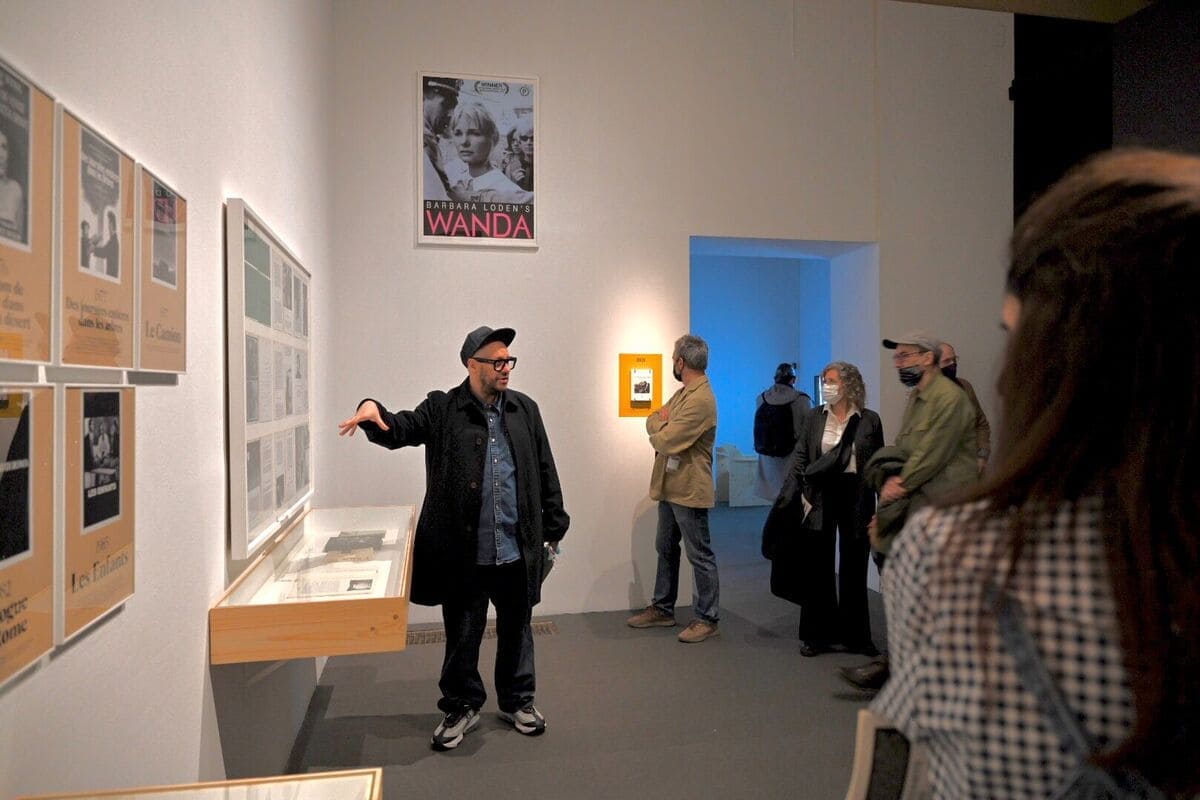
"To be alone with the book not yet written is to be still in the first dream of humanity" announces one of the author's phrases in the epilogue of the exhibition. And it is that in Marguerite Duras there is also much of "in the beginning was the word," that creative logos of a dense universe, full of women who break their archetypes, and so difficult to understand even for many other contemporary intellectuals like Simone de Beauvoir, who stated "I don't understand anything."
Marguerite Duras: "I don't know what a book is. Nobody knows. But when there is one, we know it. And when there is nothing, we know it as we know that we exist, not dead yet"But the power of the word in Duras is undeniable throughout her production, despite the stylistic change after her alcohol detoxification in the eighties and the mainstream success of her last novels: "perhaps it was simply a need to free myself, to definitively free myself from literature through literature: to arrive at writing, without further ado.
I cannot be impartial towards one of my favorite authors, as that would be denying the obvious, but I can fairly state that the exhibition that Valentín Roma and his team show at La Virreina is a luxury for all lovers of good literature.
Add The New Barcelona Post as your preferred Google source for free
Stay informed with the latest news.
