Ending a workday with a persistent headache; having difficulty driving long distances; getting irremediably dizzy when watching a 3D movie; ruling out nighttime reading due to lack of concentration; being the slowest in the office to read a report, or having the sensation of seeing double in moments of fatigue. These are situations that can creep into many people's daily lives, but which are often attributed to tiredness, stress or a dizzying pace of life for some, when in reality they can go further. And it is that four out of ten people are affected, many without knowing it, by visual dysfunctions that have nothing to do with wearing glasses. And this proportion not only occurs in the case of adults, but is replicated in the case of children.
Eva García Ramos and Juan Carlos Ondategui-Parra founded Wivi Vision in 2016 precisely with the aim of diagnosing and treating these visual dysfunctions, with methods that went beyond traditional ones. The company has made a "great leap" in this regard, according to Ondategui-Parra, who has more than 25 years of experience as an optometrist. For 20 years he set out to change traditional methods to diagnose and correct these dysfunctions, which can range from problems focusing to seeing double or blurry due to deficient fine eye alignment, to difficulties in reading due to poor oculomotor control that leads the reader to make random and meaningless jumps. "We are talking about visual efficiency," summarizes Ondategui-Parra.
Thus, Wivi targets problems linked "to the functional part of vision," and not ophthalmological ones, which have glasses and lenses as a solution. "We focus on eye movements, on their functional part: we are the physio of the eyes," illustrates García Ramos. And Wivi replaces traditional exercises performed using objects such as cardboard and cords with colored balls and a subjective evaluation with technology that includes Artificial Intelligence (AI), Big Data, and 3D combined with gamification. This combination has resulted in a series of video games that evolve based on how the user performs, and that objectively measure their progress. This technology reaches the user through a screen surrounded by sensors and special glasses to measure eye movements, which are located in specialized visual health centers, including optometrists and optical centers. Through games featuring Wivi, an alien-like character, the company's equipment allows for both diagnosing and treating and training vision objectively and measurably.
In an exercise that includes its landing in the United States, the company expects to close this year with four million in revenue.In traditional methods, objectivity does not exist, and treatments require six to twelve months, with "low loyalty" and little motivation on the part of the user, according to Ondategui-Parra. With their technology, Wivi Vision allows correcting 95% of visual dysfunction cases and doing so in a month and a half for mild cases, and two and a half for severe ones. "Before, not even you yourself knew when you were going to finish. Clinically, it represents a very radical change," claims the co-founder. Times are greatly reduced by the use of AI systems, which build data that is generatively taken into account in the design of the next exercise: "From a clinical point of view, it is the ultimate expression of personalized treatment." For this reason, for now the company has not registered regressions in any of its more than 10,500 users, when with traditional methods they occur in about a third of cases, according to the company's founders.
With extensive experience in the technological field, García Ramos joined Ondategui-Parra's aspiration to revolutionize the approach to visual dysfunctions after meeting him when her mother suffered from an illness that affected her vision. After some time considering options, the now CEO of the company was inspired during a technology conference in Las Vegas, and called Ondategui-Parra determined and convinced that the project could be carried out and contribute to improving the vision of adults and children, in an area unknown to many. In fact, 20% of cases are confused with dyslexia, and a significant number are misdiagnosed as ADHD.
Beyond dysfunctions
Wivi Vision is looking beyond the diagnosis and treatment of these dysfunctions, and also offers its technology to train vision and improve skills. This training is aimed at professionals who want to improve their performance, ranging from lawyers to consultants, but above all it is directed towards one profile: that of athletes.
"We have been making small forays into different sports because, just as you train the physical part, you can train the functional part of vision," remarks García Ramos. With this visual training, the athlete gains efficiency and precision and, therefore, speed. "It can give you tenths of a second: it gives you time. And gaining decision time is something that interests every athlete and coach," emphasizes Ondategui-Parra.
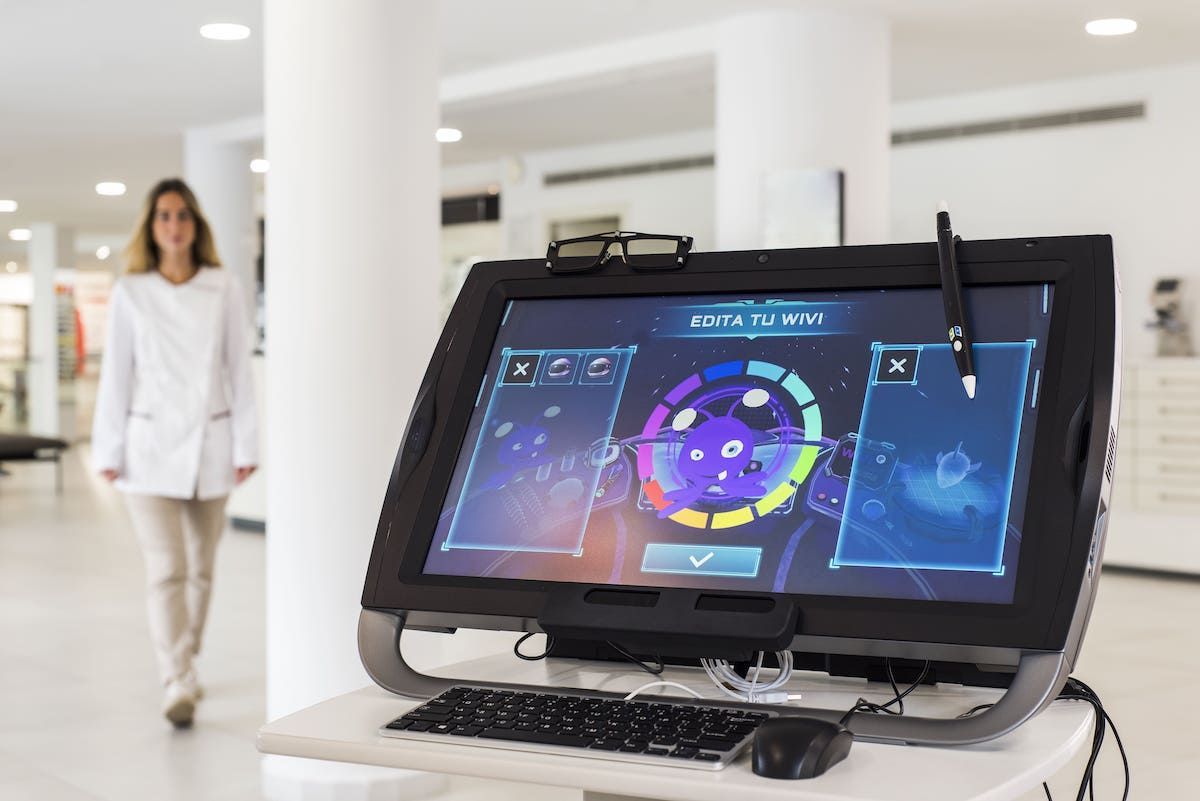
Promoting this focus on sports is one of the lines that Wivi Vision has on the table, but it is not the only one. The company has also launched new services to cover various age groups, and plans to boost penetration in Spain, also through the public system. Another major focus is on the other side of the Atlantic, with its landing in the United States. It is doing so hand in hand with Vision Rehab Technologies as the exclusive distributor of the Catalan company's technology in US centers.
Currently, Wivi Vision has about 80 devices installed in Spain. These are in addition to the fifty that are beginning to be placed in the United States, which will scale up to a total of 200. With these forecasts, the company expects to close this year with four million in revenue. "This should be the year of the leap," predicts García Ramos.
The company, which recently grew from 10 to 14 employees, faces this year after closing a four-million-euro round led by Adara Ventures and with the participation of actors such as Hearstlab, Avançsa, Caixabank DayOne, BBVA Spark, and Banco Santander. With more than 70 awards under its belt, including the Bioèxit from the CataloniaBio & HealthTech association, the company looks at the market without competitors that offer the same services and use AI to generate a video game tailored to the user, guarantees Ondategui-Parra: "There is no one in the market that performs evaluation with a clinical pattern and offers specific training with medical certification."
Add The New Barcelona Post as your preferred Google source for free
Stay informed with the latest news.