
When we talk about what is everyday or ordinary to us, words take on a boring, pejorative tone. It seems that, if we don't add the prefix extra, it doesn't deserve to be taken into account or isn't worth it. But what happens when what changes is not the word itself but the intention we put into it? Magic happens, and everything is imbued with that intentionality that transforms the most banal act into an absolutely transcendent moment. And it is in that transition of transformation where the images of William Eggleston, a living legend of photography, are framed, which the KBr Fundación MAPFRE Barcelona center presents in one of the most extensive exhibitions that have been held in our country about the photographer.
Born in the city of Memphis, William Eggleston grew up and developed his career in a complex environment, the American South, at a time when, on the one hand, the scars of a slave-owning past were still present and, on the other, a new consumer society was emerging among the middle class. Although he started taking photographs in black and white, in the mid-60s, he opted for color, and he never abandoned that practice and the almost pictorial use of it.
It is in that transition of transformation where the images of William Eggleston, a living legend of photography, are framedBut the true culmination came a few years later, in 1976, when held a solo exhibition at MoMA of his color work, which caused a great stir, not only for being the first photographer to exhibit alone, but for doing so with color photographs, which were still considered vernacular and had not acquired artistic consideration.
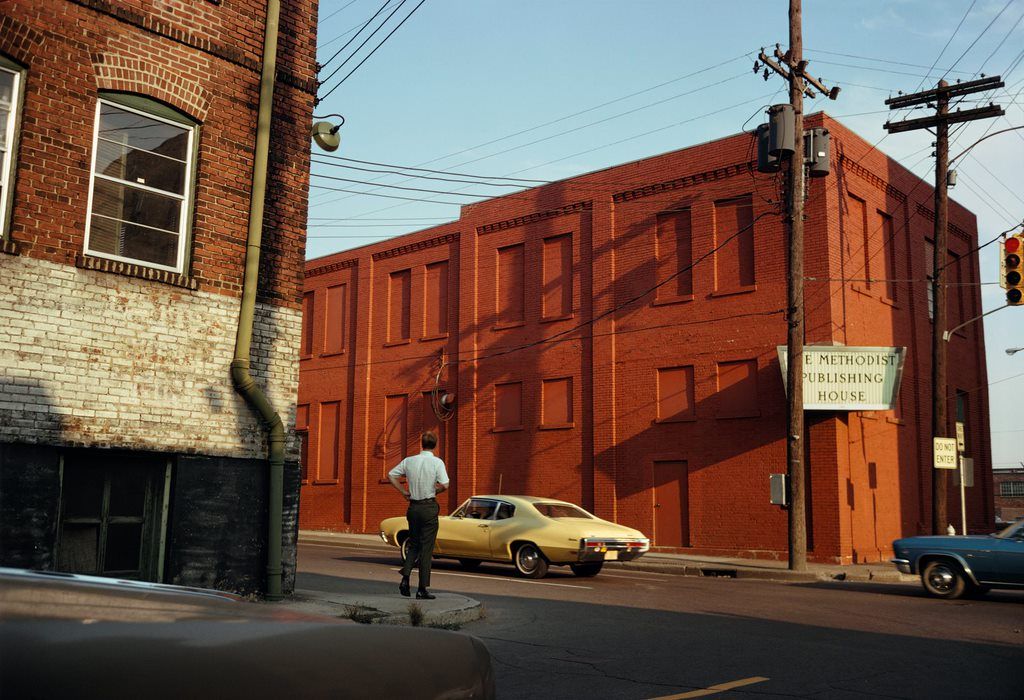
And it is that William Eggleston's work has absolutely nothing banal or ordinary about it. Already from the first black and white images, one perceives that search for the decisive moment that inspired Cartier-Bresson, along with the freedom of themes in terms of the choice of element and the protagonist focus, which flees from grandiloquence, to focus on what is right in front of his nose, even if it is the simplest thing.
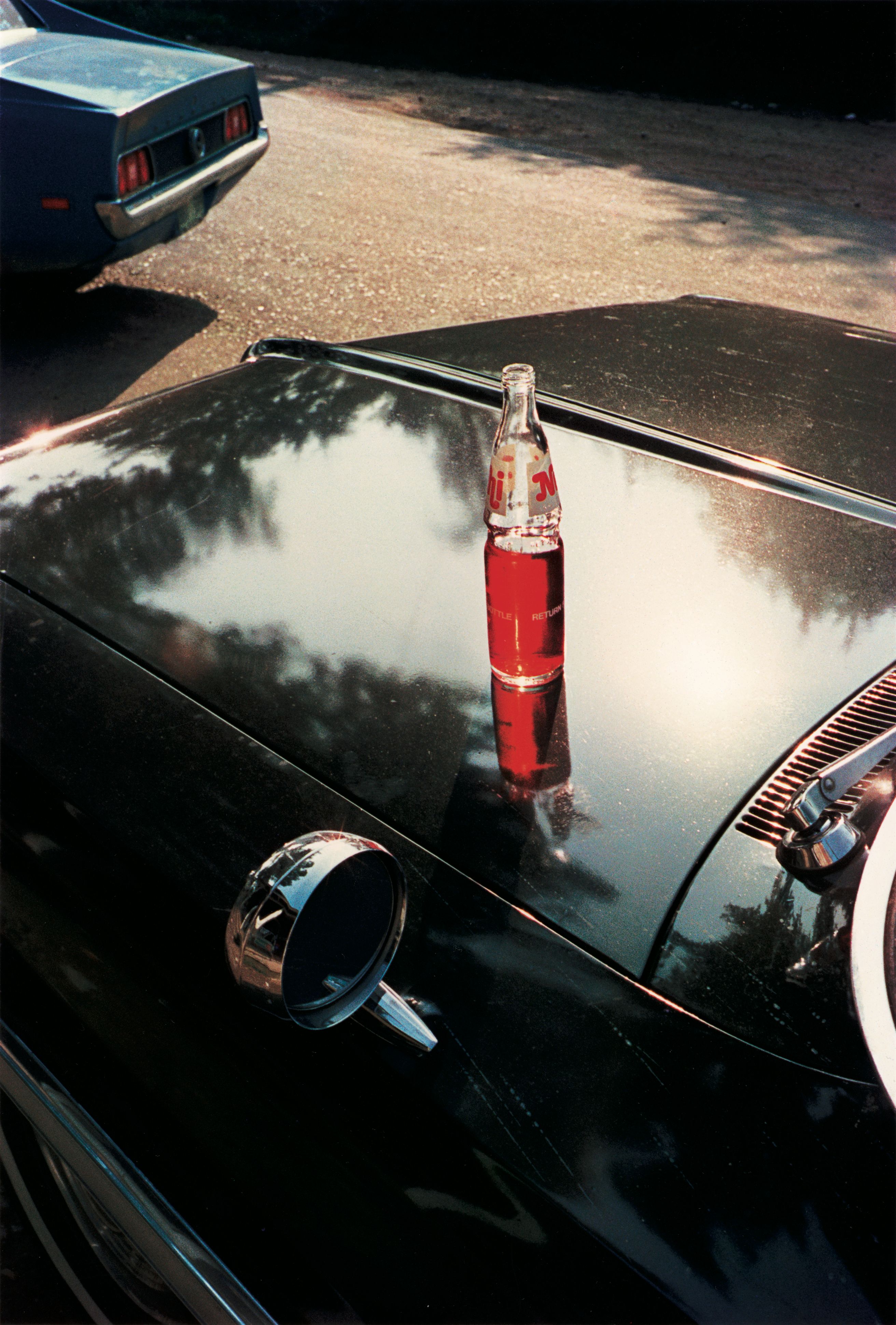
The photographer trains his gaze in each snapshot, from the simple supermarket scene, the soda bottle on the car hood, to the photo taken from inside the car itself. And all of this reaches its peak the moment he decides to switch his film to color, due to the use he makes of it.
"So one night I stayed up planning what I was going to do the next day, which was to go to the big supermarket down the street, called Montesi's ---I don't know why it seemed like a good place to try things---. I had a new exposure system in my head: overexpose the film so all the colors would come out. And, my God, everything worked. Overnight. I remember the first photo was of a boy pushing supermarket carts. When they collect the carts from the parking lot and push them to the store for other people to use. I took the photo of a red-haired, freckled boy in the light of the evening film. A pretty nice photo, actually."
The photographer trains his gaze in each snapshot and all of this reaches its peak the moment he decides to switch his film to colorIn the series Los Alamos (1965-1974) is where, as spectators, we are participants in seeing the capture of that instant, which changes everything, and makes it cease to be ordinary. And it is the photographs in this series that define what will be his own visual language, the way of seeing the whole. Because it is fair to say that we are not just seeing a photograph, but we are seeing everything. A blind field that, as Roland Barthes said, consists of everything that moves on the exterior or beneath the surface of things; it captures our attention, transforms into desire.
Eggleston's desire is reflected through his journey, following the Mississippi shore, heading south. In the horizontal light of the afternoon, which is repeated and sought again and again, like a leitmotif and like the golden veil under which to frame the scene. In the decadent places, which are beginning or have already lost their splendor, a symbol of a changing time that accelerates everything and nothing. On the roads and service stations, halfway to everything. And in the skies, of a deep, resounding blue, present as a background frame, as in the reflections of car hoods or puddles of water. "Photography makes us leave home," he affirmed.
The desire to be able to capture color, the longing for the precise instant, is present throughout his work. "I only take one photo of one thing. Literally. Never two. So that photo is already taken and the next one is waiting somewhere else." But the gaze is no longer the same. Now it is expert, and it is appreciated in the volumes and weight of the elements, in the photos, in their balance, in the large blocks of color, in the precise lines, in the horizons. Nothing is fortuitous, because by looking, one knows how to see.
William Eggleston has witnessed the disappearance of a world devoured by the nascent consumer society of his country, but he has had the enormous capacity to write a photographic testament of that transit, converting the banal and ordinary into transcendental and extraordinary, and allowing us to understand that we are never just looking at a photo, but at an unparalleled legacy. And that the whole is behind us, if we turn around. The exhibition can be visited until the end of January 2024.
Add The New Barcelona Post as your preferred Google source for free
Stay informed with the latest news.
