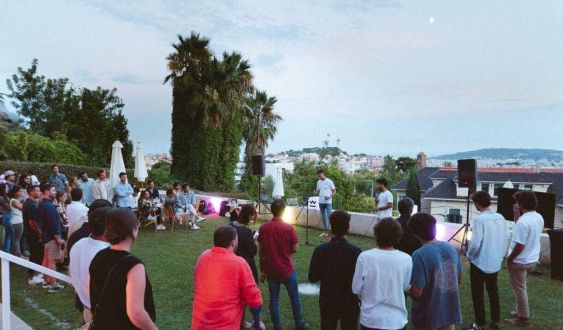
The music industry is struggling to resist the onslaught of the pandemic, but new projects are trying to oxygenate the scene. Why Not Music is one of those initiatives that has taken advantage of the last year to land in the record sector with new ways of working. Marc Perea and Dan Hammond lead the team that has made a new record company a reality in Barcelona. They arrive with the aim of "breaking established rules and taking a step further in the innovation of artistic processes."
Aware of the working models in more traditional record companies, its creators ---who have worked for Warner Music and Grup Flaix--- want to end the roles of these companies that for years have been focused on the physical sale of records. The business model on which Why Not Music is based is similar, according to its founders, to the field of startups, aspiring to become an accelerator of musical and entertainment projects.
"We seek to focus on the artist and their vision to accompany them on the path so that they can actively participate in decision-making," explains Marc Perea. They locate emerging talent to guide and accompany them in the process towards musical success. The record company presents itself as a 360-degree company, where the artist can access different services ranging from creative coaching to distribution and promotion, including musical production, management, booking, and even legal and financial advice. "We guide the artist to give them the necessary tools, but without forgetting that they are at the center of the entire process," he adds.
To achieve this goal, in addition to years of experience in the sector, its creators have a network of partners and scouts with whom to select artists and keep track of current musical trends. In just half a year ---the project materialized last March--- they have signed collaborations with producer Franfusión, based in Miami and who has worked with artists of the stature of Bad Bunny and Daddy Yankee. In these months, the label has already released several tracks. Among the most notable, the single De to with more than two million streams between Youtube and Spotify and which has featured the participation of artists such as LaZowy, one of the most relevant female voices in trap in Spain.
The accelerator locates emerging talent to guide and accompany them on the arid and difficult path to musical successWith an initial investment round of just over 100,000 euros and the intention ofto present in the next quarter a pre-seed round of 350,000 euros, burst into a sector that survives thanks to the lifeline of services instreaming. The cancellation of festivals and concerts, the new audience restrictions resulting from the outbreak of the pandemic, and the closure of physical stores during the first months of lockdown have complicated survival. However, digitalization has allowed them to save face. According to data published by Promusicae, an entity that represents more than 95% of Spanish record companies,the digital market has reached 144 million euros in turnover at the close of the first half of 2021, with a 19.7% increase compared to the same period last year. In addition, 82.3% of those revenues come from thestreamingof audio.
"When starting this project, our environment treated us a bit like crazy people," says Perea, recalling the first months of confinement, precisely when the idea began to gain prominence in their future plans. "For us, the total shutdown derived from the pandemic was an opportunity. It allowed us to stop and reflect, lay the foundations, and know in what direction we wanted the music we work on to go." With a clear direction, the team presented Why Not Music last September at an event held in Montjuic, which featured performances by some of the names that are part of the label.
The pandemic and confinement transformed into an opportunity for Marc Perea and Dan HammondThey open their doors to emerging careers at a time when digitalization has caused leadership to now be in the empire of platforms and not in major record labels. The enormous metamorphosis of the sector has put these platforms, such as YouTube or Spotify, within reach of artists. "We have seen artists like Justin Bieber succeed after becoming known through videos on YouTube, but many go unnoticed," explains Perea. Although thedo it yourselfit is more real than ever, it extends into a reality dominated by platforms that influence, algorithm in hand, what we end up listening to. Precisely, at Why Not Music they want to provide artists with tools to position themselves in the sector.They aspire to continue growing and in the long term create a digital meeting place where emerging talent can upload their songs and at the same time be connected with the industryFuture challenges so that living from songs approaches the simplicity of living in songs.
Add The New Barcelona Post as your preferred Google source for free
Stay informed with the latest news.