[dropcap letter="P"]
For those who suffer with equal abandon from the obsession with football and literature, few recommendations can be more pleasant than delighting in the collection of Argentine Football Stories selected and prologued by Roberto Fontanarrosa, the person who, probably, best knew how to assemble both disciplines.
In it, without making too much noise, almost as a tribute to its protagonist, lies one of the most beautifully written fiction stories with a spherical ball as its common thread. Its author is the Argentine journalist Juan Sasturain and it is titled Campitos. Without intending to commit any spoiler, Campitos tells the story of the groundskeeper of the fields of a mediocre club in the province of Buenos Aires and how this anonymous character hides behind the creation of the local term semillero, which is used to refer to the youth categories of a sports club. Obviously, the word comes from seed, the natural working element of the agricultural engineer José Campodónico, 'Campitos', Sasturain's gray anti-hero expert in lands, plantations, harvests and footballers, who develops a pattern with which he is able to identify by years and positions on the field the ideal place of origin to go look for the perfect defender, midfielder or winger. As if each specialist on the field were a seed of a specific plant, growing in a specific place and in a specific year.
The story, extreme, like almost everything that has to do with football and Argentina, is still a delightful narrative that tries to parameterize the formula of talent by intermingling agriculture and football. But it is not such a chimerical concept if one looks for analogies with current society. Do business schools not capture and model the best specialists in each subject, allowing multinationals to know, with a fairly high degree of approximation, what is the best source to find a certain professional profile? The one who reaches a higher educational level, the one who imposes their business model above the rest, the one who places their company's sales at the highest levels. Milestones like these help us weave the close relationship between intellectual brilliance and success and allow us to logically explain why certain professionals who share a similar trajectory and results end up succeeding in their respective fields. Seeds, fields and positions on the pitch for students, training centers and professional profiles. Natural gift for intelligence. It doesn't seem so far-fetched, does it?
To do what the Argentine does on the pitch, one needs to possess superior intelligence, no matter how much social standards disguise it as a gift from genetics.
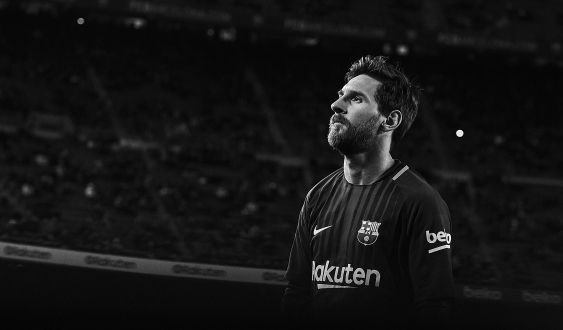
But why in the world of sport, is innate talent usually enough to justify triumph? Why is intelligence, the origin and cause associated with those who make a difference in the business, scientific or political world, a forgotten concept when analyzing sporting success? Short and to the point: Messi is stupid but he won the lottery when he was born with a unique ability to dominate a ball. And therein lies the trap. To do what the Argentine does on the pitch, one needs to possess superior intelligence, no matter how much social standards disguise it as a gift from genetics or it is a parameter that Sasturain himself leaves out of his story.
In fact, and ruining the logic of 'Campitos', Messi could become the best goalkeeper in the world if he set his mind to it. Yes, granted, it's a provocation; but his brain is capable of anticipating the movements of teammates, rivals, and the ball at a speed superior to the rest, and that makes him capable of making a difference in any position, even under the posts. You don't have to be very observant to argue that the '10' from Barcelona has a limited height and feels much more comfortable caressing the ball with his feet than with his hands, touché; but brilliance in football, as in any other sport, is not granted by feet or hands, but by the head.
If one is capable of dodging the blinding light emitted by his museum goals, his extraterrestrial assists, his video game dribbles, one will discover details of a character equally or more outstanding in the accessory than in the essential. Messi is also the one who senses when or when not to press the opponent intensely, deciding to do so only when there are real chances of stealing the ball, which happens in most cases. Messi is also the one who senses the rhythm and needs of each match and decides to position himself at the front when the game flows comfortably and recognizes that he will be lethal in the final meters; in the midfield when the team struggles to control the ball and knows that without him it drowns; or on the wing when defensive congestion is an unbreakable lock even for his magic. Messi is also the one who senses when to jump, when to brake, or when to accelerate against an opponent's charge, with which he has been able to avoid any serious injury or blow caused by a rival tackle. Messi, Messi, Messi. He senses, he senses, he senses.
Intuition is the information that we unconsciously store in the limbic part of our brain and that helps us make millions of daily decisions automatically. As an indicator of intelligence, it is usually quite reliable, and few people, whether dressed in shorts or a suit, jacket or skirt, have used their intuition like the Rosario footballer to propel their natural talent to a level never before visited by anyone. So, no matter how much it ruins poor 'Campitos'' theory, if Messi one day decided to add gloves to his boots, he could become the best goalkeeper on the planet, because on a field he has enough intelligence to be the best in whatever position he pleases.
In fact, Sasturain's character did not need to know the '10' from Barcelona to understand that a player's talent could not be categorized by only quantifiable indicators. Towards the end of the story, when a dark-souled guy discovers and tries to exploit his method, 'Campitos' confesses to him that there are footballers who escape his formula. "With this data, they will not only want to harvest but also custom-make them. Years and years in advance. Imagine, disgusting. And then they won't accept, they won't recognize, they won't be able to tolerate the exceptions. And that's the end of everything: that's the end of football", he concedes.
Thanks to his intelligence and not only his talent, Messi has become the most beautiful exception in the history of football.
Add The New Barcelona Post as your preferred Google source for free
Stay informed with the latest news.