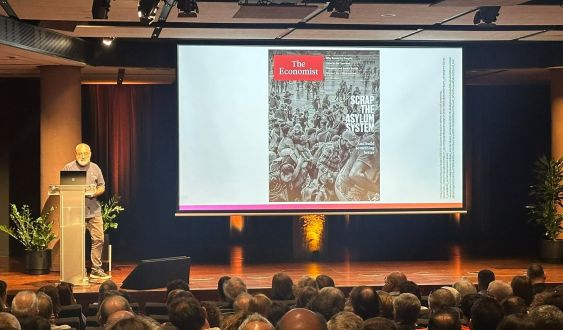
What kind of world do we want in 2048? And who is already working somewhere around the globe to make it a reality? Two disruptive questions and a single central figure: Alfons Cornella. A rebel thrice over, much like the poet Maria-Mercè Marçal. Tying in with the September rentrée, Alfons maintains the admirable custom of delivering an annual lecture in the auditorium of La Pedrera, selling out every single seat right in the heart of Barcelona. It is certainly no mean feat, backed as he is by a portfolio of a hundred innovation projects and over 35 books. Truth be told, listening to him and learning from him is time well spent.
“We must understand the present to build possible futures”
“We must understand the present to build possible futures,” he begins, shortly before reminding us that we are living through an epochal shift. Geopolitics, power, and democracy. “We face an ever-growing need for humility. There has never been as much information as there is today, and making sense of data poses an exceptional challenge,” he affirms. Too much is happening everywhere, yet fortunately the great classics never fade – such as the philosophical revolution sparked by Immanuel Kant, grounded in dignity, liberty, and institutions designed to secure peace.
The lasting appeal of three
The historian Peter Watson notes that human nature tends to seek out a third path between extremes – the Holy Trinity. In Kant’s framework it was thesis, antithesis, and synthesis, much as the economist Adam Smith wrote of land, labour, and capital. All good things come in threes, or rather, virtue resides in the middle ground. “The human brain and nature itself have an affinity for the number three. The trouble lies with extremes. We must manage tensions, strike a balance, and experiment with third ways. We need to reinvent diplomacy so that we can actually talk, because right now we are all caught up in an arms race,” Cornella points out. A timely word to the wise.
Peace can prove economically more compelling than war.
Paraphrasing economist Mariana Mazzucato, peace can prove economically more compelling than war. We have too much information – or perhaps we lack the right information to know what is genuinely true and hold the fact-checkers to account. Things simply take their course if people fail to respond. Hence, the Radicle Civics movement proposes prototyping economic and civic institutions to tackle global crises. Journalist George Monbiot singles out conversation as the bedrock of any institution: “We must restore conversation as a piece of civic infrastructure.”
The power of conversation and context
Indeed, the power of a good conversation can reshape the world we want in 2048, as can a moral awakening and putting talent at the service of what truly matters. The journalist Omar El Akkad reminds us that “silence is a moral choice”, issuing a trenchant plea for individual responsibility.
Alfons also recalls a campaign that travelled the world with the tagline: You didn’t fight your way into Harvard to end up in a bullshit job. In plain Catalan fashion: crystal clear. The path forward points toward initiatives like The School for Moral Ambition, the World Economic Forum’s Change begins here, and the Edgers community, where “rebellion is a positive force that challenges the status quo by looking through the prism of the future.”
We must restore conversation as a piece of civic infrastructure.
As Professor Otto Scharmer observes, we need to create environments where interesting minds cross paths. Meanwhile, 15,000 satellites circle the globe – and take note, for half of them already belong to Starlink. Events will unfold both in orbit and on Earth, and we must rethink the way we live and work. “Anxiety is the byproduct of trying to do everything perfectly,” Cornella notes. And perfection, as they used to tell us at school, simply does not exist...
What is progress?
For now, we continue to measure progress through the prism of economic impact. The fundamental question, however, is whether progress today is defined by technology, or whether we ought to redefine it around people. How can we live well within planetary boundaries? The geographer Samuel Miller argues that we must take a radical reading of what progress truly means. Alfons puts forward an intriguing formula: genuine progress equals human capabilities plus public value plus future freedom, divided by the sum of ecological damage, inequality, and systemic fragility. From there, the goal is to secure the highest possible score.
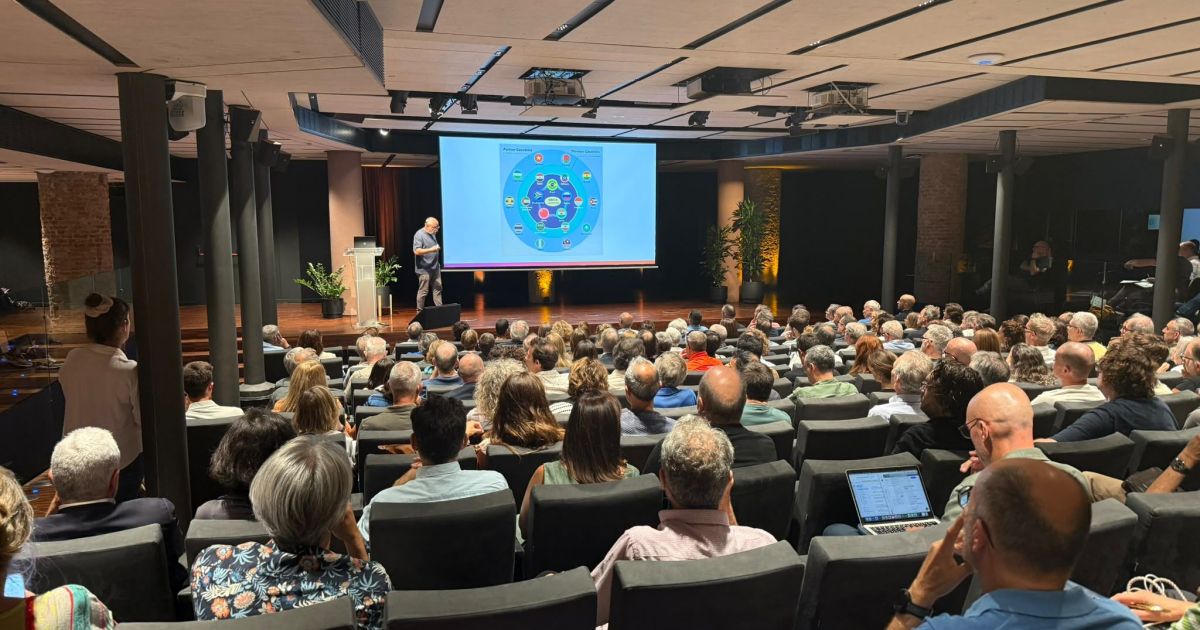
Drawing on an array of examples, Cornella explains that “there are countless people out there inventing the future, and the future is built by doing things properly millions of times over.” This applies equally to climate optimism, to cutting-edge science arriving to prove what once seemed impossible – though still in need of resources – and to “good” AI, which suffers from bad press, consumes vast amounts of power, and calls for even greater education.
Thinking, for the pleasure of it
Alfons insists that “we live in a fascinating world” where we must rediscover contemplation through focused attention, reading, and imagination, while simultaneously reinventing management and making sharper decisions amid complexity. A new three-way social contract awaits us – bringing together people, nature, and technology. Indeed, we are already confronted with the urgent need to learn to think – purely for the joy of it – and to remember, as Alfons concludes, that “the future belongs to ingenuity and innocence.”
A new three-way social contract awaits us – bringing together people, nature, and technology.
The La Pedrera auditorium empties out. What world do we want in 2048? Many of us who listened intently to Alfons find ourselves still pondering the question as we step through the main doors of one of Gaudí’s crowning masterpieces. And, in all likelihood, we will never stop asking it, because knowledge can never be taken for granted and, when all is said and done, we must understand the present to build possible futures.
“I unlearn, therefore I am,” as my colleague Alfons Cornella puts it.
Add The New Barcelona Post as your preferred Google source for free
Stay informed with the latest news.