
There are many people, among whom I count myself, who have never thrown away any book, no matter how bad it was. Therefore, they have never had to face this question: Which container should books be thrown into? In case one day I decide to throw away one, several, or my entire library ---although it is most likely that I will never do it because I don't want to part with them and, if I had to, there are wonderful bookstores like Re-Read where you can buy and sell second-hand books in perfect condition---, it seems elementary that they should be deposited in the blue container. That is, the one for paper and cardboard.
However, if in addition to the content we take into account the container, the matter becomes a little more complicated. There are books that would deserve to go to the gray container, because they have no value and nothing can be salvaged from them. Others are so toxic that we should directly be able to deposit them in special containers, as is done with batteries or radioactive waste. But, of course, it starts by saying that some books are dangerous and we already know how it ends: censored, prohibited or burned books, persecuted writers... Better not to fantasize about it, lest wanting to get rid of the books that poison our soul we end up, without realizing it, like in Fahrenheit 451 or Germany in the thirties.
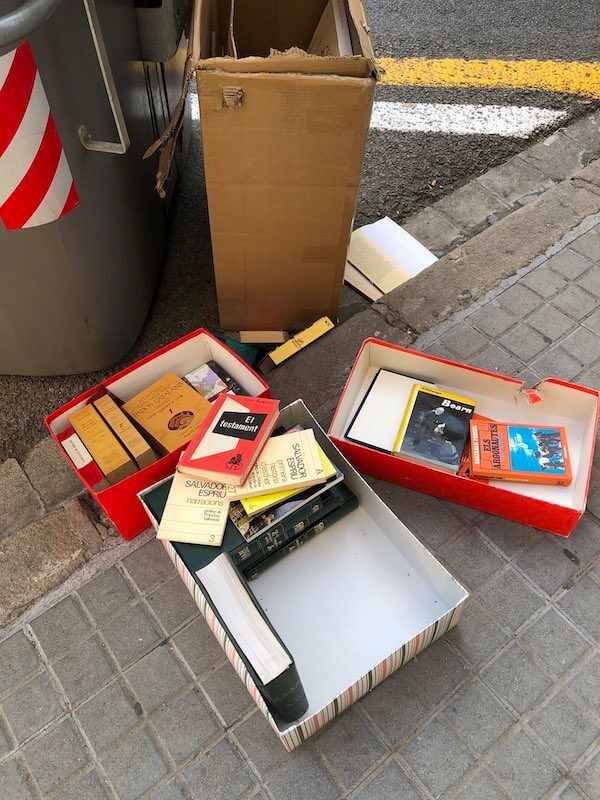
In fact, what I want to talk about this week is the act itself of throwing away books because in Barcelona, currently, it is common to find piles of abandoned books next to the containers. I have even seen entire encyclopedias. If I notice it, it is because whoever threw them away did not do it inside the corresponding container, but left them in plain sight, surely to give them a last chance to be saved from being turned into paper pulp.
A few days ago, I rescued one of these abandoned books.I was going up Roger de Llúria and at the corner with Provença I saw a box full of abandoned books next to a dumpster. There were some works by Espriu in very good condition, but they didn't tempt me. Nor did a Baltasar Porcel because I have read almost everything by him, years ago one of my favorite writers. Instead, a copy of immediately caught my attention.Bearn of Llorenç Villalonga in Catalan that I have pending to read and without thinking twice I took it.It starts by saying that some books are dangerous and we already know how it ends: censored, prohibited or burned books, persecuted writers...
If I notice them, it's because whoever threw them away didn't do it inside the corresponding container, but left them in plain sight for everyone, surely to give them one last chance to save themselves from being turned into paper pulpI shared my find on Twitter ---with the photo accompanying this article included--- and received quite a fewlikes, I imagine from people who celebrated that I had rescued that book from its inexorable end, as well as some comments from literary tweeters.
Enric Gomà asked me what edition it was, because it seems that Villalonga was polishing his Bearn as it was being reissued. It is a second edition, from 1964.
The Mallorcan Sebastià Portell told me that I would have a blast reading this classic and I felt even more like getting to it.
On the other hand, a tweet from a certain Marta Cava whom I don't know scared me: "I can't determine it well, but I see that some books have humidity/fungi and in this latter case, if not treated, it can harm other books." Since I saw that this Marta is a librarian, I thought she knew what she was talking about, therefore, taking the Procicat as an example, I have put my Bearn in quarantine. It will remain in the office until I am convinced that it will not bring a fungus pandemic to my library.
Add The New Barcelona Post as your preferred Google source for free
Stay informed with the latest news.