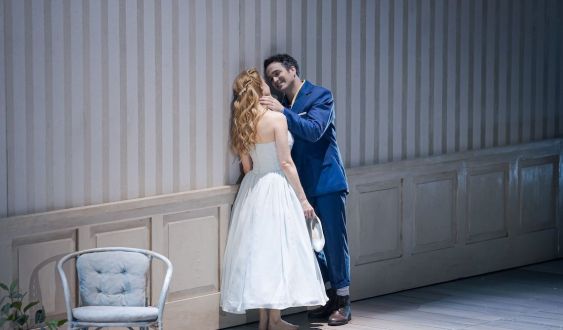
The audience's response at the Gran Teatre del Liceu initially seemed lukewarm when the curtain fell, with only one interruption for applause during the premiere of Massenet's Werther. The growing emphasis and displays of affection towards the singers confirmed that it was merely a kind of recess to catch their breath and compose themselves, after witnessing a death on stage, especially inappropriate for occurring in a festive context (the celebration of Christmas, with the same children's voices that opened the performance, in mid-summer).
The contrast between registers, like the relatively uncomfortable presence of humor ---promoted by secondary characters---, disconcerts and, in this same sense, stretches the cord of the dramatic action, staging an idea of impossible love, whose logic fundamentally violates what is reasonable with a consummation that demands loss.
The revival of Werther at the Gran Teatre del Liceu shows to what extent a work can live in different eras without losing its pulse. Johann Wolfgang von Goethe's epistolary novel, written during the pre-romantic fervor of Sturm und Drang, and Jules Massenet's opera, already fully inserted into the fin-de-siècle worldview, stage the same wound: that of the subject who, however free he wants to be ---proud of that egoic fantasy--- remains fatally subject to his affections. This dual condition ---being one's own master and, at the same time, a hostage to passion--- constitutes the core that articulates both the original text and its musical translation.
Unusually, Christof Loy opts for the design of a single stage space for the four acts, with minimal variationsRejected by the Opéra-Comique of Paris for its melancholic tone, Massenet's Werther met with unequivocal success at its Viennese premiere in 1892, five years after the score was completed. In it, the French composer weaves music of extraordinary delicacy, where subtlety and emotional outburst coexist.
Henrik Nánási's musical direction at the Gran Teatre del Liceu took the form of practically physical communication, marked by the maestro's own breathing. The musicians responded, in perfect synchronicity with the initiatives, hesitations, or outbursts of the singers. The long-awaited intervention of Xabier Anduaga did not disappoint. The Basque tenor made restraint a winning card to overflow in passages of amorous delirium.
Beside him, Kristina Stanek's Charlotte offered a no less convincing reading; capable of sustaining psychological twists without losing internal coherence, demonstrating in the most delicate moments a voice rich in nuances, absolutely aligned with her body language. The rest of the cast also showed a high level, something not always common in operas where interest is so concentrated on the protagonist couple.
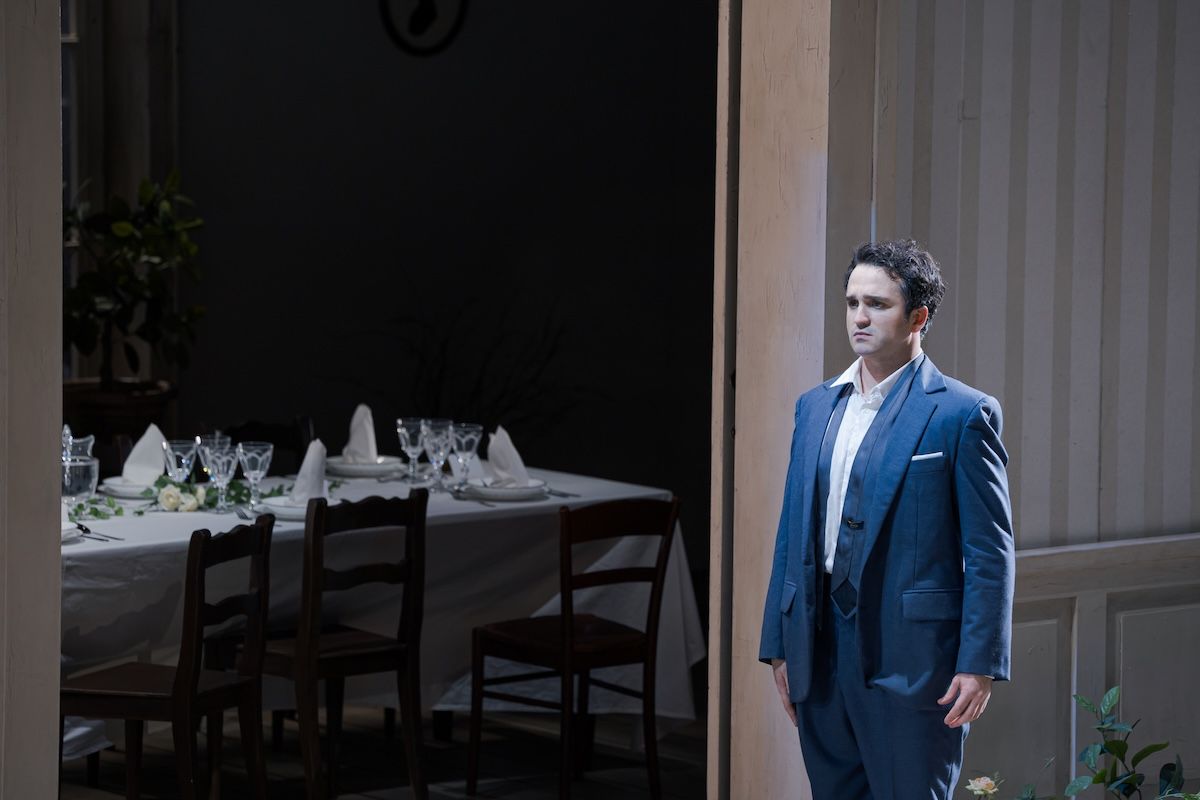
Sofía Esparza's Sophie was a delight, overflowing with light and yet human, showing herself affected by the course of Werther's passion. In addition to suffering his disinterest, she will witness up close the fateful and extensive scene that leads him to death, leaning against the wall. After the performance, in real life the soprano explained to us with a smile the mental exercises she had had to practice to remain so long contrite, and yet "doing nothing."
The fourth character who intervenes decisively, and also accompanies the curse of furtive loves, is Albert, Charlotte's fiancé, whom she had sworn to marry to her deceased mother. David Oller effectively embodied this undeniably ungrateful, but fundamental character: he precipitates the action by seeking affective control of the home, he is the necessary obstacle to the truth of love-passion.
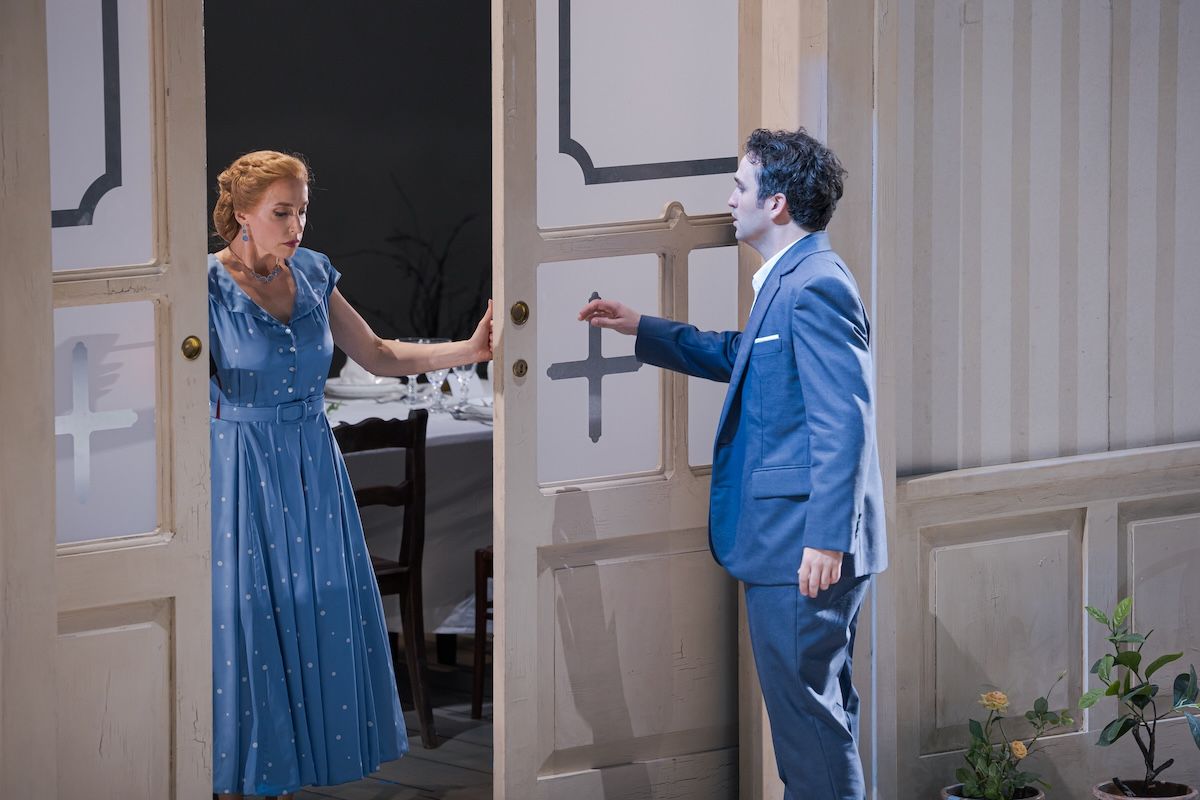
That said, the agony will be exhibited in the Tristanian manner ---almost thirty years after Wagner's opera--- before the spectators, outsideA separate chapter deserves the surprising staging of the Liceu's production, in collaboration with the Teatro alla Scala and the Théâtre des Champs-Élysées. In an unusual way, Christof Loy opts for the design of a single scenic space for the four acts, with minimal variations: the exterior of a house, timeless in its neoclassical resonances and elegant like the characters' costumes.That bordering space is equipped with sliding doors that articulate the scenic device, showing and hiding, dialectically.Architecture offers shelter, but it also makes possibleto inhabitin a sense not only physical.
Eugenio Trías used to repeat, regarding habits, that they not only dress us from the outside, but also shape our gaze or ---in Aristotelian terms--- an ethos. In Lógica del límite, the Barcelona philosopher described architecture and music as "environmental" arts, which act "on the body of the border-dweller in an immediate and sub limine way, or if you want to put it that way, they always intervene in their preconscious."
Werther's exclusion from the habitat is, for all these reasons, deeply symptomatic, inseparable from the affection that moves him. His desire finds no place in the space of comfort, where intimacy becomes legitimate and accessible, often signing the contract for its self-destruction. Would Werther's desire tolerate such viability? As if to spare himself the paradox of conjugal eros, the logic is inverted in the outcome, when the protagonist finally crosses the threshold of the domestic space.
The shots that condemn him take place inside, who knows if to crack conventions in the greenhouse, shake consciences, or preserve his affection intact. Of course, the agony will be exhibited in the Tristanian manner ---almost thirty years after Wagner's opera--- before the spectators, outside. An intermediate fence bordering the fourth wall, it enables the reconciliation of the lovers and the truth of a temporarily impossible love, as a reminiscence of another life in the atmospheric vibration that some of us have experienced.
Add The New Barcelona Post as your preferred Google source for free
Stay informed with the latest news.