
Flying further begins with knowing where you're going, and Vueling has it clear. The roadmap the airline has drawn up for 2035 defines it with key and quantifiable objectives —5 billion in investment, 60 million passengers—, but also with intangible purposes: it represents a commitment to renew its fleet, accelerate sustainability, and strengthen its strategic role in Southern Europe. Always, with a clear focus: Barcelona.
The Catalan capital saw the airline born in 2004, and since then the city has been part of its DNA, but not only that: "Barcelona is very important for Vueling's identity, and fundamental for its strategy," emphasizes Vueling's CEO and president, Carolina Martinoli. Thus, Barcelona will remain key in Vueling's growth trajectory and in its ambition to reach 60 million annual passengers by 2035, gaining 20 million compared to the 40 million it transported in 2025.
How will it do it? With more routes, more flights, and larger planes. The replacement of its Airbus aircraft with Boeing models will represent an advance in this regard: while Vueling's current planes —with a fleet of 130— have around 180 seats, the two Boeing models that the Catalan airline will incorporate will have 197 seats, or 224. And that already adds to this strategy: "With the same flights you can serve more seats."
This gradual replacement of Airbus by Boeing will begin to materialize in October, when Vueling receives the first aircraft from the American firm. It will be the first of the 50 Boeings that Vueling's parent company, the aeronautical giant IAG, awarded to the Catalan company in August. This will be the first of a global objective: to replace Vueling's entire fleet so that it ends up being all Boeing, with more efficient models from the American manufacturer, in a process that will be subject to results and forecasts being met.
The current fleet of 130 aircraft started with only two aircraft in 2004. The two planes, their five destinations, and their initial 120 employees have scaled up to 130 planes, more than 100 destinations, and 5,000 employees, in a company that contributes around 6.7 billion euros to the GDP. The ambition for 2035 is to multiply it, and raise it to 10.5 billion, 57% more than the current figure. At the state level, it wants to reach 17.5 billion, 65% more than in 2025.
Weaving the territory from Barcelona
Is Vueling looking at other cities as a main base? Will it be able to execute this roadmap if El Prat is not expanded? Will it strengthen its presence in Madrid? Faced with numerous questions from the press about Barcelona's role in Vueling's strategy, Martinoli's same answer: "Vueling's strategic geographical focus is Barcelona; domestic Spain, and connections between Spain and Europe."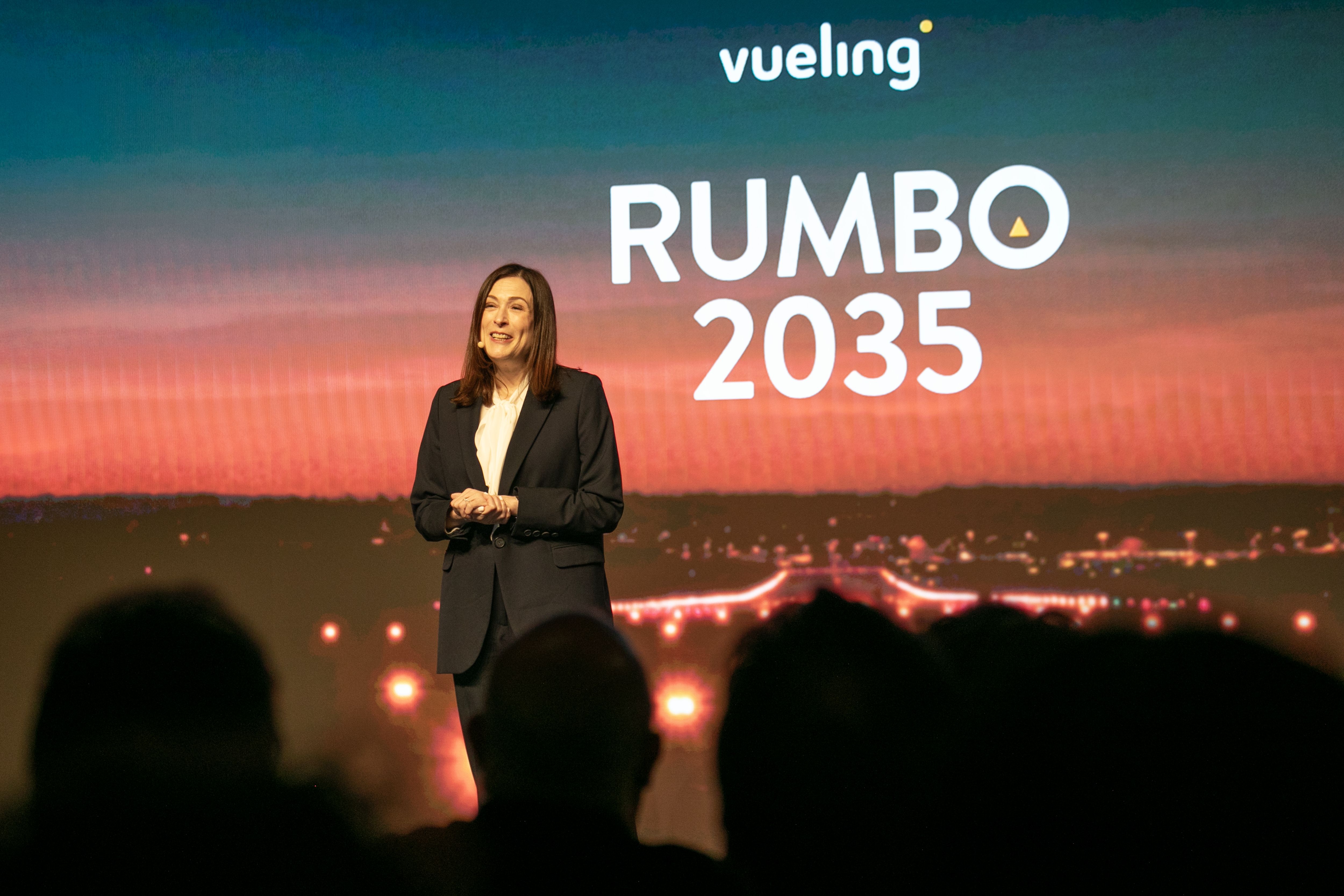
In fact, the airline focuses its efforts on connecting territories at a national level. An illustrative figure: one out of every three passengers flying within Spain does so with Vueling. "The connectivity of the territories is important," defended the company's CEO at an event in the Llotja de Mar, which has a long list of Spanish cities it flies to.
This connection will continue to be spearheaded from Barcelona. So much so that "at least half" of the 5 billion investment will fall on El Prat, both for fleet renewal and for projects linked to sustainability, technology, and customer experience. Furthermore, Martinoli dissociates Barcelona's role from the expansion of El Prat Airport, which has just closed 2025 again with a historic record, with more than 57 million passengers.
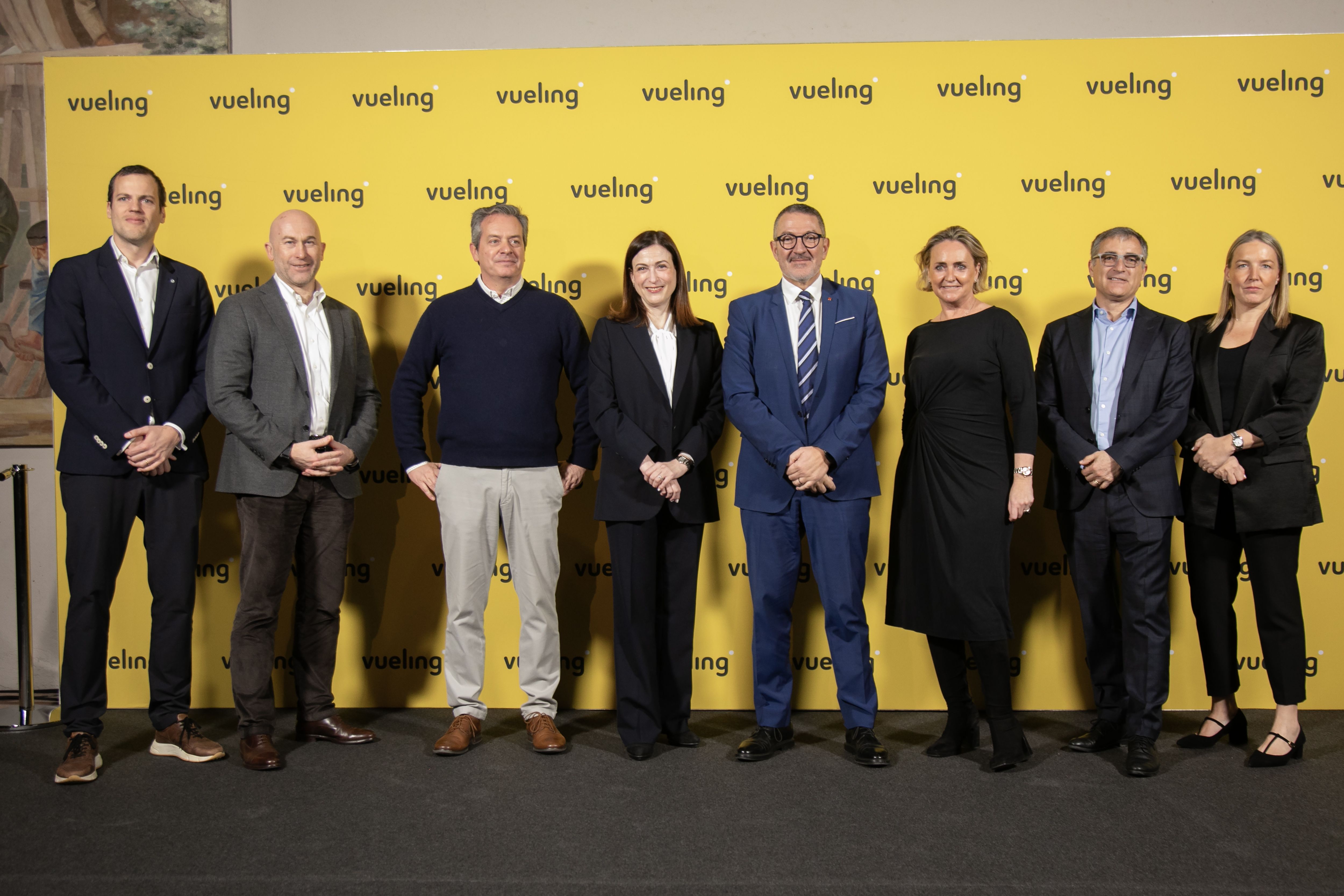
"To draw up our plan, we have taken into consideration the plans and timings foreseen for the airport, and they do not have to compromise our development." Moreover, the fact that El Prat is nearing its limit and only allows growth during off-peak hours does not represent any handicap for Vueling, on the contrary: "Off-peak hours work well for us to build our network."
The expansion of El Prat will not condition Vueling's growth, but it will condition Catalonia's, according to the Minister of Business and Labor, Miquel Sàmper: "It is essential to maintain the growth level of our economy," the minister guaranteed. After praising Vueling's commitment to Barcelona, he expressed confidence that the close link between the company and the city will continue to develop for 20 more years, "and whatever it takes." Because the company, in addition to numbers, provides intangible value, according to Martinoli: "Aviation is a force for good. It generates social and human value, by getting to know other ways of life and other cultures. Flying makes us better."
Add The New Barcelona Post as your preferred Google source for free
Stay informed with the latest news.