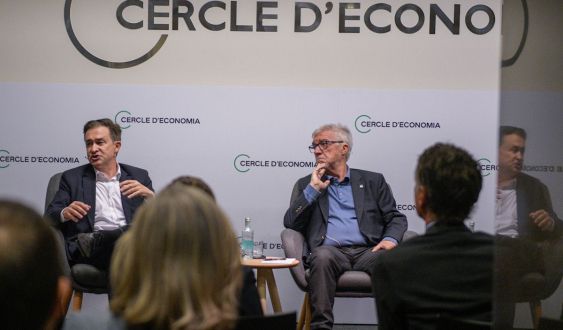
The Cercle d'Economia, Barcelona Global, and Femcat have joined forces for the first time to promote a series of debates with which to recover "a certain national self-esteem" and analyze strategic projects for its economy, in a context of reindustrialization, as explained this Thursday by the president of the Cercle d'Economia, Jaume Guardiola. He said this to welcome the first session of the cycle, led by the general director of the Barcelona Supercomputing Center-Centro Nacional de Supercomputación (BSC-CNS), Mateo Valero, and the general director of Cisco in Spain, Andreu Vilamitjana, both in charge of analyzing Barcelona's position as a European benchmark in the field of chip design.
Valero dedicated himself to explaining the opportunity that the Catalan capital has to position itself in the creation of open-source chips, a key project for Europe's technological autonomy. "In ten years, only free hardware and software will exist. There is the possibility that Europe, Spain, and Catalonia can do it," he assured. In this sense, he highlighted that the BSC has been chosen to coordinate at a European level the design of the fastest chips, those that can be used for supercomputers or autonomous cars.
"This, if it has to be good for someone, it must be for universities," Valero tirelessly repeated, focusing on the need to generate good opportunities so that all the talent trained in local universities like the Universitat Politècnica de Catalunya (UPC) does not have to leave. "The future is in universities," he stressed.
To this end, he also advocated for the need for centers to generate research that is not only excellent but also relevant to society and that connects with the needs of companies. "The BSC is the largest spin-off of the UPC. One of the key objectives of research is to create wealth for the country. If we do not transfer what we do to companies, we have failed," he stated.
For his part, Vilamitjana reviewed how Cisco's decision to locate its first European chip design center in Barcelona was cooked up, focused on innovating with low-power and high-processing capacity proposals, used in platforms like Meta. "These are decisions that arise from recklessness," he assured. The general director of Cisco Spain indicated that it has also been the result of public-private collaboration with the Government, the Generalitat, and the City Council. In fact, he indicated, the first contact was made at the meetings of the Cercle d'Economia, in which the President of the Government, Pedro Sánchez, participated. "For me, it has been a dream come true and a reward for recklessness," he stressed.
In the same vein as Valero, Vilamitjana focused on the need to attract talent to boost industries such as chips, in addition to retaining local talent. "It is not easy to find the necessary profiles. We have been working for a few months and have incorporated some people, but not as many as we want," he said. Of course, without forgetting that "sometimes, what is outside Barcelona is magnified" and that one has to believe in it more.
Next session on renewable hydrogen
The conferences promoted by the three institutions will aim to analyze strategic projects for the future of the Catalan economy "with the intention of promoting their knowledge and the involvement of public and private agents, both economic and industrial." The cycle will consist of three blocks that will last throughout the year and will deal with driving projects such as chip design or the development of renewable hydrogen, which will be the topic of the second session, scheduled for May 18. For now, the three institutions already have ten talks planned, with topics such as electric vehicles, vaccine production, cutting-edge medicine, and the quantum ecosystem.
Add The New Barcelona Post as your preferred Google source for free
Stay informed with the latest news.
