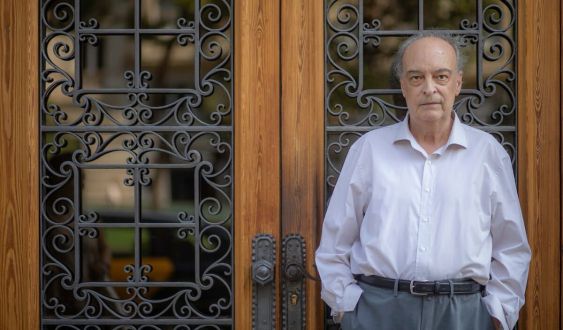
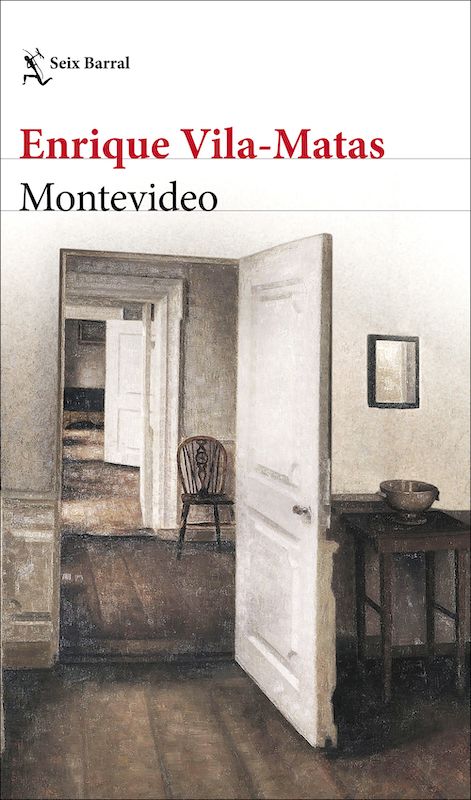
Enrique Vila-Matas (Barcelona, 1948) did not want to hand over his latest book to Seix Barral because he was having such a good time with it. "I have enjoyed it a lot," says the writer about Montevideo, a novel defined as "a true fiction, a great treatise on the ambiguity of the world." It is difficult to unravel the plot, a very vilamatian trait, but what you need to know is that it is about a writer who cannot escape literature and who embarks on a circular journey through doors and adjoining rooms that connect Paris with Cascais, Montevideo, Reykjavik, St. Gallen, and Bogotá.
The seed of this story is found in Julio Cortázar's short story The Condemned Door. In it, the protagonist, "particularly gray" according to Vila-Matas, arrives at the Cervantes hotel in Montevideo recommended by a friend. In the room next door, the manager tells him, lives a single woman who works and returns late at night. The problem comes when, night falls, the protagonist hears in the adjoining room the crying of a baby and a woman comforting him.
To Cortázar's story, another must be added to understand the latest novel by the Barcelona writer, in this case, written by Adolfo Bioy Casares. In A Journey or The Immortal Magician, a similar plot unfolds, as well as strangely coincidental. The protagonist also wanted to stay at the Cervantes hotel in Montevideo, but the taxi driver makes a mistake and takes him to another. In his case, in the room next door, he did not hear the crying of a baby, but a couple making love.
Both writers wrote a similar story, with the Cervantes hotel as the central core, and, when the coincidence was told to Vila-Matas, it stuck with him. And he began to investigate. One day he looked for whether that literary hotel existed and discovered that it was in a state of total decadence, even used for partner swapping. When his publisher invited him to do a tour of Chile, he asked to include Uruguay so he could pass through Montevideo. Obviously, he went to see the Cervantes hotel. He asked for the room Cortázar talks about, room 205, and the establishment did not know that the Argentine writer had passed through there, but they did know his compatriot, the singer Carlos Gardel.
It was at that moment that Vila-Matas decided to begin an investigation, transformed today into Montevideo. "I intended the usual, to know if reality and fiction are the same or almost the same," the author maintains. He was not given Cortázar's room, but his character was. "I entered the fantastic register without realizing it and then fear began to enter me. I was having a great time," he recounts. All with ambiguity hovering on every page, so much so that he suffered for the ending, between narrators and characters who are not what they seem.
With constant doubts and mirror games, trying to find his "true room," like Virginia Woolf, Vila-Matas has managed to "be free to the maximum," without making concessions to anyone. If someone might find the journey through doors and cities of the protagonist of Montevideo, turned writer, but formerly a delinquent, to be too little, the Barcelona author warns that he continues to write it, even though it was published this Wednesday. "Now whenever I read something I like, I write it in a Word document because it is related to the book," he cryptically advances.
With Montevideo, Vila-Matas "intended the usual, to know if reality and fiction are the same or almost the same""Three years have passed since his previous novel, a pandemic and transformative personal circumstances, vitally and literarily," says his editor, Elena Ramírez. The first draft of the book took him a year, before he entered the hospital and underwent a kidney transplant, donated by his wife, Paula de Palma, to whom he dedicates the novel with a "my enamored soul trembles."Without going into detail, he thanked the Hospital Clínic for its work, wanting to recall that the success rate of living donor transplants is much higher than that of deceased donors.
As he recovered, "after an extreme experience," he returned to the text and revised it in depth, writing "with all the intensity in the world." A process that has been accompanied by the euphoria he felt after the operation, starting "a new world," in which, however, he continues to declaim against those who seek autofiction or always good characters, against those who put a "I'd rather not" on office walls. And he warns: "If you take literature seriously, you are lost." For those who don't believe it, think of room 205 of the Hotel Cervantes in Montevideo, now transformed into a tourist attraction for which Vila-Matas feels responsible.
Add The New Barcelona Post as your preferred Google source for free
Stay informed with the latest news.
