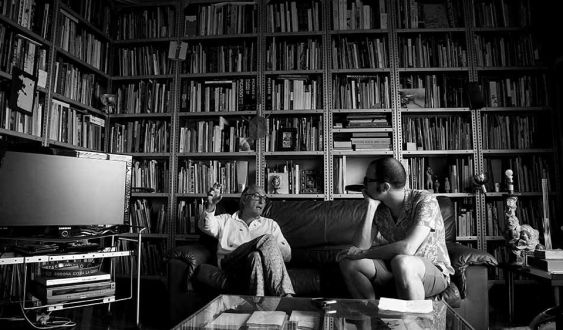
The poet Vicenç Altaió talks with Albert Forns and Morrosko Vila-San-Juan for The New Barcelona Post about his relationship with JV Foix, Joan Brossa, Josep Palau i Fabre, Perejaume, Antoni Tàpies and Albert Serra:
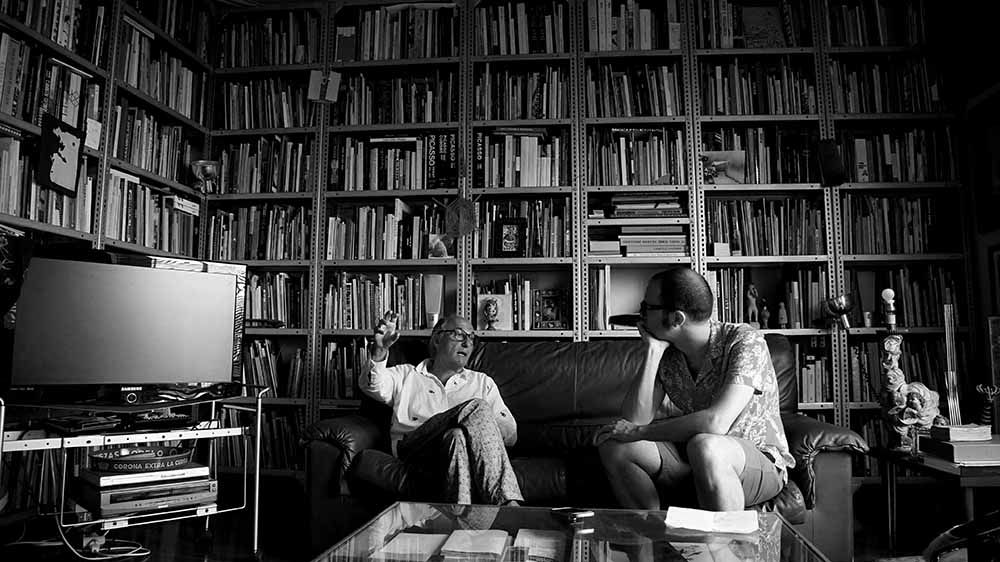
You have a spectacular library. Have you read everything? Everything.
How do books appear in your life? Did your parents have a large library at home? No, there are few books at home, but a lot of love for books. My parents read little –we are six siblings–, but there are always books, they give them to you for birthdays, etc. Two moments I remember well: the day that, at 16, I was given a book by Amado Nervo, a poet who, except for Pere Gimferrer, no one else in Catalonia must know now. But it was what I read, and a poet is what I wanted to be. I also have many memories of La força d'estimar –The Strength to Love– by Martin Luther King, edited by La Mirada, and the books by Pierre Teilhard de Chardin.
And then there was the book and gift shop owned by a monk who had left the order, in Mollet, the next town over. I remember my father, who was his friend, sent me, "go see him, he does what you like." And I would walk, 7 kilometers, and help him. And this guy gave me many authors to read, like Espriu, but what impressed me most about him was that, upon returning from a trip he made to Mesopotamia, he showed me a copy of Salvador Espriu's poetic work that he had submerged in the Euphrates River. And for me it was an artistic discovery, because I saw that the book can also be an object carrying meaning, in this case an Espriu bathed in the foundational waters of civilization.
"Come in, come in, there are none of mine left" JV Foix told me; (...) I read Foix without understanding anything at all, because I still didn't have a sense of the language or the wordAnd with Catalan literature, what contact do you have? You are small and at school they teach you everything in Castilian: they talk to you about Federico García Lorca, already at that time, and also about Rubén Darío and Gustavo Adolfo Bécquer, but they never quote any Catalan author. On the other hand, at home you see books by your grandfather or parents, published in Catalan because Ediciones 62 already exists then. There has already been a whole modernity, there has been a gauche divine that has moved and acted, and therefore I live both cultures habitually; one is the official, the other the natural. Francoism had been very effective, because there was a part of Catalan culture that we totally ignored, and it wasn't until university that I started asking myself questions.
It is at university when you come into contact with Foix, Brossa, and the great poets. At the Autonomous University, I discover and become aware of this whole unknown world of Catalan literature, and Joaquim Molas guides us with readings, and makes us read Nabi by Josep Carner, and the Elegies de Bierville by Carles Riba. And at one point, he makes us choose a poet for a project, among whom were Sagarra, Espriu, Carner, Pere Quart, and JV Foix. Foix's name was the most unfamiliar to me, and it was through obscurity that I ended up with a poet who has been of great clarity to me and who defines me. I arrived at his house, knocked on the door – I was 17 and he was about to turn 80 – and when he opened it, I apologized, and the first thing Foix said to me was "come in, come in" – he addressed us all formally – "come in, because none of my kind are left." That is to say, it was the meeting of someone who had lost their entire framework of cultural life with someone very young who also knew nothing of that cultural life. "Come in, come in, now it's your turn," he told me: Foix was very clearly aware that he was passing the torch to us.
Did you like his poetry? I read Foix without understanding anything at all, because I still didn't have a sense of the language or the word, and I learned that it is thanks to difficulty that one learns a language, by immersing oneself in dictionaries, contrary to what is said in the field of vehicular communication.
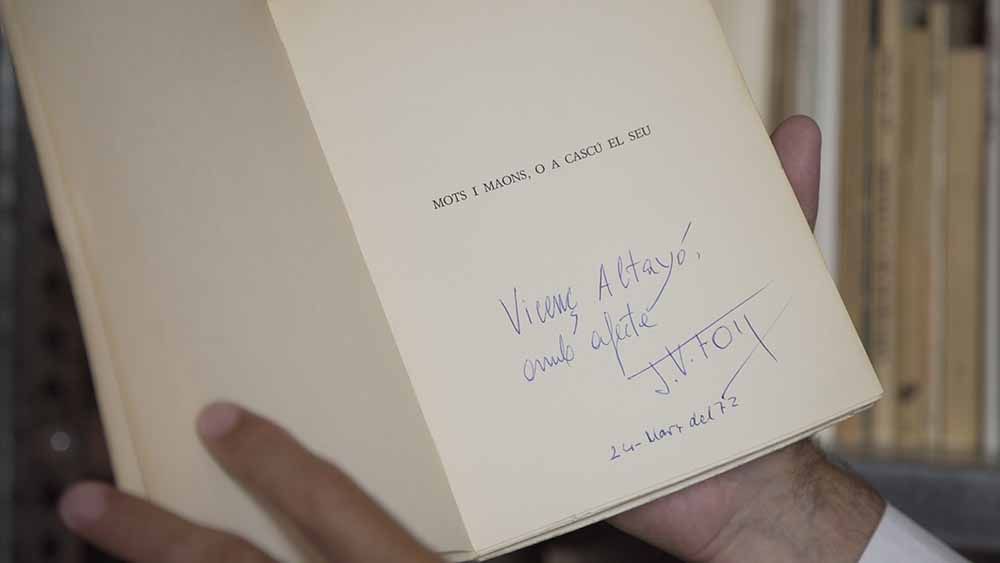
What marked you about JV Foix? From Foix I learned extraordinary things, surely the most powerful is that we were rebellious young people, with long hair, but he repeatedly gave me the same advice: "Altaió, Altaió: do not think that because you have long, greasy hair and dirty nails you will be more of an artist than others." Patapám. With a single phrase, he educates you in hygienic rationalism, in aesthetics, in the sense of work. And this is told to you by a dreamer who came from surrealism... And then he would take you to his library and pick up a classic from Bernat Metge, open it and make you read the same thing he had just told you, for example, "do not think that because you wear...". Then he would say "Do you see? Plotinus." And he would show you that, when it comes down to it, human substance is always the same and it is the forms that change. We learned a lot from Foix.
"The world cannot go well if the Filmoteca closes during the summer," says the last dedication Brossa made to me; (...) Brossa was close to young artists and gave them free rein, and there I learned to do the sameIn the Catalan PEN you come into contact with Palau i Fabre. A dark man, you often say. The conflict of Palau i Fabre is that of the teenager, which is what we were then. That's why he was the closest poet and knew how to present the sense of rebellion and youthful recklessness. The first prologue that Jaume Creus and I wrote together is for a book by Palau. He was scorned at the university. First, by generation, Palau i Fabre flees and goes into exile very young, and it is abroad where he connects with broad-minded people, Octavio Paz, Pablo Picasso... When Jaume Creus and I went to see him for the first time after he returned from Llançà and exile in Paris, we found that he lived in the dark, illuminated only by a low light bulb. And when you asked him about his relationship with Antonin Artaud, you saw him open his eyes like crazy to see that there was someone who wanted to listen to him. It was curious because, when he went out, he always wore very flowery shirts, a stylistic trait that I may have inherited from him, but despite this sense of light, he had a very closed inner world. With Palau i Fabre we lived extraordinary moments. Years later, I remember seeing him one day in the Joan Prats gallery, with his wheelchair stopped in front of a Perejaume painting where there was a horizon that was like a loaf of bread. He was looking at it intently, people passed by him and he paid them no attention. With a friend, we went out for a beer and to catch up, and after a very long conversation, when we returned Palau was still sitting there, looking at the same painting.
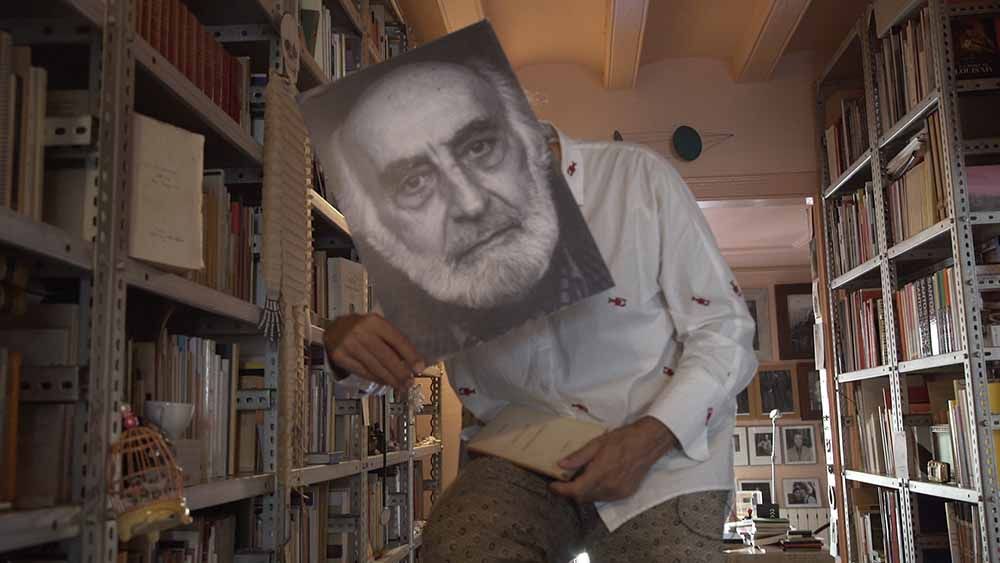
Did that darkness of Palau i Fabre come from a lack of social recognition? It's that he wasn't recognized. He had produced a very large body of work as a poet, but he himself closed it early, and then began the theatrical cycle, but here, theater in Catalan was not done. He had some stories, but he hadn't started yet. It is through contact with young people that we managed to put him back on stage, and then, naturally, the market came and the Proa publishing house absorbed him and put him in the place he deserved, so that today no one disputes the literary value of the work of that generation. But these are authors who 40 years ago barely existed for anyone.
Before burning the coffin, we opened it and threw a deck of cards inside.You also visit Joan Brossa often, since your student days, right? In that chaotic workshop, full of papers on the floor: "Don't mess anything up for me!", Pilar Aymerich says he told her the day she went to photograph him. I visited him many times, because one day I would ask him for an object poem for the magazine Eczema, another day there would be an Italian magazine that wanted to do something with him... All those papers had something of a set design, because one day I went and there wasn't a single one left because it had flooded and they had been damaged. The next time there were papers everywhere again. Brossa used to leave notes, and I have a few saved [he goes to look for them]. Look, this must be from 1975: "Friend Altaió, I had to leave, I waited for you until now, here is the poem, as we agreed, I'll wait for you on Friday around 6 pm."
They are notes he left me and that I kept. This other one Pepa Llopis gave me when he died. "The ticket affair is resolved. Vicenç Altaió will use them. He will also take care of the gasoline." It was from a trip to Valencia. These are details of everyday life. I had few books by Brossa dedicated, and shortly before he died, with a strange intuition, I went to see him there on Balmes street, where I perfectly remember him complaining: "The world cannot go well if the Filmoteca closes during the summer."
Perejaume is someone who lives the magical and the real at the same timeIt's a marvel that you keep all these papers and little papers. Foix advised me: "You, when you are older, what do you want to be?" "Me, like you, a poet," I told him. "Well, keep a second job." And so I did. I was very clear that my second job would not be pastry-making, nor would it be returning to the family business from which I had voluntarily left: my second job would be culture. And I saw that there was potential in all of that. I was born disorganized, but after meeting Foix, at 17 I became methodical. It's that thing about "don't think that because you have long, greasy hair and dirty nails you will be more of an artist than others." In this apartment I have the documentation of all the books I have prepared, in that display case all the books I have published, and this whole shelf are books where I have participated, with prologues, epilogues or texts in collective books. And here are all the KRTU books, on this shelf all those published in Santa Mónica, and then all the object magazines...
Brossa died that December, months after the dedication, and I took care of his burial. I have had to organize many funerals in our culture, for good friends who pass away. I remember I was here at home and Jaume Josa, who often drove Brossa, called me and said "boy, I have to give you bad news, Brossa fell down the stairs and died. Pepa and the family ask us if we can take care of the burial." "The first thing we have to do," I told Jaume, "is to say that by will of the family and Brossa himself, there will be no protocol and everything will be 'fila cero' (zero queue)." This way we avoided pressure from museum directors, politicians, culture ministers, etc. Everyone entered to accompany the deceased on the same level, which is a very republican measure, exactly what Brossa was. The burial included music by Mestres Quadreny and Carles Santos, and even – and very few people know this – before burning the coffin we opened it and threw a deck of cards inside. We told the family so that no one would consider it a desecration, but we thought Brossa should leave the world with an untricked deck of cards.
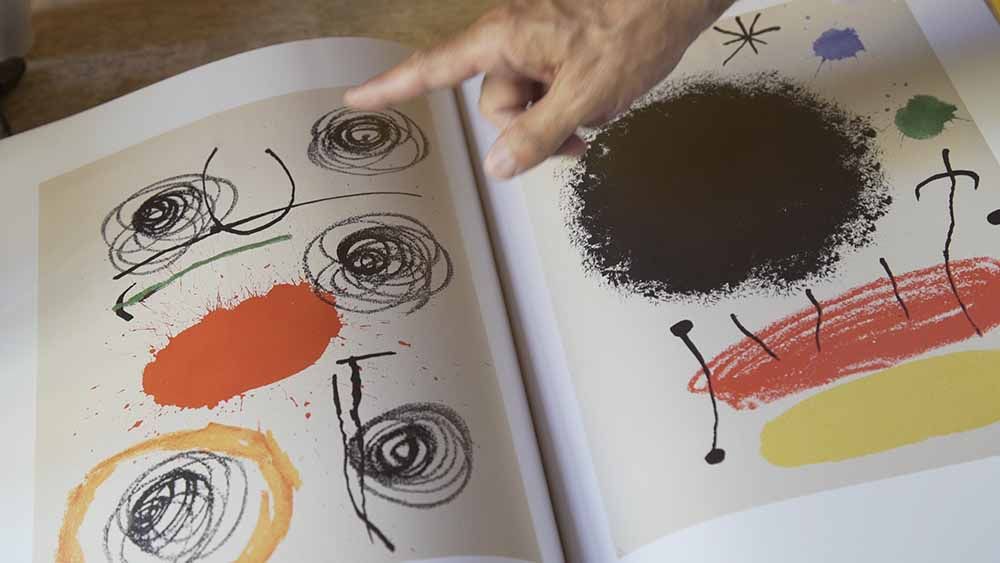
Before KRTU and Santa Mònica, you were curator of Espai 10 at the Fundació Joan Miró. Did you know Miró? I didn't know him deeply, because Miró didn't speak. Miró looked at you, he had luminous and childlike eyes, he smiled, the times I saw him it was always like that. We didn't have conversations. Not even with Brossa, we were very good friends but we didn't chat much either. When we left an inauguration, he already made sure conversations ended to start the theater of life, and he did action poems live, which we later saw converted into object poems within the artistic circuit: he would take a cork and stick a fishbone in it, etc. There are people, like Brossa, who transform their life into a work of art, but with whom you don't have an intellectual relationship. But he was close to young artists and gave them free rein, and there I learned to do the same. Throughout my life I have given confidence and free rein to many people. Brossa helped us a lot with the magazine Èczema, and managed to get us the City of Barcelona Award, despite being so young.
You know Perejaume through him. One of the first things Joan Brossa tells me when I start meeting him is "I've met someone just like you, go see him," and he was referring to Perejaume. I went to see a very young Perejaume, who at that time I don't know if he still lived in Sant Pol de Mar, where his parents were from.
Perejaume is someone who lives the magical and the real at the same time. Perejaume and I have in common, as a generation, this participation in places without borders. I have always believed that Perejaume was the first postmodern after the straight line of modernity, those who had a writing that was always written in the same way, and where each one was because they had a different and identifiable style, be it Miró, Tàpies or Chillida. Not him, he is recognizable, but not by the style of his calligraphy.
With Perejaume we made a very beautiful issue of the magazine Èczema, where there was a balloon with one of his first poems, in the Brossian style. The poem was printed on a hot air balloon, and the balloon had the particularity that when air was blown into it, it took the shape of the world. You lit the wick, a cotton ball with alcohol, and through the combustion you found that, as the balloon inflated and you could read the sonnet, halfway through the reading the poem slipped from your hands and took off into the sky where, depending on the cold and the winds, it would end up with an anonymous reader. It was a very early metaphor, but very authentic.
Tàpies had a very great influence because any opinion of his could be decisive for another artistWe are talking about Antoni Tàpies. After Miró and Dalí, he is the most important Catalan painter, and despite everything, in the artistic world here I have always seen a certain resentment towards his figure. Look, I've also heard these topics, but I entertain myself very little with gossip, I don't believe in this type of magazine Hello! transferred to the cultural plane. I have had a cultural, professional, and friendly relationship with all these people. And one is like this, one is like that, but I have always found a good way to be. There are artists who only work for themselves, but the moment we have had to make an exchange, it has always been positive.
When we were preparing the exhibition about Palau i Fabre with Julià Guillamon, for example, we had a crisis one day when Julià discovered some letters that Palau didn't like, and the man stopped the whole operation just before inaugurating the exhibition. So I went to see Palau, and that very closed person opened up to me and asked for my forgiveness and apologies. And I didn't convince him by scolding him, but by telling him "listen, Palau, this money is not ours. It's the country, it's Catalonia that has put that money to make an exhibition for you!" And bang, he heard this and automatically asked for my forgiveness.
I went to see Tàpies many times and there was complicity and friendship, he even made me some drawings for some covers. Perhaps he didn't come to understand the non-elevated treatment I gave to some of the things he had passed on to me, but I have memories of great intellectual power, and towards the end of his life, memories of extreme tenderness. One of the last times I brought a good friend, Alfredo Jaar, interested in the relationship between art and politics, I remember that Tàpies was chatting there the whole time with his hand placed on mine, and I couldn't believe it, it was a moment of great tenderness because that was not typical of him.
But it happens that, sometimes, people who have power are very influential, and their opinion can cause many adversities. I can be talking with young poets, for example, and naturally express an opinion about the last book I just read, and this in their ears can be magnified. Tàpies had a very great influence in the artistic sector, and any opinion of his could be decisive for another artist.
Albert Serra has given cinematic function to radical lifeHave you ever been to Campins? Of course, I had the privilege of going to Campins several times to see the work he had done during the summer. The first year, that huge amount of work was striking; none of my friends produced so much, but the following year you understood that there was a systematization of formats, of technique, like a kind of tracing. And in winter you would see him at home, talking about the world, reading science books, religion books, and editing books, usually poetry.
And finally there's Albert Serra. Do you know each other from Cadaqués? No, we met before. An artist girl who does great work around Marcel Proust told me about a Catalan guy "like you" who was starting to succeed in Paris and leaving everyone stunned, and with whom we shared an imaginary, and she reminded me of Brossa, "I know someone just like you, go see him." And I called him and he told me "I know you very well, I've read your books," and we met at the Empordà museum in Figueres for me to sign his books, a while before going to an event about Pere Portabella at the Toy Museum. I meet Albert Serra who arrives with two sacks full of books. At first I thought that among everything I had written, maybe they would fill the sacks, but my surprise was to see that one full sack was all the same book, Biathànatos o L'elogi del suïcidi and the other sack was full of Tràfic d'idees. He carried 20 books of each, because at that time he had the habit of sharing books with others, and he gave them to friends. It was a very big moment, I took them and, as if nothing, I went on signing them one by one. In Cadaqués we met one day, about 10 years ago, I was writing in the back of my house, Albert Serra passes by and invites me to a party, because he and his community had rented an apartment in the village. And that night we were chatting from half past seven in the evening until 4 in the morning, when they called me to tell me that Lanfranco Bombelli had died. We spent the night chatting in front of each other, without moving from the same tile, so to speak. And since there were many people from Cadaqués there, the next day the whole town knew about the meeting between two fools who had spent eight hours chatting.
What unites you with Serra? We have a genuine intellectual passion. Serra has given cinematographic function to radical life, and obviously many people will not be able to understand his way of working, or will even suffer it, but I, who have lived other similar radicalisms with Pasolini or with Palau i Fabre, am willing to let him do it and know how to find ourselves in places that are totally improper and original.
Serra told me not to read anything by Casanova, and I obviously read everythingAnd in this "letting it happen," you let it transform you into Casanova. Yes, in the film Història de la meva mort–Historia de mi muerte. Serra calls me one day, we go to eat, and he tells me he's thought I could play Casanova. "But what should I do?" I asked him. And he told me "what you must keep in mind is, above all, that in Romania, where we will go to shoot, there are many wild bears, and since it's possible that in the middle of filming we might encounter one, you must remember to take off your clothes and go down the mountain not straight, but in a zigzag." "Ah, I understand now," I told him, "like Miró, who drew those lines in all directions." So, we understood each other very easily.
He told me not to read anything by Casanova, and I obviously read it all because everything is as I am, crushed, that culture be life and not be noticed, and that there be a hybrid between what is original that we will contribute. And finally we let Serra do his philological work, because we record reality in continuous time, and then editing is the crux of the matter: knowing how to discern and construct moments. His method at that time was to record everything during life, and then do tireless work of watching everything and assembling it according to criteria that perhaps are not of logic or syntax, but can be combinations of colors, pauses, etc. The film is very particular, very original and very hard, but when it was screened in Locarno, at the great European festival of experimental cinema, it was immediately super appreciated, and people had the capacity to watch it and highlight it. At this moment, Serra has become, after Dalí, Miró and, naturally, Tàpies, the greatest Catalan artist with the most international recognition.
Add The New Barcelona Post as your preferred Google source for free
Stay informed with the latest news.