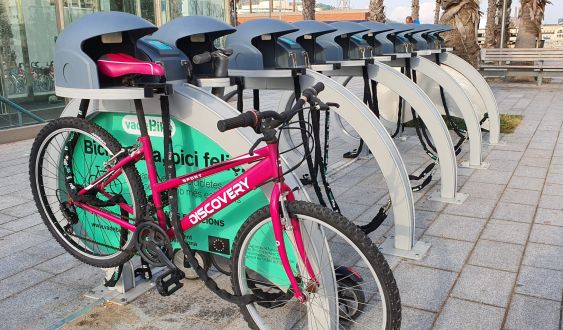
Marta Recasens had her bicycle stolen one day when she went to teach at the UPC architecture school. That personal experience led her to design and patent a secure bicycle parking system, an initiative that, over time, transformed into a business idea and ended up turning her into an entrepreneur. She founded VadeCity, a startup focused on developing intelligent solutions to meet the needs of citizens and improve urban mobility.
[subscribe_newsletter_esp]
The first product VadeCity launched on the market was VadeBike, a modular system of secure bicycle parking that has now evolved to also incorporate anchors for parking scooters. This second-generation module, however, will incorporate another major novelty starting in March: it offers a recharging system for the batteries of parked scooters and electric bicycles. "We are taking another step and offering added value, as the same infrastructure serves as both parking and a charging station," says Recasens.
According to the founder and CEO of the startup, with this evolution, "VadeBike stands as an electric charging station system for the micromobility sector." The recharging process, she explains, is done wirelessly, and the challenge is for the consumed electrical energy to be of renewable origin. Thus, VadeBike modules will be connected to the electrical grid, but will also be equipped with a totem that, in addition to signaling the station, will produce energy with photovoltaic modules.

The idea is for this totem to be covered with solar panels and to also serve as a support for the deployment of the 5G telephony network or for installing video cameras and sensors ---to measure, for example, traffic or pollution levels--- that allow capturing and generating data for the city. "VadeBike is a smart city project; we want to help city councils organize micromobility and solve real problems they have on the table, such as where to park bicycles and scooters," argues Recasens.
According to the entrepreneur, her system is not only useful for citizens and city councils, but its business model also incorporates B2B, since the objective is to make VadeBike available to shared micromobility companies, that is, to bicycle and scooter rental operators. Currently, these companies must equip themselves with a logistical system —usually nocturnal— to proceed with changing the batteries of their devices. VadeBike now offers them an alternative model: obliging users to park in its modules, which allows, on the one hand, to prevent bicycles or scooters from being left anywhere and, on the other, to charge the battery.
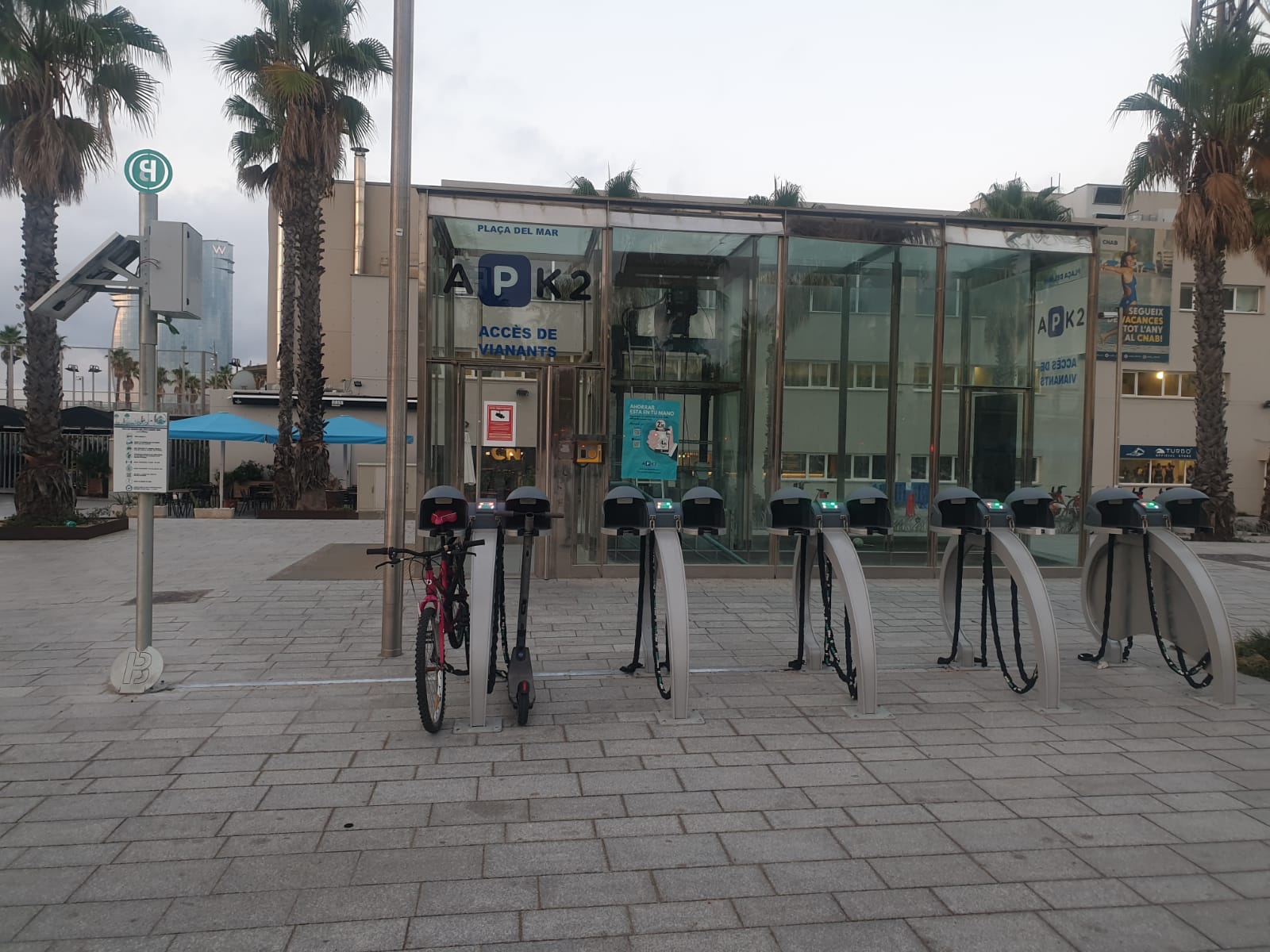
To prevent sharing firms from monopolizing all stations, the VadeBike system allows for dynamic management and distribution of uses, that is, to establish a percentage of spaces reserved exclusively for users of private bikes and scooters and another percentage for rental or leasing vehicles. "Our goal is to promote sustainable mobility and intermodality; we see bicycles and scooters as a complementary means of transport to public transport, which is why we have already signed agreements, for example, with Ferrocarrils de la Generalitat (FGC)," says Recasens. It is estimated that 70,000 bicycle trips are made daily in Barcelona; of these movements, one in four correspond to the public Bicing system and the rest are made with private bikes.
The businesswoman is aware that the future of VadeBike largely depends on the decisions that city councils end up adopting, which will have to call public tenders to award this type of service. "City councils are already working on it; in each municipality the formula used will be different, but I believe that what makes the most sense is for the city councils to buy the hardware, that is, for the city to own the infrastructure, and then for the operation to be awarded to management companies," she considers. With the Barcelona City Council, the company has a pilot program of 150 anti-theft spaces underway, as in 2015 it won the Barcelona Open Challenge award.
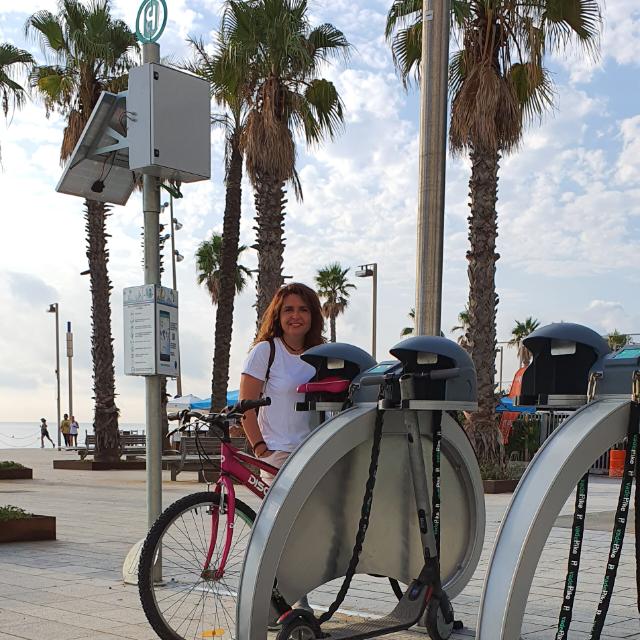
While city councils ponder, VadeBike has already moved forward to deploy its network in private spaces. Thus, the startup has reached agreements to install its secure modules for parking bicycles with the four major public universities in Barcelona: UB, UAB, UPC, and UPF. VadeBike has also partnered with Saba car parks in the Catalan capital, where, for now, it has installed fifty spaces in the Hospital Clínic, Rambla Catalunya, Passeig de Gràcia-Mallorca, and Plaça Urquinaona car parks. For Saba, the incorporation of the VadeBike system allows it to reaffirm its strategy of converting its car parks into sustainable mobility hubs, since now, in addition to parking cars or motorcycles, its car parks offer the option of recharging batteries, picking up online purchases, or accessing shared mobility services for motorcycles, cars, or scooters.
In the private sector, another growth avenue for VadeBike is agreements with developers and owners of office buildings, as they can thus offer secure parking to employees who commute to work by bicycle or scooter.
VadeBike currently has a network of 500 bicycle parking spaces deployed in the so-called first-generation modules, that is, those it has commercialized in the last two years. Now, it is launching this hybrid model (which incorporates scooters and the possibility of recharging) with the challenge of closing the year with a minimum of 3,500 spaces —both in public and private spaces— in Barcelona and Madrid, a city they now plan to enter. In three years, Recasens' forecast is to be present in five cities.
Raise one million euros
To finance and boost this growth plan, VadeBike has just launched a funding round with which it expects to raise one million euros. In this process, the company has the advice of the consulting firm Ineo Corporate, chaired by Francesc Homs. According to Recasens, the objective is to bring in an investor who, in addition to capital, contributes their experience in sectors such as mobility, services, or energy.
This round is the third for VadeCity, which initially raised 500,000 euros through friends and acquaintances (family, friends and fools). In parallel, the company has obtained 2.66 million in public funds from the European Union's innovation program Horizon 2020, in addition to having 60,000 euros in bank financing.
To use the VadeBike parking modules, users must download a mobile application to locate the terminals and make a reservation. To activate the anchoring and unanchoring mechanism, simply bring the mobile phone close to a terminal, as the system works with bluetooth technology. The startup offers a rate of 48 euros per year that entitles users to park their bicycle for a maximum of eight hours a day to encourage rotation "and not turn public space into a bicycle warehouse," says Recasens. There is also the possibility of contracting a monthly rate of 29 euros that allows for a fixed anchor and, in addition, to be able to use the rest of the network eight hours a day. Another option that will be offered will be daily pay-per-use, stipulated at one euro.
"The VadeBike device is unique in the world," assures the architect and entrepreneur, who emphasizes that the design ---based on the golden ratio--- has a European patent. The brand's modules are suitable for all types of scooters and bicycles, including folding ones. Each vehicle is fixed at three points, which protects the wheels, the chain, and the structure of the bike. The same system also stores the helmet. VadeCity subcontracts the production of VadeBike modules to a Catalan company, CM Laser, with a plant in Barberà del Vallès.
Add The New Barcelona Post as your preferred Google source for free
Stay informed with the latest news.
