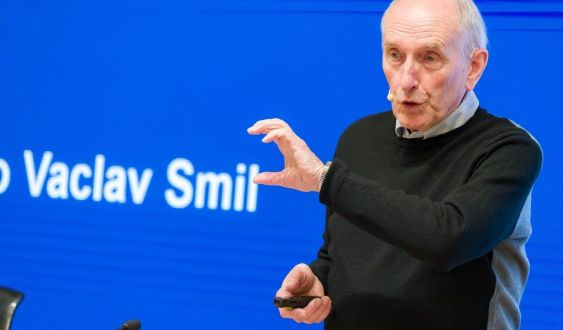
Vaclav Smil is a scientist considered one of the top 100 global thinkers according to Foreign Policy. Smil has dedicated his professional career to researching energy, environmental and population change, food production and nutrition, technical innovation, risk assessment, and public policies. He has the honor of being considered a go-to author by billionaire Bill Gates, after having published 40 books and almost 500 articles on his research areas.
The also professor emeritus at the University of Manitoba and member of the Royal Society of Canada (Science Academy) has just finished the report Natural Gas in the New Energy World. In it, he analyzes the role that natural gas can play in the energy transition towards a more sustainable and less environmentally harmful production model.
"Any description of natural gas as a huge asset to be abandoned or thought about expelling gas completely and belittling it as a very short bridge between coal and renewables, could represent a big mistake," Smil argues. For the professor, natural gas is "a perfect fuel" for the energy transition from coal to renewable energies. It is because its combustion generates 40% less carbon compared to coal itself and is also less polluting compared to kerosene and gasoline. "It is a perfect intermediate option," he defends.
"Any description of natural gas as a huge asset to be abandoned could represent a big mistake," Smil argues.In this sense, he emphasizes that natural gas generates emissions, but in a smaller quantity than coal does, and furthermore, it is flexible, can be transported, and can be burned, which generates an efficiency that no other fossil fuel transformation energy currently has. Other virtues include that it allows for increasing the substitution of coal-fired electricity generation and complementing renewable generation; there is no other reliable short-term option for heat production, and its difficult replacement as an energy source in many industrial processes and as a raw material in the manufacture of essential materials and compounds.
With these characteristics, the scientist sees it necessary to bet on natural gas in this model change, for which he stresses that "there is no rational scenario that relegates natural gas to an insignificant role or that turns it into a relic of the past before the year 2050." For this reason, he is critical of the unrealistic scenarios drawn from summits such as COP26. "They are simply promises, but if they are not materialized, no one can guarantee the results," he explains, adding that the decarbonization process will not be an immediate change and will require time. "We need many, many decades," he insists.
As an example, Smil indicates that, in 2020, 83% of the world's energy came from fossil fuels. This amount has only been reduced by 4% in the last 20 years, thanks to factors such as greater use of renewable energies and the electrification of mobility. But, according to COP26, by 2030, a 45% reduction must be achieved. "How are we going to reduce our dependence on fossil fuels 25 times faster in 2022 compared to what we did a year ago?" he asks. For him, "so far, there is no clear or technically firm path" to achieve decarbonization.
In 2020, 83% of the world's energy came from fossil fuels, an amount that has only been reduced by 4% in the last 20 yearsGoing to more distant horizons, like 2050, the University of Manitoba professor is not very optimistic either."All recent scenarios for 2050 are just stories or more or less plausible proposals, driven more by politics than by realistically evaluated technical capabilities, and only if the EU follows the aggressive decarbonization course for at least a decade, will we be able to understand what will truly be possible by 2050," he states.
Therefore, he recalls that, according to European forecasts, natural gas is estimated to supply approximately 20% of the gross inland energy consumption of member states in 2030 and approximately 18% in 2050. "Clearly, in any realistic scenario of gradual decarbonization, natural gas will remain one of the pillars of global and European energy supply for the next generation and the only uncertainty is what its long-term future will be like," he emphasizes.
What can be done to accelerate the transition?
Smil points out as a challenge for the energy transition that practically half of the new technologies needed to make it possible have not yet been invented or cost too much money. In the first group, there is the lack of batteries with sufficient storage capacity, while, in the second, it is known how to produce green hydrogen, but, for now, it is too expensive.
Half of the new technologies needed to make the energy transition possible have not yet been invented or cost too much money"This is the problem with the decarbonization process: many of the things we need are still pending discovery or remain very expensive and cannot be implemented massively," he summarizes.The solution involves continuing to invest in research, as well as in ways to make existing technologies more economical.
Regarding this last issue, the scientist emphasizes the prices of natural gas in the future, taking into account its contribution to the change of model. In his recent report, published by the Naturgy Foundation, he considers that "adequate investment in the development of existing reserves and the expansion of the global market should lead us to lower prices; conversely, the lack of such investments, combined with the premature closure of other fossil fuel (or nuclear) powered capacities, could lead to even higher price peaks in the future."
Add The New Barcelona Post as your preferred Google source for free
Stay informed with the latest news.
