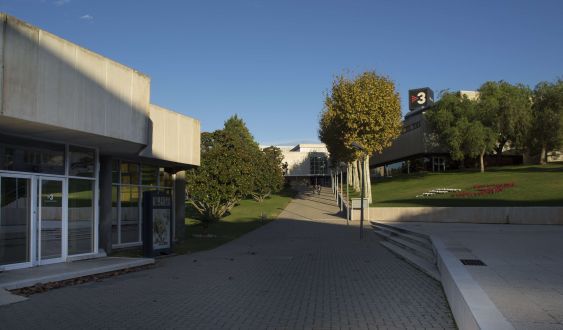
In the first minute of the more than three hours that the electoral debate held on TV3 lasted, the public television already received the first kick. Carlos Carrizosa, the Ciutadans candidate and in charge of opening the dialectical fire, began his turn to speak with a "Enough already!" that was intended to be an amendment to the entirety of the very venue from which he addressed the audience.
An audience that, throughout a night of incessant tweets and a televised dialectical struggle between the nine candidates to preside over the Generalitat, accumulated 2 million viewers, exceeding 26% of screen share. A film with nine protagonists, plus Vicent Sanchís, alternating the functions of a moderator with those of an occasional sparring.
Once again, TV3 was content and container, demonstrating the great media, strategic and symbolic dimension of a public television that, in 37 years of history, has already seen it all.
2021 marks TV3's eleventh consecutive year of leadership in Catalonia, maintained consecutively for the last 42 months, a new record for the house. Another notable success, this one qualitative, is its leadership in terms of valuation. The viewer panel prepared by GfK gives it an 8.5 out of 10 for the third year in a row.
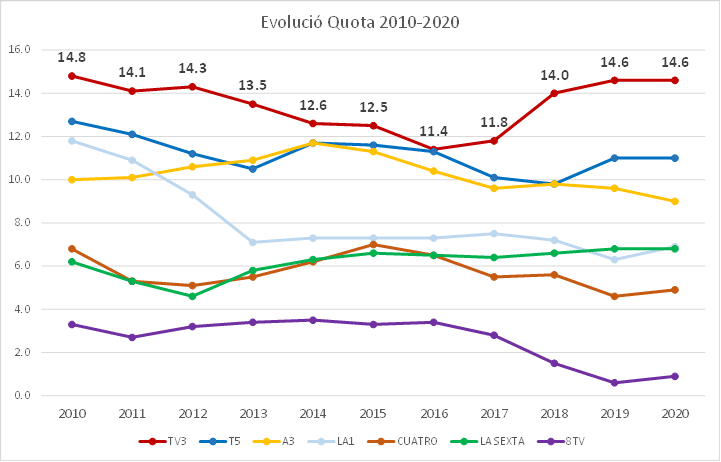
Returning to the coldness of the numbers, TV3 closed 2020 with a 14.6% screen share, three and a half points behind Telecinco, its immediate pursuer in the share war. The third in this race is Antena 3, which managed to capture 9% of the attention of elusive viewers, increasingly absorbed by other screens and demanding novelties at the same rate they get them on Netflix.
The season premiere was Altsasu, a co-production between TVC, Euskal Telebista, the Som media group and the production company Baleuko. Beyond the controversies about the terrible dubbing of the series or the treatment of the conflict that fuels the plot, the data indicate that the bet made on this four-episode miniseries has been a success: a 22% screen share at the premiere and 17% in the last episode, broadcast on February 9. Other important programs for the channel, pending to see the evolution of the recently premiered Nexes, are the inexhaustible 30 Minuts, Polònia, El Foraster, Està Passant or Tabús, all of them among the most watched of the last season.
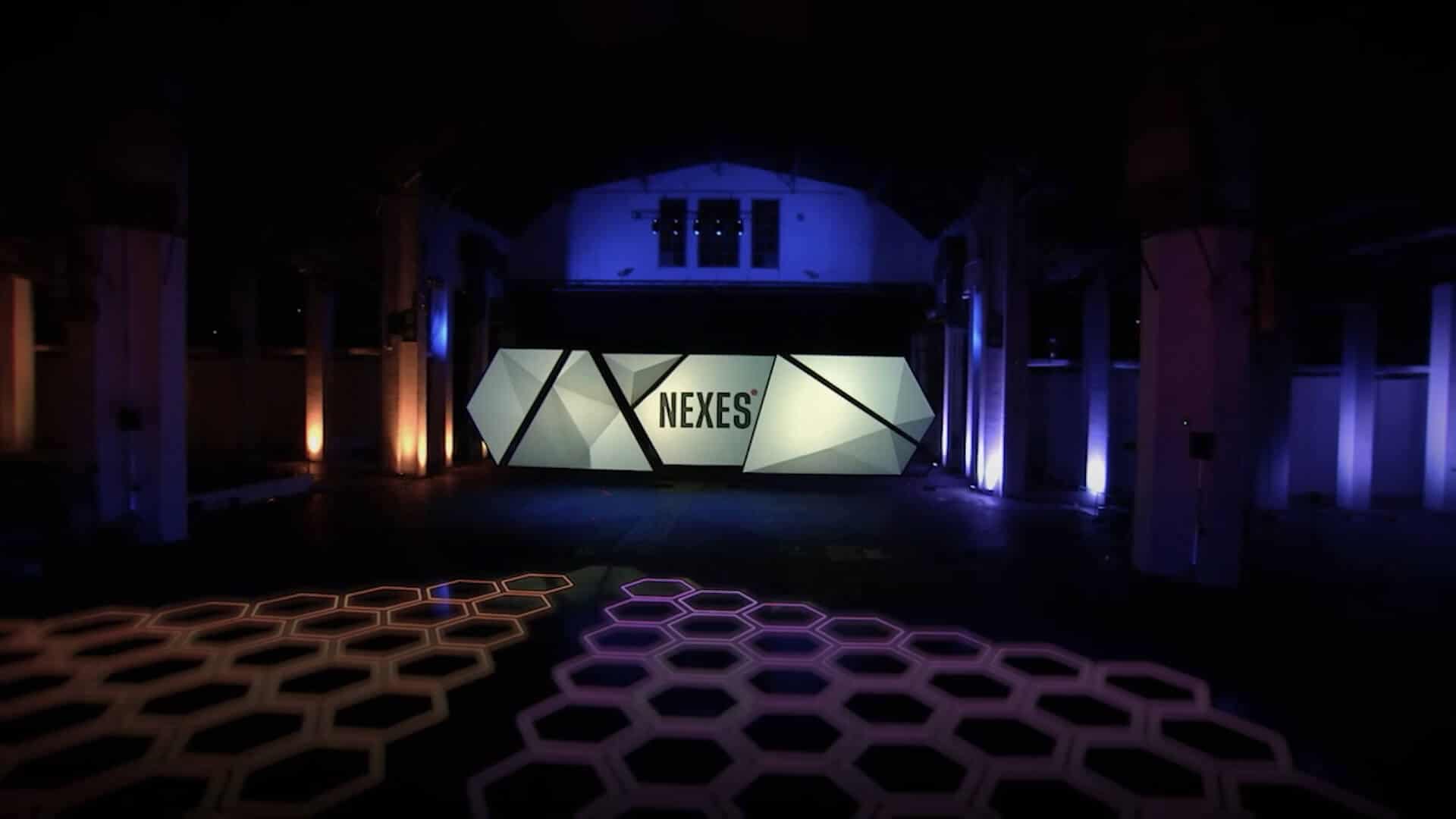
The set of the program "Nexes", presented by Jordi Basté and Mònica Terribas.
But the great asset of Televisió de Catalunya are its news services, which have made the different editions of its Telenotícies the cornerstone of the programming. With screen shares close to 30% in the daily edition and 25% on weekends, the data indicate that the characteristic countdown that precedes each "TN" is a sound familiar to many Catalans. A very revealing fact is that in 356 of the 366 days of 2020, the most watched program in Catalonia was one of the editions of the news.
The Covid monotopic in 2020 had an interesting counterpoint in the US elections in autumn. The duel between Trump and Biden became the epicenter of world political news for weeks and TV3 made a real informative all-in; in line with its vocation to act as an important public service, hitting the streets many kilometers from the usual radius of action of a regional television. TV3's bet on the American elections was a winner, with a deployment on the ground typical of a first-rate television. The effort of many professionals resulted in extensive and permanently updated coverage of the race to the White House. News coverage of this magnitude reaffirms the words of Vicent Sanchis, director of TV3, when he emphasizes that "we have an international vocation, we are not and do not want to be a local television."
Vicent Sanchis, director of TV3, states that "we have an international vocation, we are not and do not want to be a local television"
The debate on the public television model is a central issue for Sanchis, who wants to design a viable future for TVC in a context of budgetary restrictions. As he recalls, "in 2005, we earned 150 million euros from advertising, while last year we did not reach 50 million" and in reference to the budget he states that "15 years ago, the contribution was 340 million euros and, currently, it is 260 million".
With these rules of the game and with the obligation to compete with private televisions, the Corporació Catalana de Mitjans Audiovisuals (CCMA) is looking for innovative formulas with the aim of retaining its audience and conquering new audiences.

The creation of the New Formats Laboratory in 2017 precisely pursued the objective of detecting new trends, good practices and innovation in television. Through the observation and study of programs broadcast by other televisions around the world, the aim was to find inspiration for own formats and at the same time have a greater knowledge of the competition.
From that project we are now beginning to see the fruits, in the form of programs that are not limited to the television screen, but are premiered on multiplatform. Saül Gordillo, director of Digital Media at the CCMA, warns of the importance for the future of the channel of "proposing new formats that help us conquer those audiences that do not watch linear TV".
Saül Gordillo, director of Digital Media at the CCMA, warns of the importance for the future of the channel of "proposing new formats that help us conquer those audiences that do not watch linear television"
Programs like Mood Z, aimed at the generation baptized with this letter, can be watched on Televisió de Catalunya's TikTok, Instagram, Twitter and YouTube profiles. Other proposals in the same vein are La Comunitat, Cover or Jugada Mestra, a bet on experimental comedy that can be recovered in podcast form on platforms such as iVoox, Spotify, Google Assistant or Alexa.
Beyond the digital branching of programming, the ultimate intention of the CCMA is to create content in Catalan in an environment where this language is a minority.

The problem? That in conquering these new audiences, no advertising revenue is obtained. Of the 50 million euros earned last year by the CCMA in advertising, 45 million corresponded to television, 4 million to radio and only one million to digital media. So a big unknown for la Corpo will be how to monetize the content it strives to publish online.
Taking into account the climate of political instability of recent years, not very conducive to the strategic planning of a public TV, and navigating between the paradigm shift in audiovisual consumption and the drop in advertising revenue, TV3 is at a point where "magical balances must be achieved, taking into account that, as of today, 85% of audiovisual content production is own (and internal) and that 60% of TV3's total budget is allocated to personnel expenses. Personnel who, due to Covid, have logically been reduced, adding sick leave, quarantines and at-risk individuals," as Vicent Sanchis explains.
In 356 of the 366 days of 2020, the most watched program in Catalonia was one of the editions of Telenotícies
With these perspectives, can Televisió de Catalunya once again be the engine of audiovisual production that it was in the 80s?
The answer is not at all clear, but today's reality is different and the irruption of large streaming platforms like Netflix has changed the rules of the game.
The public television entity is in a transition stage in which it must face very important issues to be able to face the future with guarantees: how to adapt to the new ecosystem, continue competing with private televisions in a context of budgetary restrictions, rethink its children's and youth offer or how to monetize new digital audiences.
While the pieces of the puzzle are being fitted together, the solid quality of the professionals of the house and the recurring trust of the viewers demonstrated by the audience figures, validate, for now, a public television model that has shipwrecked in other waters, but that in Catalonia has learned to navigate the storm.
[subscribe_newsletter_esp]
Add The New Barcelona Post as your preferred Google source for free
Stay informed with the latest news.