[dropcap letter="L"]
a Bartomeu house, Noucentista in style, today home to the Consell Català de la Música and the Jardí dels Tarongers association, hosts chamber music evenings that transport the listener to another era. The era in which Josep Maria Bartomeu (1888-1980) animated the musical activity of the city of Barcelona by premiering works, such as Manuel Blancafort's Quartet de Pedralbes, and accompanying the career of top-level performers, among them Victoria de los Ángeles. The commitment to the arts, in difficult decades, managed to transcend his lifetime, as the donation to the Barcelona city council of a privileged space, "of a markedly Mediterranean style," was closed under the condition of perpetuating the dissemination of music. A reality undertaken by the current project, inaugurated in 2014, which features different cycles.
INTERIORITIES FOUND IN INTERIORS
A sentence as an invitation summarizes that spirit, whose validity is not only archaeological, but inherent to the emotions awakened by the aesthetic experience: "we offer music lovers the opportunity to experience intimate musical sessions that move them." Music is not only enjoyed outdoors in the Jardí dels Tarongers, during the warmer seasons, as in the case of the magnificent concert by Bandart and the Jove Orquestra Nacional de Catalunya. In the autumn and winter cycles, the magic of chamber music performance can be rediscovered in an interior with paintings by Antoni Vila i Arrufat, in a proximity to the artist unknown today, which takes the listener back to past centuries.
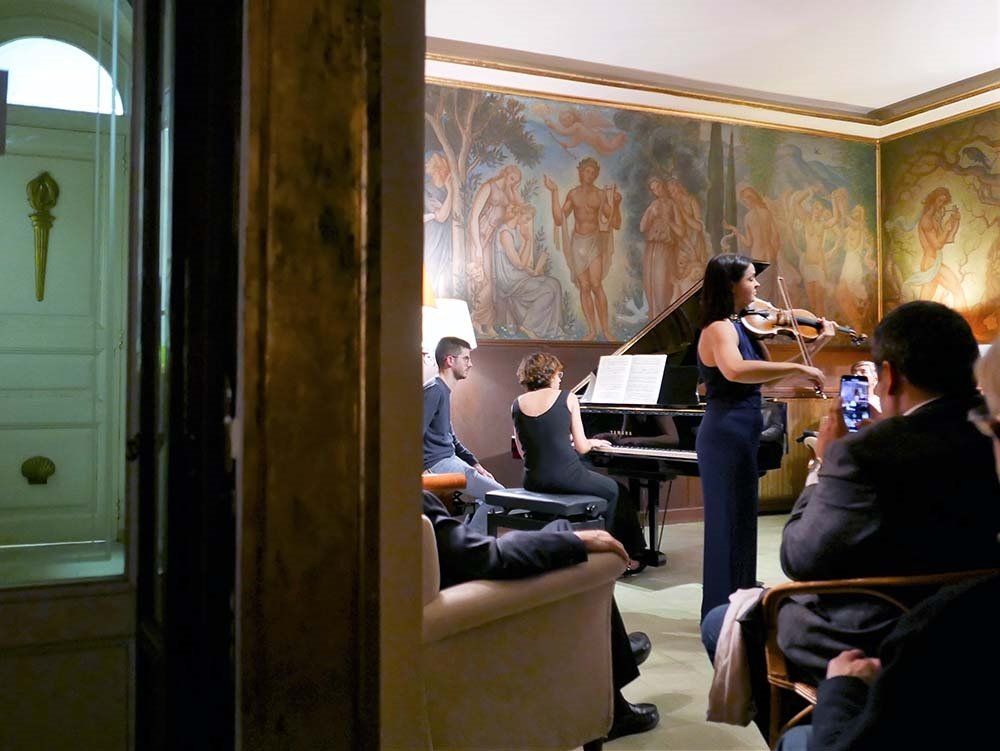
Even if the recreation of interpretive conditions by early music has made possible an approximation to the aesthetics of the corresponding eras, these works are rarely heard in the type of rooms for which they were conceived: halls or salons much smaller than current auditoriums, even than their respective chamber halls. The presence of the instrument, the way the sound occupies the space and affects the listener who is in it along with the artist is qualitatively different. There is no insurmountable distance, nor the obligatory impersonality, characteristics that -it can be assumed- allow for a much more intense aesthetic experience, similar to that of the most famous domestic music evenings, the Schubertíadas.
Thus, the Jardí dels Tarongers becomes a stage for a practically extinct proximity. Being side by side with the artist, at a short distance from the interpretation of a work that comes to feel like one's own, that seems to resonate within oneself. For chamber music is not just music made with few instruments, it is music that appeals to the inner selves that are sharing the same space. This exclusive experience is, in reality, open to all. In exchange for a symbolic payment, the possibility of a genuine experience is offered in recitals without intermission, which usually do not reach an hour in length. A fact that does not prevent important pieces from being performed, following the tradition imposed by the patron, who programmed works as fundamental, progressive and disparate as Claudio Monteverdi's Orfeo, Erik Satie's Socrate or Arnold Schönberg's Gurrelieder.
Chamber music is not just a type of music made with few instruments, but music that appeals to the inner selves that are sharing the same interior.It is, in short, a friendly format, whose closeness culminates with the possibility of sharing a glass of cava, after the performance, with the young artists. Musicians at the beginning of promising careers, and excellently willing to squeeze the live experience. Many of them soon consolidate, with little surprise we discover them shortly after programmed in larger and more recognized venues, and inevitably at a greater distance from the spectator. We think -to mention only three- of names like Sara Blanch, who will sing at the Gran Teatre del Liceu this December, the charismatic pianist Carles Marigó or the flutist Elisabet Franch, who recently debuted at Carnegie Hall. All of them passed through El Jardí dels Tarongers.
POSSESSED PERFORMERS AND SPECTATORS
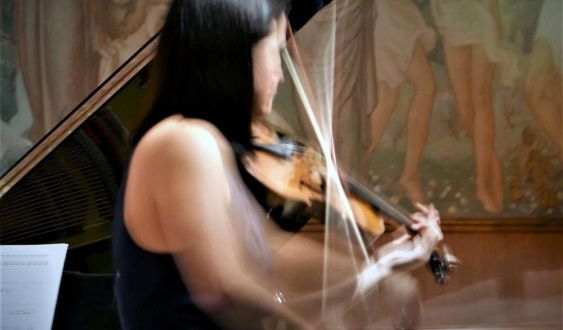
An excellent example of the evocation aroused by a musical experience of this type was the last recital -on Friday, November 30- with the participation of Maria Canyigueral, on piano, and Lana Trotovsek, whose violin, created around 1750, captivated those present. A kind of magnetism -or simply the sonic vibration, tuned with Pythagorean neatness- expands in the vicinity of the source that generates it. The energy does not travel far, but condenses in situ, within the walls of the Vila i Arrufat hall thanks to more than acceptable acoustics. Both the Catalan and Slovenian artists know the main pieces of the repertoire for violin and piano, and in fact they are currently immersed in the project of recording the complete Beethoven sonatas, with the fifth -"Spring", one of the most striking- included in the evening's program.

But, above all, the ninth stands out, the "Kreutzer" sonata, its significance enhanced by the demonic fame retrospectively assigned to it, according to Tolstoy's eponymous story. Published in 1889, it illustrates how the complicity between a pianist and the violinist accompanying her in the performance of that piece leads to an adulterous relationship, outside the prevailing ethics and intensely suffered by the husband, who ultimately acts as a bitter narrator, reaching the extreme of an inspired madness: "This sonata is terrible, especially this part (…) What is that? I don't understand it. What does it produce? And why does it produce such an effect? It is said that music influences in such a way that it elevates the spirit. Nonsense, a lie! That's right, it produces an effect, a terrible effect (…) Music makes me forget myself, my real situation, it transports me to another situation."
Chamber music impacts the intimacy of the protagonists of many of the best fictions -including cinematic ones- that are assumed as real due to the involvement of readers/spectators. In this sense, both the sentimental progress and the blunders and misfortunes of Barry Lyndon seem, in Stanley Kubrick's film, unfailingly governed by the beautiful Andante con moto from Franz Schubert's Piano Trio in E-flat Major, Op. 100. A minimalist piece in terms of instrumental resources, and hence, perhaps -thanks to the good work of Schubert/Kubrick- its maximum impact on the listener/spectator, feeling intimately linked to the plot; to the vital unfolding that reflects the glory and misery of the same individual in his struggle to make a place for himself in high society. The internal movement of emotions, the transformation experienced by the protagonists is also evident in the gambling scene:
Even if Kubrick's use of that movement is anachronistic—since the work was composed by Schubert in 1827, shortly before his death, and not in the 18th century—for film purposes it works masterfully. Over the piano's discreet walking, the cello theme rises and traces a solemn and emotional filigree, which—one would say—is now installed for life in the deep strata of our psyche, as if it had always been there. But the piece advances, and the relationships between instruments are inverted, enriched with the entry of the violin and the dramatic series of questions and answers that Schubert hints at, and with which Kubrick captures the swaying, the tremendous and yet beautiful fragility of the protagonist.
Both the sentimental progress and the blunders and misfortunes of Barry Lyndon seem unfailingly governed by Franz Schubert's beautiful Andante con moto from the trio.Spectators perceive all the psychological details, through the empathy inherent in the process of identification with the character, but also thanks to the character that emanates from the musicality associated with him. Felix Mendelssohn wrote a series of piano pieces titledSongs Without Wordsand remarked in a letter to his sister Fanny—in fact, it is believed that she collaborated in the compositional task—the greater precision of music, in contrast to the false determination and semantic security of concepts. Without words, with silences or through ellipsis, one can (make) understandeverything. We now think about the role of music in a film likeIn the Mood for Love, by Wong Kar-Wai, in which a man and a woman who have been betrayed by their respective partners live door to door, keep each other company and offer comfort, inevitably exploring the possibility of a romantic encounter without anything (of what is desired) happening.
The music invites to conceive the reality of an attraction that is not visibly materialized, only in the mind of the viewer/listener in light of some hyper-aesthetic images and, above all, a soundtrack full of contrasts (Nat King Cole and his Quizás, quizás quizás), in which the equally recurrent theme Andante prevails: a string melody marked by counterpoint in pizzicato, a heartbeat that marks the parallel progress of both individuals. The effects of musical complicity occur spontaneously through the understanding of the performers/actors, dedicated to the same cause. Similarly, and far from its apparent passivity, the viewer of cinematographic fictions becomes a second-degree interpreter by participating in the meaning of the sound event, whose reality weaves within itself a plot that can never be completely alien to them.
"WORLDLINESS", FROM PROUST TO LA GRANDE BELLEZZA
To a sonata no less literary than the Kreutzer, the last artists to pass through the Jardí dels Tarongers -Lana Trotovsek and Maria Canyigueral- dedicated an excellent and successful (awarded) album. It is César Franck's Sonata in A major, one of the possible inspirations for the fictional "Vinteuil Sonata" -referred to by Marcel Proust in Un amour de Swann- and famous for "the little phrase" that brings together the characters in love. The explanation of the spiritual reunion of the lovers around that music may seem somewhat contrived; it tempts the string of kitsch aestheticism -in an absolutely premeditated way by Proust- as well as with the complicit allusion to the sexual act through the mention of the Cattleya orchid, preferred by the demi-mondaine Odette de Crecy. Not in vain does Swann's love-passion represent a fall, which he will only recognize at the last moment, when he knows himself free from the biochemical cocktail that intoxicates and confuses the senses, recognizing that, in fact, she was not his type (pas mon genre).
"It was as at the beginning of the world, as if there were only the two of them on earth, or rather in that world closed to everything else, built by the logic of a creator and where there would never be anything but the two of them: this sonata"Until then, what is given is the experience of a temporal simultaneity, which music seals and platonically elevates. Proust does not fall short in his attempt to exploit through images and comparisonsthatthat music arouses: "At first the solitary piano complained, like a bird abandoned by its mate. The violin heard it, responded from a nearby tree. It was like at the beginning of the world, as if only the two of them were on earth, or rather in that world closed to everything else, built by the logic of a creator and where there would never be anything more than the two of them: this sonata." It is a cyclic sonata -César Franck's- with a theme that is stated, transformed, and rediscovered. Indeed, the instruments recreate themselves in mirror games with just the right punctuality and dynamism, like two lovers who look into each other's eyes and recognize themselves alone in a newly constituted world, who finish the phrase previously started by the other or simultaneously give responses that only they understand as identical.
The passage of the sonata referred to in Proustian fiction -included in the first volume of À la recherche du temps perdu, despite its relatively independent character- could be found in the Allegretto poco mosso, the closing movement, but the suggestion lends itself to other "recognitions," for example, in some of the ecstatic passages of the Ben moderato: Recitativo-Fantasia. However, what that music means is something that no one can determine beyond their own experience, beyond the feelings it awakens, associated with really lived experiences or with daydreams of mythical flavor. The feedback between both spheres -that of reality and fantasy- constitutes, in fact, the foundation of an emotionality that is updated in the course (and with the accumulation) of aesthetic experiences; that stirs feeling in a kind of present perfect, whose foundation seems to lie in another life.
https://www.youtube.com/watch?v=Dyt430YkQn0
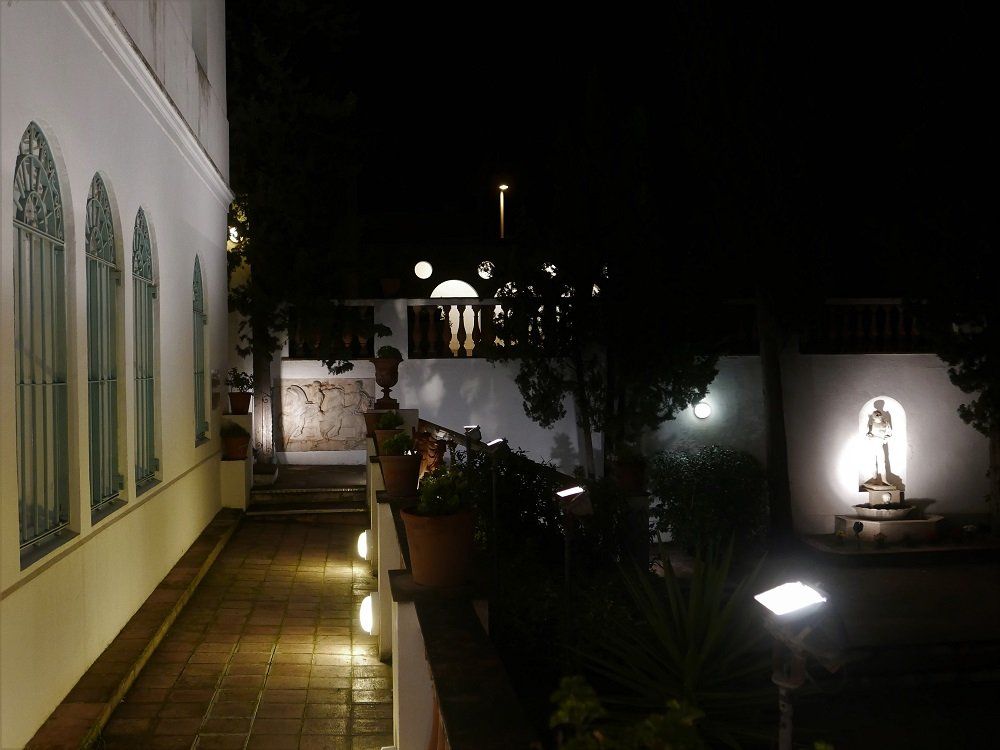
Walking at night through the Gardens of Casa Bartomeu, getting lost in the exteriors of a remote world or delighting in the interiority of music, refers to a search for meaning that feels lost from the origin. The Great Beauty, by Paolo Sorrentino, has taught us that the attempts that come later -succeeding over time- are mere simulacra, which elevate or debase. Divine or denigrating celebrations. Vain efforts to feel again, as for the first time, an excess of fire within. The distant infatuation -so often musically induced- that the reader or viewer of fictions consoles themselves by rekindling. A mythical, immemorial past, one that enables and spurs memory, not always sweetly. The "world of yesterday," to which the good Jep Gambardella harks back, is not the world governed by supposedly unbreakable values and reckless geopolitical decisions. It is the world of desiring interiority in which wonder and the longing to fulfill it are forged.
In the "Gambardella case," infatuation is affirmed impenitently, adhering to the phantasmatic image of a being who can never be possessed. The reality of desire as ecstatic joy is inaugurated as a trauma; a rupture that knows no return, insofar as it delays ad eternum its possible repair -the realization of desire- displacing it beyond time. "You'll never have me," the protagonist-double of Lost Highway had whispered to her lover after making love, in a psychotic and inspired recreation of what the protagonist of Vertigo experienced decades earlier. A qualitatively different space-time must host and fructify the revelation of pure and unconditional beauty, that form of ardent and saving love that protects the one invested by the feeling, and which some say we will rediscover at the end of our days, when there is no time. Or perhaps when, finally, the novel begins.
Add The New Barcelona Post as your preferred Google source for free
Stay informed with the latest news.
