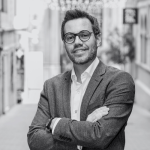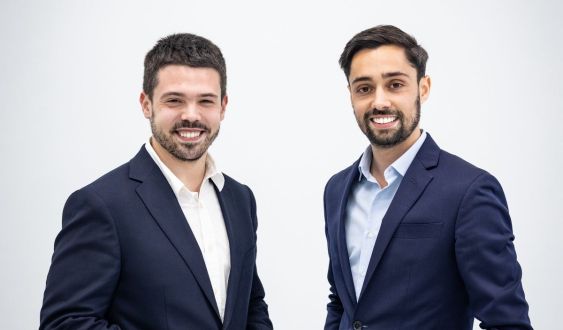
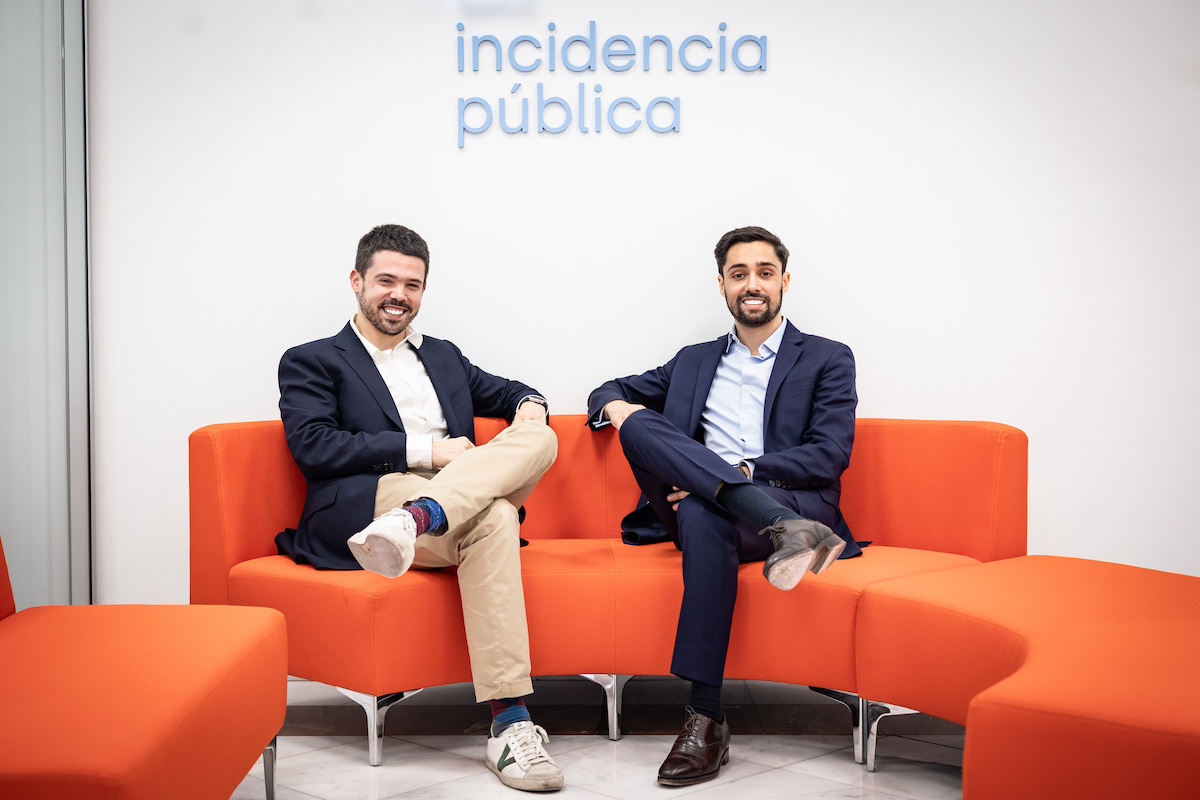
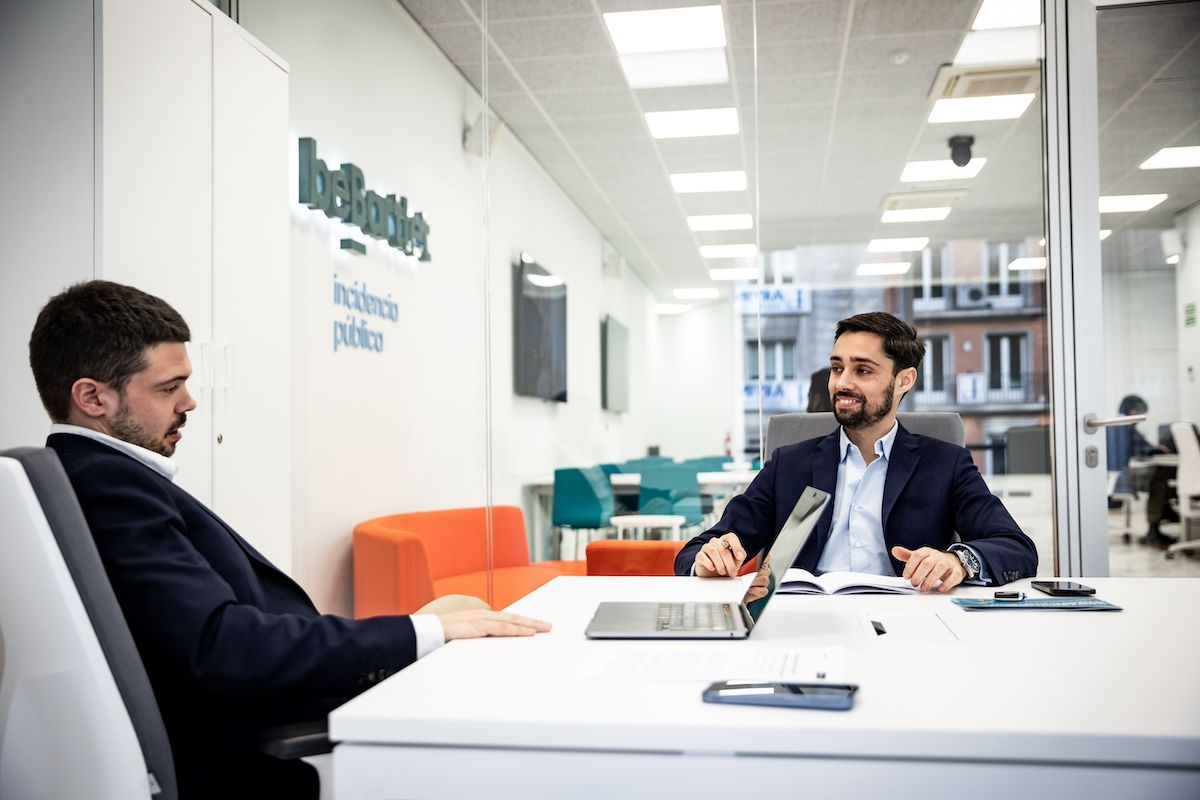
Nacho Corredor and Adrian Jofre look like an electoral ticket. They are complementary personalities. One is intuitive and expansive, the other is methodical and reserved. One knows the public world better than anyone, while the other comes from the private world. However, both grew up in Barcelona, but currently live in Madrid, from where they run the beBartlet consultancy.
A few months ago, they published the book Incidencia pública. El poder en el siglo XXI with Arpa publishing house (the reason for this interview), and also inaugurated an office in Barcelona, from where they argue that "Barcelona will only succeed if the world looks at Barcelona."
--- How did this book come about?
--- Nacho Corredor: It was a genuine interest of the editor, Álvaro Palau, who is a 30-year-old guy from Barcelona who founded what for us is the reference essay publisher in this city, Arpa. The publishing house has focused a lot on social and political essays, and now wanted to make a contribution regarding business manuals. We were interested in the idea, but not only to make an intellectual contribution, but also to explain the way we work differently within the communication and public affairs sector from a business logic.
--- What is this way of working?
--- Adrian Jofre: To have a long-term vision, an approach to public affairs from the right to participation and to understand that what we do is fundamental for a solid democracy. It is essential to guarantee this right to participation from a scientific and democratic approach.
--- N. C.: The distinct vision of what we contribute has to do with understanding that the power of the 21st century is exercised from the bottom up, and not from the top down. That is, what legitimizes changes has to do with the social legitimacy of what is proposed. It is not relevant today to know a politician for things to change. What is relevant is to understand how public opinion, society, and citizens can accept or ask for things to change as we think they should change. The basis of public-private collaboration is not knowing someone, but the exchange of knowledge between the two parties and the involvement of society to legitimize the result of everything.
--- Is it a generational change?
--- A. J.: It's the 21st century. There are people of our generation who don't understand the 21st century, even though it's the century they will live in the most. There are people born in other centuries who perfectly understand the 21st century. It's not an element of generation, but an element of mentality, of perspective, of democratic commitment.
--- N. C.: In any other country with a long democratic tradition, this would not be a generational factor. If we can relate it to a generational factor here, it's because we are the first generation born entirely in democracy. In our country, there is still a great need for pedagogy on how to participate in public affairs. Ultimately, it has to do with how democracies work and how companies are a fundamental actor in the construction of public policies.
--- There is a territorial difference in how it is approached from Madrid or from Barcelona.
--- N. C.: Probably the productive fabric in each of the two cities explains the tradition of a difference in the relationship with power. Madrid is a city based mainly on services, while Barcelona and Catalonia have traditionally been based on an economy linked to industry. And this has also created a logic of business elites with different biases in one city and the other. This has traditionally been the case, but probably the caricature today is not so easily replicable, because the concept of industry has evolved, and Madrid and Barcelona converge in many aspects. One only has to see the liveliness of the business associations in Catalonia, be it Pimec or Foment, and their interaction with public power and their participation in public debate.
--- You, despite living in Madrid, have a Barcelona profile. How does it affect you?
--- A. J.: Surely our way of understanding ourselves as Spaniards comes from being from Barcelona. And our position in Madrid, in terms of public affairs, is very influenced by the fact that we have a direct connection with the city. We spend a lot of time in Barcelona, and we share many spaces with people from Barcelona, and we understand the city's priorities. Today this is very relevant, because the political situation in all of Spain depends a lot on what happens here. You only have to look at the whole debate on fiscal and energy policy, very conditioned by Junts. But today everything that goes through our labor legislation also goes through ERC. And today everything that affects the economy goes through the PSC, because Barcelona and the Generalitat want to play a role as a political and economic agent. To win the debates in Madrid, you have to win first from Barcelona.
--- Why do you think you stand out as a company within the sector?
--- A. J.: Among other things, because of our vision of doing business. Most of our sector is led by journalists, former politicians or people linked to institutions. With us there are many more profiles. Not only people who come from these spaces, but we also have economists, people who come from NGOs, the third sector or engineers. This allows us to consolidate our scientific and democratic approach.
--- N. C.: And in terms of methodology. Knowledge, probably, is the main factor of transformation of societies, and in the field of public policies it is the element from which they self-legitimize. The fact of having economists or engineers, in the end, is a way of explaining that the fundamental part of the value we want to bring to the market has to do with taking knowledge from the academic sphere and sharing it with society to transform public policies at the service of everyone. And another element is innovation: we have managed to do things in a different way within a very traditional sector, and it is perceived that we are innovative.
"Probably the first generation that understands society from a European and global logic is ours"--- And now you are taking this with a headquarters and a new team to Barcelona.
--- N. C.: There is a widespread feeling that Barcelona is in a new stage, which has probably been consolidated with the institutional changes in Catalonia in recent months. There is probably a need for civil society to generate new horizons that will restore to Barcelona society the illusion of building a shared objective. And all this probably happens because in recent years there has been a lack of exchange, not only of knowledge, but of many other things. And in this context, we can contribute the vision of the people of Barcelona and the desire that the people of this city have to occupy a relevant place in the world.
--- A. J.: I believe that Barcelona society does not have to compete for the restitution of a past statu quo, but for the construction of a new statu quo where the competition is international and where the obsessions of civil society should be more directed towards capturing new opportunities beyond our borders. And that is why we must think from a global world logic. Before, we talked about the generational element. Probably the first generation that understands society and the country from a European and global logic is also ours. Our ecosystem is not limited to the most immediate geographical borders, and I believe this has value in this new stage.

--- There are large Catalan companies that, for years, have understood that their world goes beyond the State.
--- N. C.: The ambition of the city must be that the global economic world thinks of Barcelona instead of other European cities when prioritizing its investments. Barcelona will only succeed if the world looks at Barcelona. The goal is not for Madrid to come to Barcelona. In fact, I believe that Madrid and Barcelona have logics of cooperation as cities. Together they add a lot. Faced with the German collapse and American protectionism, Barcelona and Madrid can together be the answer to many of the challenges of the global economy. There is an enormous opportunity, and we want to contribute to making it possible.
--- You say in the book that the raw material of the economy is not only money, but now it is above all trust.
--- A. J.: Confidence is the biggest catalyst for agreement, and many times agreements are not closed because there is no confidence between the actors who have to reach these agreements. Why is there no confidence or why is there less confidence? Well, because ideological blocs increasingly share fewer realities. They do not undergo joint socialization processes. This also happens between businessmen and institutions or politics. We need socialization processes, since the fact that we have completely parallel life paths means that these conditions in which this confidence is generated are not created. And this, without a doubt, is one more element that contributes to the polarization process we have been experiencing in the West in recent years.
"The next five years will decide the next century"--- How do you get them to end up meeting?
--- N. C.: Generating socialization conditions in the stages prior to assuming responsibilities. We started generating these spaces several years ago around Mariana Mazzucato's concept of mission. She says that public-private partnerships oriented towards shared purposes between the public and private sectors must be generated to find answers to the great challenges of the 21st century.
--- Is the goal that all this talent will eventually be incorporated into positions of power?
--- A. J.: This is our hope. We believe that it is our contribution to a better country: generating these spaces and these conditions of trust so that agreements can be catalyzed in the future. And that is why we dedicate a lot of time, many resources, and a large part of our activity to making these conditions possible.
--- N. C.: The next five years will decide the next century. And it is essential that we overcome all possible barriers between those who have to make it possible.
Add The New Barcelona Post as your preferred Google source for free
Stay informed with the latest news.