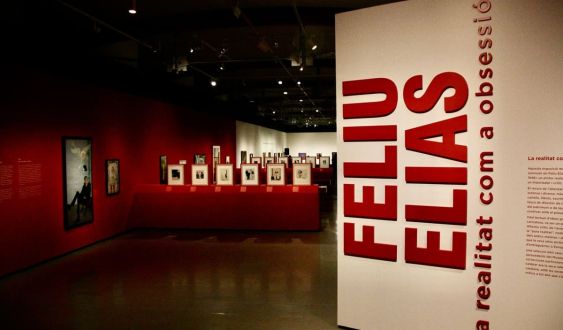
I was expecting an exhibition about the painter Feliu Elias and I leave knowing three people, embodied in him like the Mystery of God: Feliu Elias, the painter; Apa, the cartoonist; and Joan Sacs, the art critic (1878-1948). It could be an exercise in splitting (disembowelment), or simply taking different artistic names by a single person, but little by little I discover that there is more to it than that. Too many contradictions, too many dissonant voices, too many clashing personalities. I don't dare to give it a medical diagnosis, it is not appropriate to do this in an art museum, which is a place where we all admit the universal illness: but I do notice that the exhibition multiplies by three, that the portrait of the era can therefore be contemplated through three prisms, and that one can defend one thing and its opposite (and what lies beyond) at the same time. La realitat com a obsessió, reads the title. But reality, to be so, perhaps needs more than one and more than two pairs of glasses.
The exhibition has been put together using pieces from the museum's collection, which is rich enough to allow us to draw on our national values without having to spend too much. We don't have the funding of the Prado, as you know, and when you are only the "cultural co-capital of Spain" you cannot expect to be funded to be anything more than a provincial city. Fortunately, thanks to the imagination of Pepe Serra, the tenacity of Joan Oliveras, and the knowledge of co-curator Mariàngels Fondevila, who share a gigantic institutional and patrimonial pride as a common link. Love, as always. Now all that's left is for the people of Barcelona to go, because this is an exhibition aimed more at the people from here. The people from here who want to understand things, of course.
Feliu Elias tries to be realistic when he paints, but I fear that the future had already passed him by and that is why he does not succeed. In part it is the future, modernity, that gives that somewhat Hopper-esque character to his paintings (the great example would be La galeria, so full of narrative and figuration that it seems more like a dream than a portrait); and in part it also helps, I am sure, his soul as a draftsman and caricaturist, which undoubtedly makes him confuse realism with truth: a great draftsman and caricaturist like Apa, that is, like himself, knows that in good caricatures there is the best reality because they contain more doses of truth than in any hyperrealist painting.
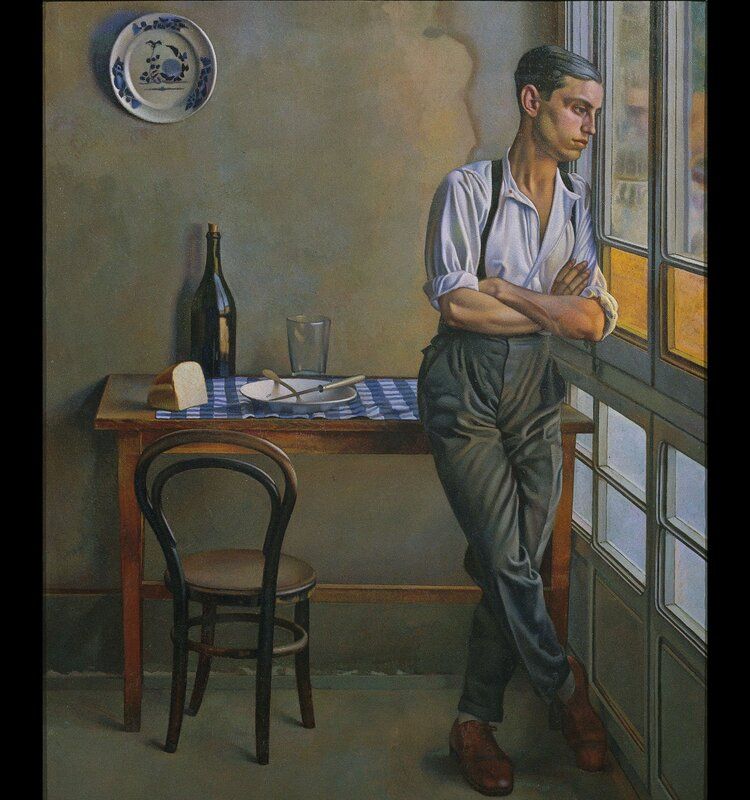
Feliu Elias may have an "obsession" with reality, I'm not saying he doesn't, but reality is more real when it's not a photograph. Many of his paintings are associated with German New Objectivity, and in their beginnings, many draw from Impressionism and Pointillism, but he never manages to be innocuous, cold, or materialistic. No matter how often he places objects at the center of everything, his objects have a knack for possessing a soul, and not even they themselves can escape it. In the same way that his faces and figures, so seemingly everyday and even boring, hide mysteries and tensions that one would want to continue knowing beyond the painting. "Provocative enigmas," like those he himself confesses objects provoke in him, and which can never be inanimate. No, Feliu Elias is not a realist no matter how much he wants to be, nor is Apa fanciful or grotesque or exaggerated in his caricatures: in them, raw and ruthless, we sometimes find much more realism than in the chairs and still lifes of the canvases.
The third party in discord would be the art critic, represented through the protagonist's likes and dislikes: in this space, we will not only see a mural composition by the author himself (surprisingly delirious), but also the exhibition of a good part of his blessed painters placed face to face against his condemned painters (among whom Picasso the Cubist or Dalí the Surrealist stand out, only "saved" when they embrace reality). It is not strange that Dalí, who was not mad, called him "mentally weak" in a letter. Dalí did not have as many contradictions as Feliu Elias, therein lies the difference: he had them, but they did not clash simultaneously, but were the product of an evolution, as in the case of Picasso.
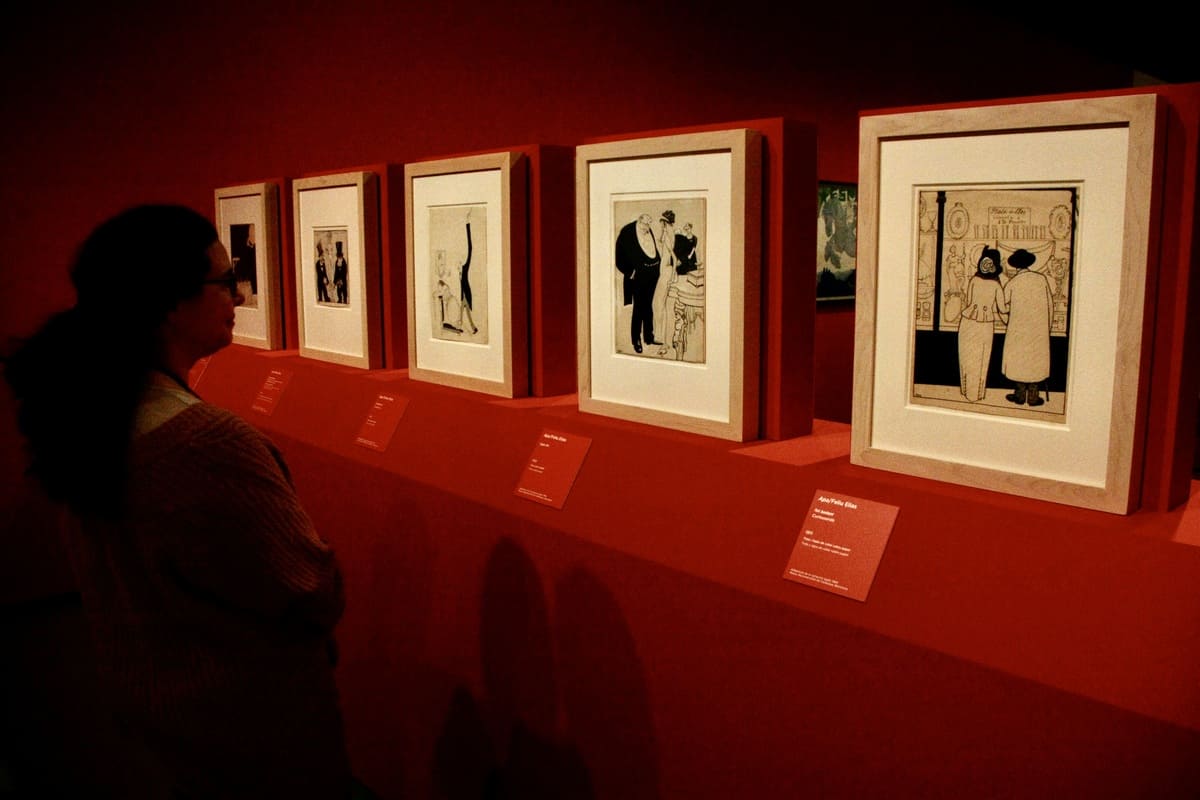
In Feliu Elias, however, contradictions coexist every day: on the one hand, social criticism, progressive ideas, proximity to Acció Catalana, criticism of the bourgeoisie and the clergy (and the Germans of the Great War), but at the same time this stark intolerance towards the avant-garde, experimentation, and futurism. It's hard to understand. It's so hard to understand that this humble servant begins, more than seeing pictorial paintings, to imagine the medical chart.
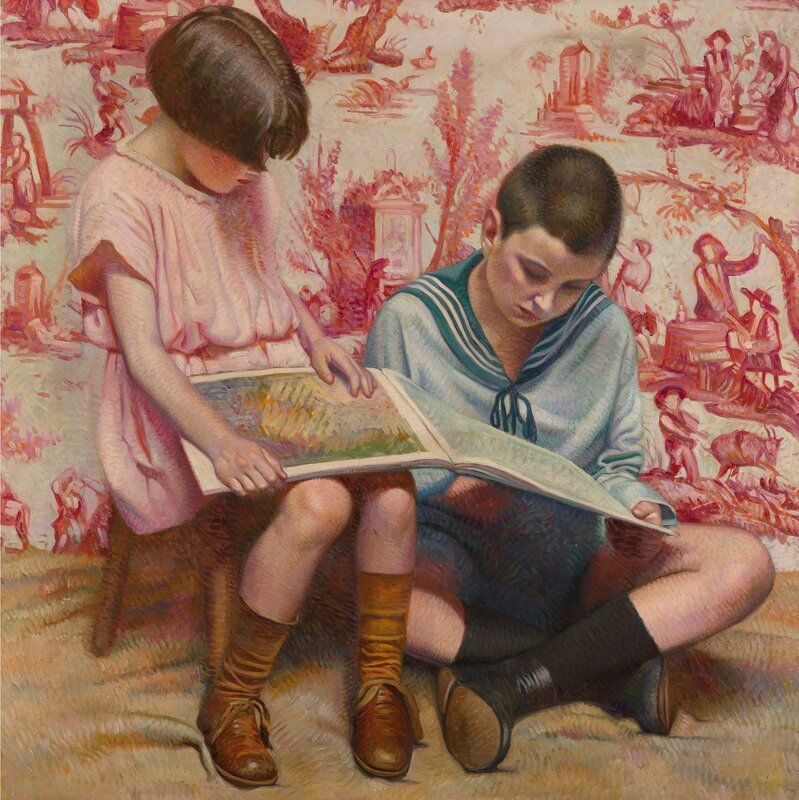
Prolific draftsman and painter, poster artist, columnist, magazine director, three times exiled, defender of classical art (like Romanesque) and of crafts (of the craft), he could never free himself from a century where modernity could not help but impregnate his brush. I think I come to the conclusion that his criticism of non-realists is, deep down and subconsciously, his way of criticizing a reality that is too dynamic. The twenties and thirties were certainly difficult to process, and the desire to return to the stillness of objects (humans also understood as decorative objects) is understandable. He tries to imitate the Dutch, especially Vermeer, or Sisley's impressionism, but without further pretensions. A condensation of Catalan "seny" and "rauxa" that, for any foreign visitor, would seem like an exhibition by three different authors. That's why I say it's a recommended exhibition for locals. Outside of us, it might be difficult to understand the hat with three perfectly placed shadows at the end of the exhibition. Sanity, outburst, and... what would be the third? I believe it would be, if we take Elias as an example, cynicism. A way like any other to survive.
Add The New Barcelona Post as your preferred Google source for free
Stay informed with the latest news.
