
82,000 tons of goods transported and 3,000 tons of CO2 saved. This is the balance of the first year of the intermodal route that XPO Logistics launched in autumn 2022 between Barcelona and the Italian port of Savona. It did so by combining road, sea, and land transport with Barcelona as its epicenter, contributing to the strengthening of the city as a logistics hub in Southern Europe.
The maritime route between Barcelona and Savona is the common point where hundreds of goods converge, arriving in the Catalan capital either by road or by train. Then, they cross the Mediterranean aboard vessels with capacities reaching 500 semi-trailers and close to 70,000 tons, to then arrive on Italian soil and continue their journey either by train or road. And vice versa, to be distributed throughout Europe.
With sustainability as its guiding principle, the logistics company chose to operate this route with Grimaldi's hybrid vessels. It is aboard one of them, the ECO Livorno, where the general director for Southern Europe and Morocco of XPO Logistics, Massimo Marsili, presents the annual balance. And he does so docked at the Port of Barcelona without contributing to the city's pollution, as the ship emits no emissions while in port.
In fact, it is the first zero-emission vessel while docked operating in the port of Barcelona, as highlighted by the CEO of Grimaldi Logística in Spain, Mario Massarotti. He said this from the ship's bridge, also alongside the president of the Port of Barcelona, Lluís Salvadó, and the ship's captain, Salvatore Cacace.
"We are on the vessel of the future," proclaimed Salvadó, who praised ships that prioritize innovation and emission reduction. In this regard, he recalled that the Port of Barcelona is working on the electrification of its docks, and emphasized that it is collaborating with the Grimaldi group to put into operation next year the first electric vessel supply point at the ferry terminal.
Preparing the electrical grid for a ship's supply requires "a quite significant infrastructure on land," warned Massarotti. He considers this a challenge for any port, because "it seems simple, but it is not." He sees it as unavoidable to advance in sustainability, as well as to invest in sea highways, through which people and goods circulate.
Given the shortage of drivers, multimodal transport
Marsili agreed that "sustainability is a key element" and that advancing in emission reduction is an obligation. For this reason, XPO explores new projects and possibilities, such as the use of alternative fuel HVO, and has revealed that it is studying initiatives in collaboration with Amazon.
"Multimodal is already very important for us, and it will be even more so," Marsili predicted. And it will be for sustainability, but not only for this reason, since multimodal transport can be the solution to a problem facing Europe: the shortage of professional drivers, which affects all European countries and is expected to increase in the coming years.
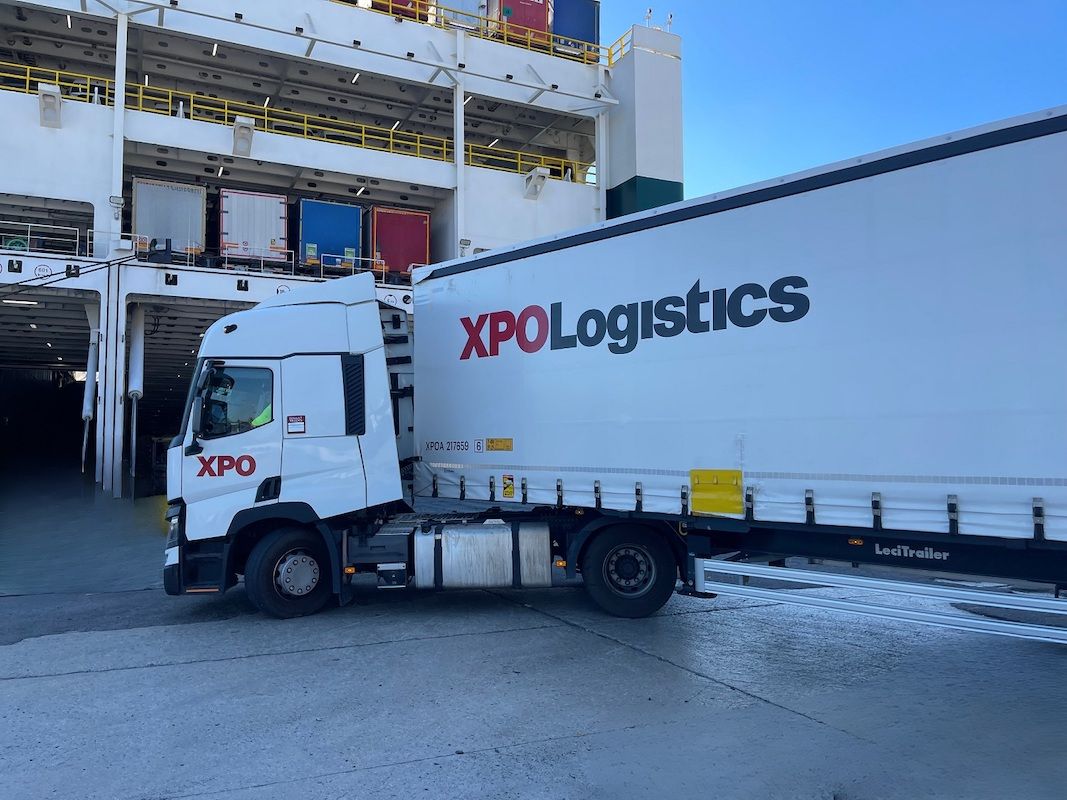
The shortage of professional drivers affects all European countries, and multimodal transport can be the solutionIn addition, to synchronize these routes by sea, asphalt, and rail, XPO uses a type of semi-trailers that adapt to the three transport modalities. With a greater capacity than other vehicles, P400 semi-trailers contribute to maximize efficiency and sustainability, and they do so with sea departures and arrivals from Barcelona to the world.
Add The New Barcelona Post as your preferred Google source for free
Stay informed with the latest news.
