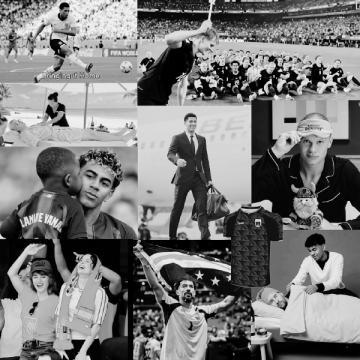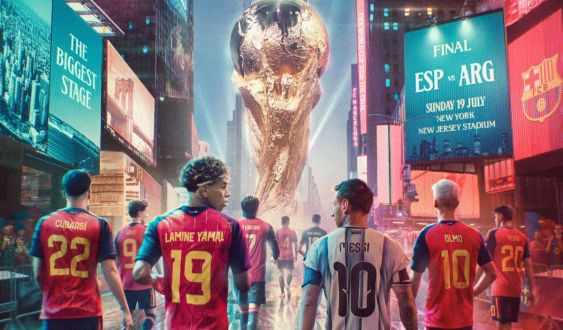
Last night, Barcelona had its eyes on New York. Well, actually on New Jersey. And not because Americans have a special gift for packaging any sporting event with a great show —which they do— nor because La Roja is precisely a team that awakens unanimous fervor among Barcelonians, but because in the World Cup final between Argentina and Spain, Barça was very present. And Barcelona too.
It was very present, of course, because of Ferran Torres' goal, which marked the victory of the Spanish national team. But also because eight Barça players were part of Spain's squad and because, on the other side of the field, was Leo Messi. And despite the fact that the great photograph many expected —Messi against Lamine Yamal— ultimately did not end up defining the match, it did keep the culé spirit alive, nostalgic and with opposing feelings; and that is also very culé.
In fact, close to 30,000 people followed the final from the giant screen installed at the Fórum. And to this figure should be added the thousands of people who watched it from home or in bars. It was enough to open the window and listen. Or return home after the final whistle and find a city spontaneously celebrating in the streets. An euphoria that, on a global scale, had 2.2 billion people in front of the television worldwide, sharing one of the most followed sporting events on the planet.
But what millions of people saw on Sunday is also the result of an industry with a long tradition and talent deeply rooted in our territory. An industry that, moreover, has an enormous economic weight. In fact, according to the report El fútbol que mueve Barcelona (The Football that Moves Barcelona), prepared by the Barcelona Chamber of Commerce, the football industry generates 1,521 million euros annually in gross added value in Barcelona and sustains 27,822 full-time jobs.
This impact, by the way, stems from a direct expenditure of 981 million euros within the Barcelona area and a tax collection of 311.9 million euros by public administrations, derived from the clubs' operations, payroll, service contracting, match day activity, and consumption associated with fans and families linked to football. Specifically, 242.6 million euros, 77% of the total, come from personal income tax (IRPF) and Social Security contributions, VAT linked to club activity and match days represents 66.7 million euros, and local fees and taxes add another 2.6 million.
Most of the impact of the football industry in Barcelona, of course, corresponds to FC Barcelona, responsible for about 1.3 billion euros of gross added value. According to the Chamber of Commerce study, Barça supports 23,726 jobs and contributes 271 million euros annually in taxes. It is followed by RCD Espanyol, with 201 million euros, 3,689 jobs, and a tax return of 36.8 million euros.
But the report also highlights the role of local clubs. UE Sant Andreu generates 5.7 million euros and 100 jobs; CE Sabadell, 5.2 million and 92 jobs; CE Europa, 5.1 million and 92 jobs; FC Terrassa, 3.5 million and 63 jobs; and CE L'Hospitalet, 3.4 million and 60 jobs. Despite having much more modest budgets, the study emphasizes that these clubs have a particularly relevant impact on commerce, restaurants, and mobility in their surroundings thanks to the recurring influx of fans throughout the season.
But these figures only tell part of the story. The other part forces us to look outwards. FC Barcelona has been, for decades, one of the city's great international ambassadors. Match days and visits to the Spotify Camp Nou Experience, for example, attract more than 1.3 million international tourists each year, generating more than 1.4 million overnight stays in Barcelona.
Barça match days and visits to the Spotify Camp Nou Experience attract more than 1.3 million international tourists annually
It is not only, therefore, a football club; it is one of the main gateways to the city. It is responsible for 5% of the tourism that arrives in the Barcelona region. It is the first word we are answered with worldwide when we say we are from Barcelona. Brief and direct: "Barça?".
It is what makes us "this city that bears the name of our club," even if it is a slip of the tongue. And it is, of course, responsible for the fact that when the world looks at football, it often also ends up looking at Barcelona. And yesterday was no exception.
Add The New Barcelona Post as your preferred Google source for free
Stay informed with the latest news.