[dropcap letter="L"]
iteral floral motifs, the structure of domes or the shapes of waves may seem like recurring topics in painting, destined to have no further journey. But in the hands of Najia Mehadji (1950) they become something else. If anyone flees from the commonplace, it is this Franco-Moroccan artist, who lives and works between Paris and Essaouira. The retrospective dedicated to her by the Museum of Modern Art of Céret, La trace et le souffle ("The trace and the breath"), is a breath of vividness and intensity: a power that is expressed through the fixation on architectural structures, the plant world, the folds and plays of clothing and waves. Full of authenticity, she is capable of endowing all these elements with a renewed vibration, a rhythm that surprises and shakes. The journey through the 150 pieces that make up the exhibition seems to take the visitor by the arm and want to make them spin and dance like Camille Claudel's sculpture, La Valse, which serves as inspiration for some of her paintings.
To explore and understand the skill of the artist's inspiring motifs is one of the great values of the journey proposed by the exhibition, which can be visited until November 4. Curated by the director of the Museum of Modern Art of Céret, Nathalie Gallissot, this is the first retrospective dedicated to Mehadji. Despite being little known in Spain, she has an extensive career and work distributed in prominent public and private collections, and in museums such as the Centre Pompidou and the Arab World Institute in Paris or the Mohammed VI Museum of Modern and Contemporary Art in Rabat. Four years ago, Ceret had already discovered a part of Mehadji's work with the exhibition Le peintre et l'arène.
It is a work that is imbued with references from East and West, to which it pays tribute and spreads through multiple rediscovered techniques and forms. The exhibition manages to reflect the internal coherence of her production. Taking the thread of the influence exerted on her by Le Corbusier's architecture and oriental architecture, old drawings are exhibited (of a mosque in Algiers, of the Alhambra in Granada, of the Basilica of Santa Sophia...) that allow contemplating the paintings of the Franco-Moroccan artist with more perspective. Later, a painting by El Greco (The Disrobing of Christ); the films Ordet (by Carl Theodor Dreyer) and La danse serpentine (by the Lumière Brothers), the dance of the dervishes (a Turkish dance where they dance on themselves until ecstasy) or the sub-Saharan gnawa soul music will appear. Such are the diverse artistic relationships she establishes, where, as can be seen, movement and the folds of clothing stand out. These are her vital constants. With very particular skill and a firm step, her pictorial universe delves into capturing the dynamism of movement. A movement that often rises with symbolic, spiritual meaning, breathing voluptuousness on all sides.
Mehadji makes good on the phrase of the philosopher Gilles Deleuze: "in art it is not about reproducing forms but about capturing forces."
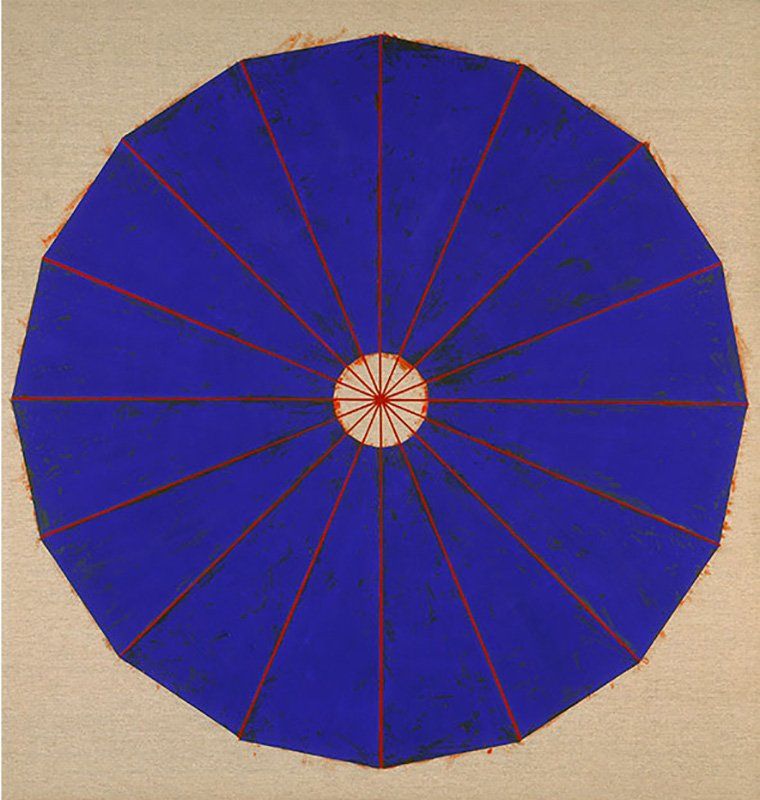
Everything seems to have its meaning and reason in Mehadji. In a video at the end of the exhibition, the artist herself explains that she created a series of dome paintings as a result of the impact of the Bosnian war in the 90s. Attracted by the drawing of lines in space, the relationship between volumes and the forms of nature, the first part of the exhibition plays with domes, rhombuses, planes and surfaces within the painting, and squeezes all the juice from floral forms, as a symbol of beauty and also of the fragility and brevity of life. Blues, reds, yellows, maroons, blacks... Often they are strong colors, occasionally sparse. She plays with your gaze, with the effects of perspective, and invites you to look and find new centers of attention, where it seemed they did not exist.
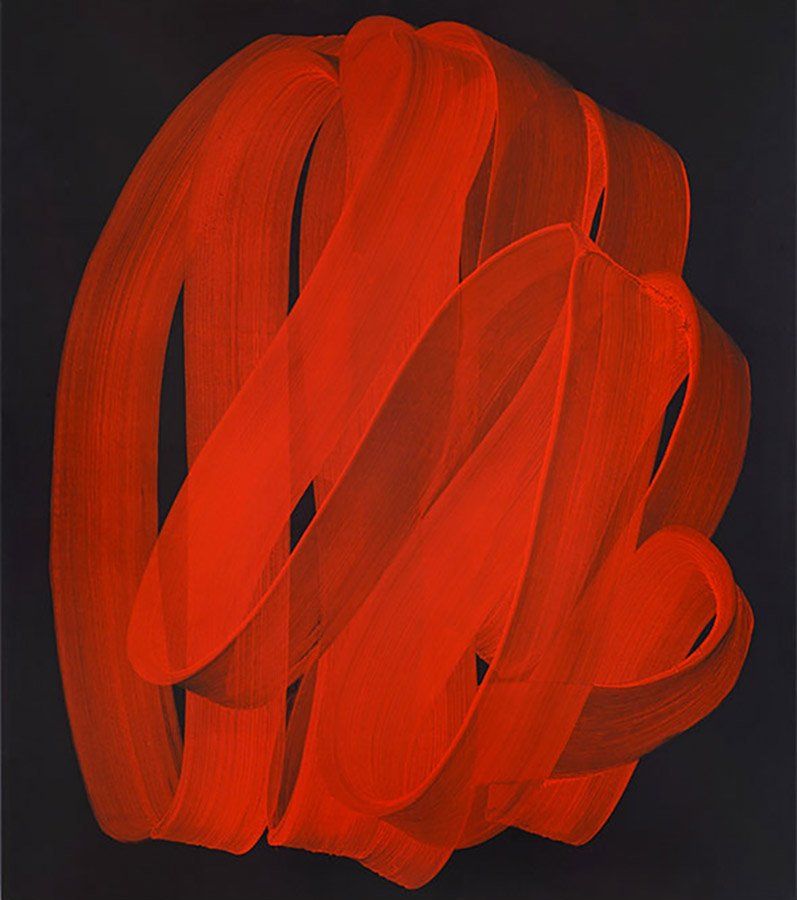
The different series (of domes, of flowers, of waves...) encapsulate within themselves a movement and a meaning that grows and branches out. For example, in the series dedicated to the pomegranate flower, a mystical and mythological flower of Asian origin, it achieves spectacular results. The same happens with the wave paintings -often with incisive titles-, where you have no choice but to become engrossed in the force of a precise and enigmatic gesture at the same time, of an exultant naturalness. Mehadji makes good on the phrase of the philosopher Gilles Deleuze: "in art it is not about reproducing forms but about capturing forces." This becomes especially manifest in the series of wave and bud paintings, of a hypnotic magnetism. This succession of paintings, perhaps the most surprising of all, pushes the sensation of movement to the extreme, as if density, speed, and depth never stopped moving within the painting, as if it were not a fixed object within an exhibition hall. Mehadji acts like a child who takes a ribbon and keeps making it go up and down capriciously with ever different effects and impacts: the contorted forms, the vitality bursting or drowned, give it a kinetic energy that changes direction in each canvas. The Suite Goyesque, dedicated to the disasters of war, with a burnt yellow color, seems to depart from this ensemble, but it is of a disturbing forcefulness.
Amidst so much dynamism, it is perfectly understandable that, to close the exhibition -and at the suggestion of the center- Mehadji chose The Sardana of Peace by Picasso as the piece from the permanent collection that connects with her work. One more example of the free spirit that acts as a motor. And a reminder for those who do not know the Museum of Modern Art of Céret: it houses pieces by prominent artists who passed through the capital of Vallespir, such as Picasso, Manolo Hugué, Arístides Maillol, Miró, Juan Gris or Marc Chagall. Mehadji's exhibition is open until November 4.
Add The New Barcelona Post as your preferred Google source for free
Stay informed with the latest news.