[dropcap letter="L"]
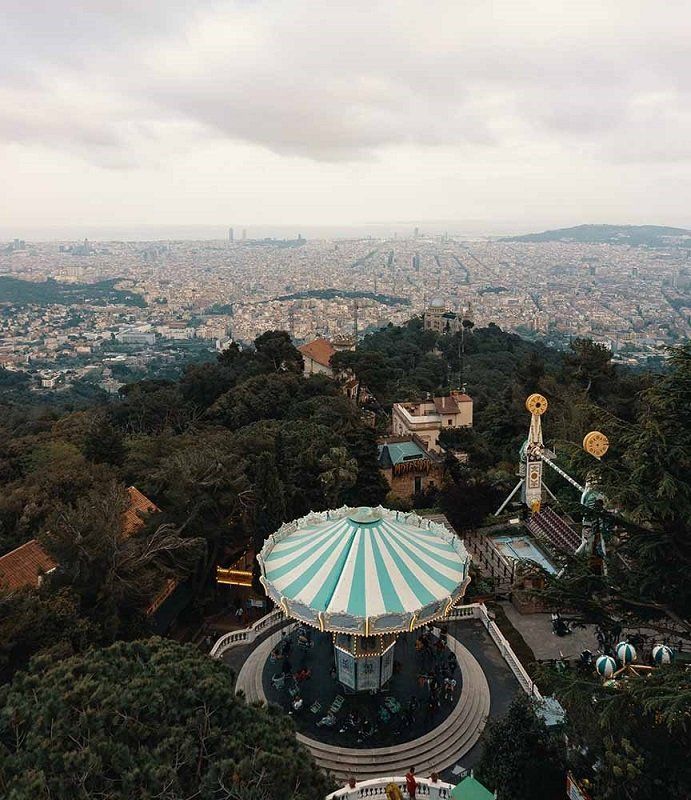
he vision one has of Barcelona is a horizontal vision sustained by the grids of the Cerdá plan that project the illusion of a flat city, harmonized by a controlled and measured height that cannot surpass the Sagrada Familia. The most powerful image to understand Barcelona's inclination for "small dimension" is the Illa building, a work by Rafael Moneo and Manuel de Solà-Morales, two renowned architects who won the FAD award in 1994. The building is a horizontal skyscraper that seems to want to rise but cannot, nor are they allowed to. This limit on buildable height is an approach that forces the city to expand horizontally and to renounce architectural verticality.
The "Porcioles era" was a period in the city's history when mayor José María Porcioles determined a vertical city project, allowing more floors to be built upwards and downwards from buildings. Terraced and cantilevered homes were built in the middle of the eixample, clearly visible attics were erected as added volumes to the original buildings, a result of an uncontrolled speculative building policy that became popularized with the phrase "A l'Eixample li surten barrets" (The Eixample is growing hats). These were times when Barcelona coexisted with shantytowns and an urban planning policy without control or aesthetic criteria, based on making the city grow without paying attention to adequate future development.
The figure of Porcioles went far beyond the merely political, as historian Martí Marín well summarized by stating that he was "more than a mayor, less than a minister." The strategy of action carried out was based on the "letter of marque" justified as the only way to bring Barcelona out of the past to orient it towards the future with initiatives such as the Municipal Charter of Barcelona. Porcioles' permissive and erratic vertical Barcelona has consolidated the interpretation of the notion of verticality as a negative and speculative aspect. The apprehension and rejection of the vertical city are motivated not only by urban planning reasons, but also by symbolic and social reasons. A skyscraper is perceived as a tower from which only the privileged can access its elitist penthouses, which sends a message of a city that has "an up and a down," that bases its constructions on speculation, corrupting the public. However, this negative vision could be contrasted with a positive one that would be the representation of skyscrapers as a reflection of technological potential, innovation, or as a new, more efficient and sustainable way to take advantage of the lack of buildable space.
It was during the projection of Olympic Barcelona when the ideal of limiting the maximum buildable height to 150 meters was set. Horizontal Barcelona has always triumphed over vertical Barcelona.The image of a Barcelona without skyscrapers is part of a widespread belief in the Mediterranean as a model city, as also happens in Rome or Athens. In the opposite direction, there are cities like New York, London or Madrid that have based their model on verticality. In current Barcelona, buildings barely exceed 150 meters in height: the well-known Agbar tower is 144 meters high, the Mapfre tower rises to 154 meters and the central tower of the Sagrada Familia will reach 172 meters in height once finished, one meter less in height than Montjuïc mountain. The only exception to this approach is Norman Foster's Collserola Tower, which reaches 289 meters in height. In Madrid, the tallest building is Torre MNN1, with more than 250 meters, followed by Torre de Cristal with 249 meters, Torre CEPSA with 248 meters, Torre PwC with 236 meters, Torre MNN2 with more than 230 meters, Torre España with 232, Torre Espacio with 224 meters and Torre Picasso with 156 meters. It was during the projection of Olympic Barcelona when the ideal of limiting the maximum buildable height to 150 meters was set. Horizontal Barcelona has always triumphed over vertical Barcelona without, until today, a public debate having taken place that allows posing the following question: can 21st century Barcelona afford not to project itself upwards when it has so many problems generating an effective metropolitan area?
In recent weeks, from different forums and in several articles, it has been suggested that it would be good for Barcelona to open the debate on the vertical city as a possible model to be able to advance towards a more modern and competitive city. The reasons that operate require making the construction of new buildings more profitable, such as the possibility of granting licenses to raise new floors in already constructed buildings. Faced with this proposal, the opposite is given, arguing that a vertical city implies a city that draws in the citizen's imagination the idea of greater social inequality, greater speculation and favoring the most privileged. There are also those who wield aesthetic reasons and cultural tradition closer to small spaces, to the city that can be encompassed with the eyes by raising one's gaze only a little.
The Sagrada Familia project for 2026 states that in 2022 the basilica will reach 172.5 meters; therefore, it is not surprising that the economic world looks towards the sky observing how the temple rises in order to also contemplate how its buildings rise. The news that the Sagrada Familia will grow should allow opening the debate on the new Barcelona if it wants to consider the viability of making more city compatible with better city.
Add The New Barcelona Post as your preferred Google source for free
Stay informed with the latest news.