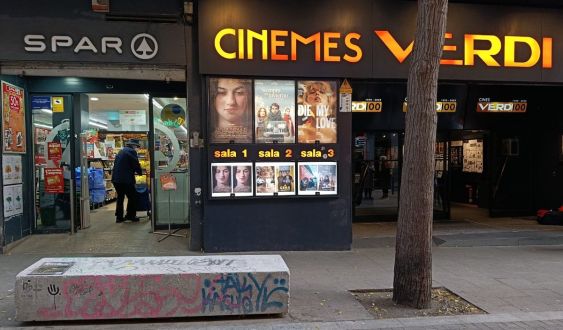
A supermarket in Barcelona will close and be converted into movie theaters. Yes, like that, and not the other way around, as is usually more common. While large chains tend to gain ground over historic spaces, this time the phagocytosis is in reverse: the Verdi Cinemas will create two new screens in the space currently occupied by a supermarket of an international chain.
"It had always been a dream, and in the centenary year we are going to do it," celebrated the head of Cines Verdi, Paz Recolons, at the presentation of the cinema's 100 years from one of its screens. The premises to be expanded are owned by Verdi; it is currently rented, and the lease will not be renewed, something that supermarket workers have explained they view with resignation.
They still do not know if the supermarket will move to another nearby location to make way for the Verdi expansion, with works that will begin in February — coinciding with the anniversary — and are expected to last until October. With the works, the cinemas will go from nine screens to eleven, and will gain 200 seats to reach 1,750. This commitment to growth comes after a 2024 in which its audience increased by 30%, to 500,000, in contrast to the general 1.3% reduction in the sector.
The expansion will be just one of the elements celebrating these 100 years of activity, as explained by Adolfo Blanco, CEO of A Contracorriente Films, which has managed Verdi for ten years. From screenings to exhibitions, a book, and a documentary, the centenary seeks to reach the public and highlight its trajectory and auteur cinema from multiple angles. Also from the most unpredictable: together with the Filmoteca de Catalunya and other collaborators, they are working to restore the first film screened at the Verdi: Los náufragos del destino.
"It's a film that no one has seen. There are restorable materials, and it seems to be on the right track and that we will be able to see it. Surely we are not talking about a great classic of cinema, but it could be a great classic of the city, because it was the first one seen in this theater," Blanco highlighted. And the fact is that what is now the Verdi did not start as a cinema, but as a theater. But the audience was declining and, in parallel, was increasing when a film was screened, which is why its managers decided to make this change, and it reopened on February 11, 1926, under the name Salón Ateneo Cine. The conversion into a multiplex, gaining more screens, came years later, in 1981, with the impulse of Enric Pérez, who adopted an approach that favors European auteur cinema and original version, to the delight of cinephiles who are attracted by a program that does not disappoint.
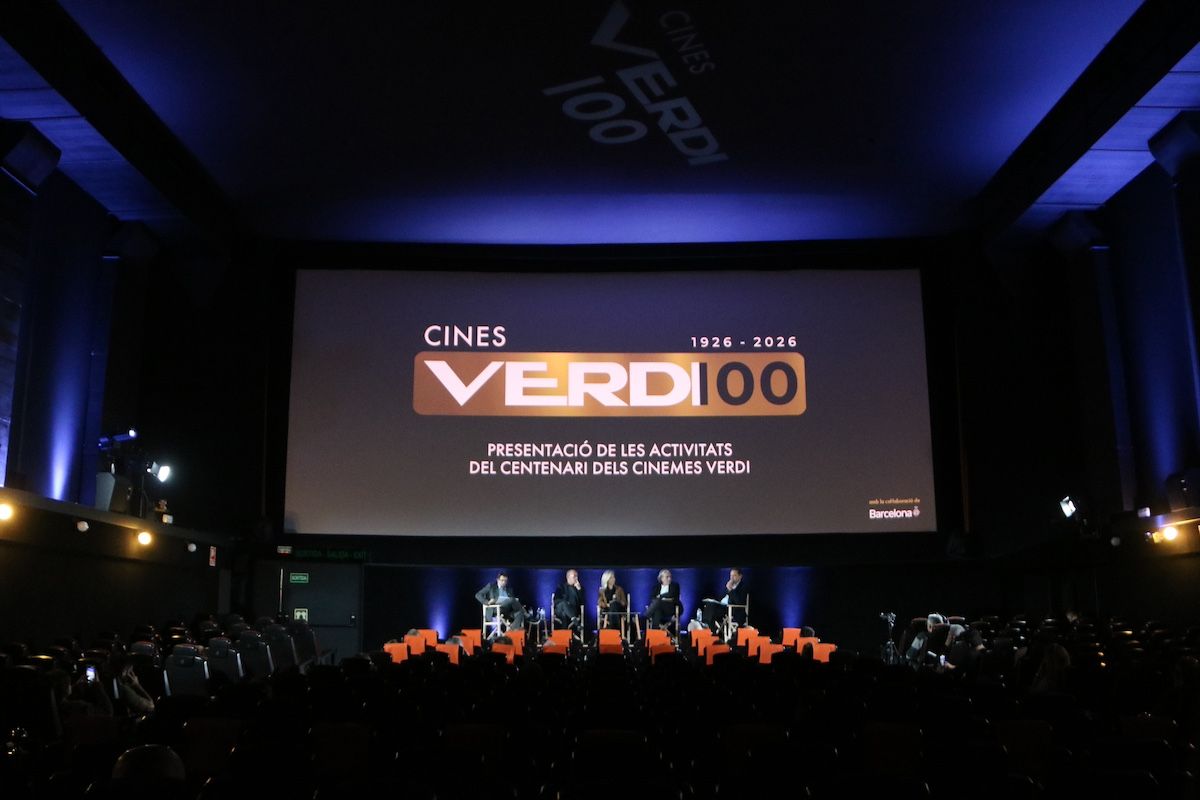
All this history will be compiled in a book with Plataforma Editorial, which will review a history and evolution that has progressed in parallel to that of the surrounding neighborhood. It is a history with bumps and crises, which have led it to the sweet moment that the Verdi is now experiencing, and which will also be celebrated through a program of free screenings in Barcelona libraries; with an exhibition in the Jaume Fuster library, located in nearby Lesseps, and with hundreds of screenings for school groups, to make them "fall in love" with the world of cinema.
Another highlight of the centenary will arrive, of course, through the big screen. It will do so with a feature film with documentary touches that, with the Verdi as a common thread, aims to be a tribute to cinema and the stories it generates. Directed by Berta García Lacht with the name La vida es Verdi, the documentary has been co-produced with Isabel Coixet, with the aim of reflecting "the cinephile footprint left by an establishment like the Verdi."
The feature film, which will premiere on February 10 as the kick-off to the anniversary, features unexpected faces —or not so much anymore—, such as Richard Gere. The famous actor visited the cinema in May, within the framework of the Barcelona Film Fest, a festival that this year will precisely feature the Verdi, also within the framework of this centenary. And the celebrations do not end here: the anniversary will have its role in the Gràcia festivities, the Verdi Classics "will reappear in some way on the small screen", and many novelties that will celebrate the anniversary for a whole year, until February 2027.
"The core of Gràcia"
The Verdi have reached their centenary being not only a cinema, but also acting as a "distributor and producer, and promoter of a festival that contributes to placing Barcelona in a cosmopolitan logic," highlighted the Councilor for Culture, Xavier Marcé."This set of distribution, programming, and love for cinema elements gives Verdi many years of future," emphasized Marcé, who remarked that "celebrating a centenary is not just an event, but a test of endurance."And this endurance acquires additional value in an environment as dense and sought-after as the Gràcia neighborhood, as highlighted by Edgar García, director of the Catalan Institute of Cultural Companies of the Generalitat. After recalling his visits to the Verdi cinemas —especially for the late-night session after dinner and before a drink—, he valued "the Verdi's gaze towards independent cinema, European cinema, and auteur cinema," a gaze that has been maintained this decade with A Contracorriente.
This location of the cinemas in Gràcia has marked the Verdi and this gaze, and at the same time, "Gràcia cannot be understood without the Verdi; they are a fundamental part of the neighborhood," praised Ignasi Camós, general director of the Institute of Cinematography and Audiovisual Arts (ICAA) of the Ministry of Culture. Camós, born precisely in Gràcia, went further: "The Verdi is the core of the neighborhood, it represents more than a cinema. It is a great refuge for lovers of the seventh art, a paradise for cinephiles, and a clear example of a will to care for auteur and European cinema."
Add The New Barcelona Post as your preferred Google source for free
Stay informed with the latest news.
