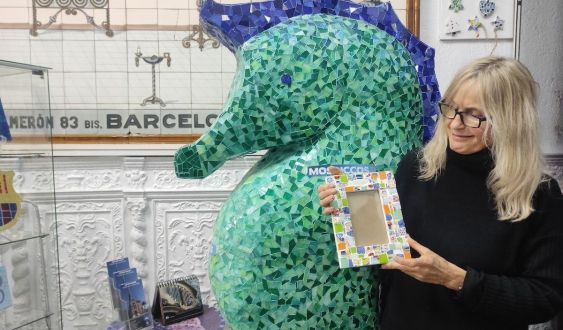
The first time Angelika Heinbach visited Güell Park, she was about twenty years old, and she left that fabulous enclosure with an image etched in her retinas. The brilliance and color of the relief that shapes a dragon, the benches to sit on, and the columns of the unique space left her impressed. And they were nothing more than pieces of broken ceramic glued together in a disordered way, and she wanted to learn that technique.
First, self-taught, and then in mosaic and trencadís courses, Angelika consolidated her mastery of knowing how to shape fragments of tile, glass, or plates. She has always done so driven by her admiration for modernist architectural works made with this technique that gave wings to Antoni Gaudí to achieve the undulating forms of his structures.
In fact, with trencadís, many things that Gaudí surprises us with are learned. The great common sense he applied to his creations, in this case taking advantage of broken materials, is a way of working that draws from the same source as other practical and sustainable solutions by the architect. For example, the hyperbolic paraboloid, one of Gaudí's geometric secrets, and so many other formulas inspired by mother nature.
Well, in the trencadís of Güell Park, Angelika's inspiration was born to, years later, teach this system for decorating on a small or large scale. Artistic creation was not unknown to her. At home, as a child, she saw her mother paint silk and, although she opted for languages and translation, everything she felt in Barcelona prompted a change of course in her.
"It was the year of the crisis, 2008, when I lost the job I had in a multinational company," she explains. And then, delving into what we could read as a metaphor, in that, apparently, fragmented future, she thought: "Now is the time to try if I can build something with everything I have learned about trencadís." And so, from the crisis and the break with a stable job, she made her opportunity. She created the firm Mosaiccos to work with trencadís as an artist and, very soon, also as an organizer of workshops: "I made my passion my profession."
With trencadís, Angelika not only takes advantage of waste from tiles, glass, or various ceramics, but also what she learned working in large teams for multinational companies. The cohesion of these employees could be enriched by sitting at the same table, figuring out how to compose a small work of art.
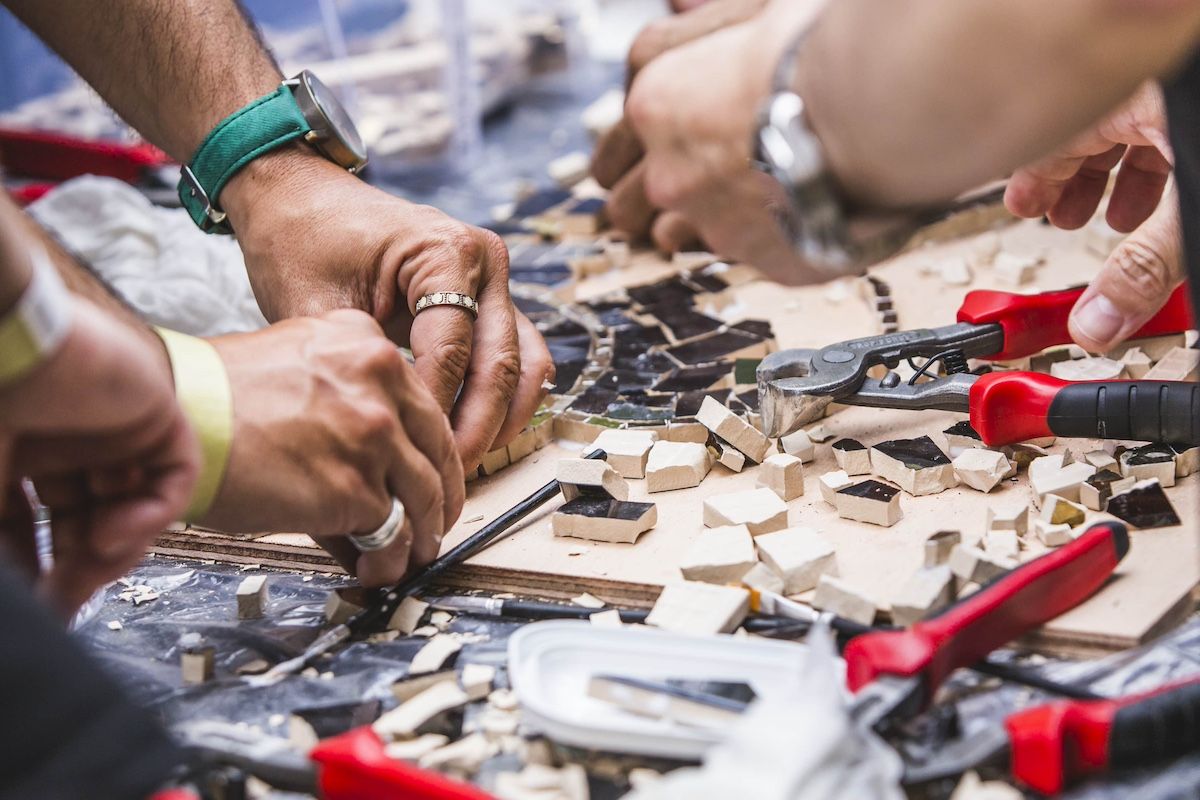
She set up a space in her shop in the Born neighborhood with a large table to host small groups of friends, families, or work teams. Currently, she has two workshops, one in the Born, with capacity for about fifty people, and the other in La Ribera, near the Palau de la Música, for 35 people: "But we go wherever, hotels, the Llotja, the Torre de Bellesguard, the Colònia Güell, La Pedrera, many emblematic places, wherever the client chooses." Normally, what they call team building, the playful or creative experiences to foster group cohesion, are carried out in these special places or in the companies' own facilities.
Tourists who make their own souvenir
Social media has made Angelika's workshops well-known among German tourists and many other nationalities. This is the type of tourist who seeks what is different, more original, or characteristic of the place they visit. In this case, Catalan modernist architecture, of which Gaudí is the great reference, is the point of connection with the trencadís workshops. In them, foreigners sit down to emulate these artists whom they also admire.
Protective glasses, pliers, and a wide variety of colored ceramic pieces await them on the table so they can make their own souvenir of this city. "Many groups of Catalan people also come, families or friends celebrating one of their birthdays," Angelika specifies.
"Photo frames are the most chosen object for working on trencadís in a piece that they will then take home finished," she says. And, in the case of children, she points out, "animals, like the salamander, dogs and cats, or the elephant, are what attract them most." Workshops like these are a space to take time for oneself, to create, seek inspiration, try how a craft helps us to pause, to concentrate on the present moment, and to relate from another perspective with family, friends, or co-workers who are nearby doing the same as us.
For those who have come from outside, this tasting as artists also means a space for cultural exchange. With the trencadís, they immerse themselves in the way of doing Catalan modernism. Taking advantage of glass, broken plates, mirrors, they give new life to these materials that, otherwise, would be lost.
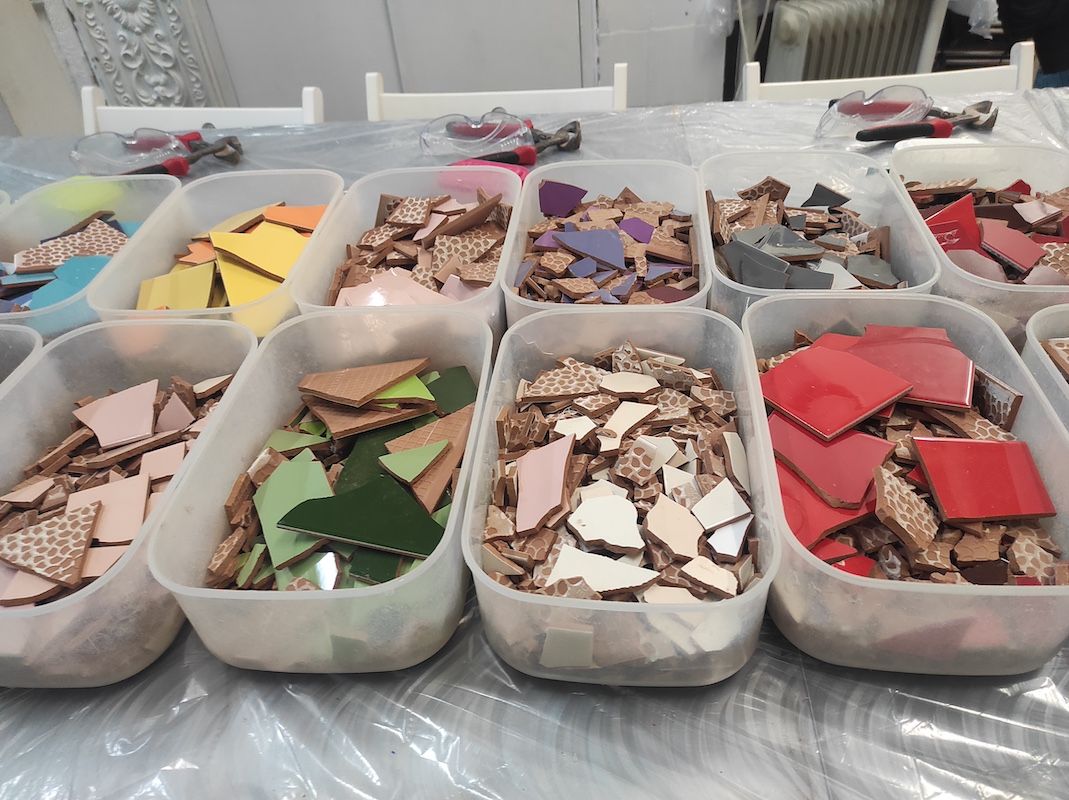
Magnets for the fridge, small boxes for storing small items, photo frames, company logos, sports team shields or participants' names are some of the new lives that emerge on the table, while other things also happen.
Before starting, Angelika explains to the participants the difference between mosaic and trencadís. "Mosaic ---of Mesopotamian, Greek and Roman origin---, is made with regular pieces of glass or ceramic, while trencadís, which I discovered in the works of architects Josep Maria Jujol and Antoni Gaudí, is made with irregular pieces of material," she clarifies.
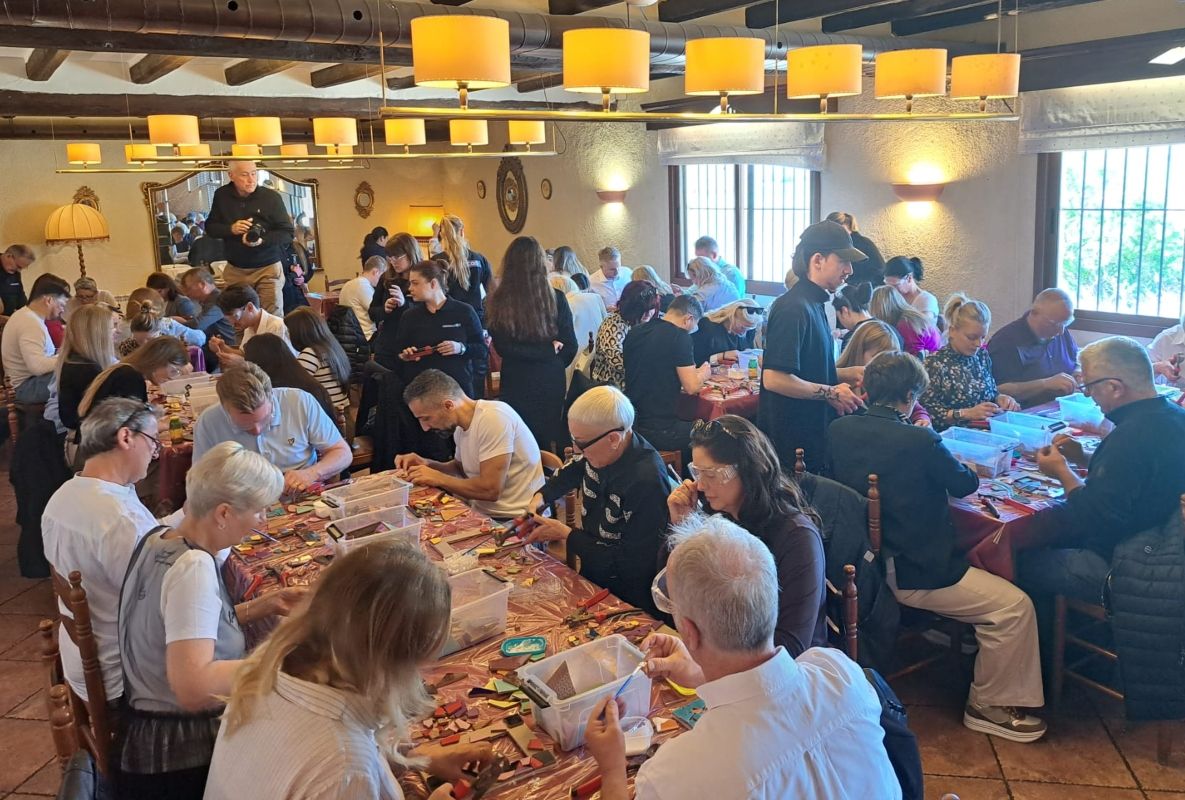
She has had 400 Japanese people making their creations with trencadís. "They greatly appreciate all of Gaudí's work and culture in general, and also the good quality of Mediterranean Catalan cuisine," she comments. "I also fell in love with Gaudí, his work and this city, which offers an exceptional quality of life. It is a magnificent combination of a very beautiful city, precious with its old core and its great cultural offer, and by the sea," she highlights.
"The overcrowding of tourists is good for our businesses, but I understand that when you live in the most crowded places like the Born or the Gòtic, it's not easy," she admits. And she comments that the Born of thirty years ago was very inhospitable, dangerous, but that in the current one, more measures should be taken to prevent robberies. And, although she recognizes that it is not easy, "we should seek quality and sustainable tourism, that people with a cultural level come, and not to get drunk."
Add The New Barcelona Post as your preferred Google source for free
Stay informed with the latest news.
