[dropcap letter="U"]
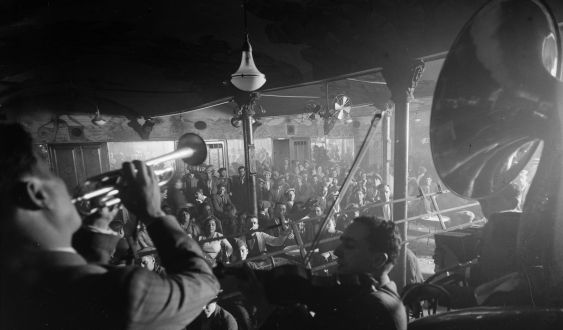
nas weeks before the proclamation of the Republic, during a visit with friends to the Barcelona dancing club La Criolla, Josep Pla wrote in the local's guestbook: "Tenen un cafè ple de vida, que és un gran element turístic i ens fa quedar molt bé" [They have a café full of life, which is a great tourist element and makes us look very good]. It was February 13, 1931. On June 15 of the same year, journalist Sebastià Gasch scribbled the following dedication on the same pages: "Al señor Antonio, cordialíssim amo de La Criolla, l'únich lloch de Barcelona que ens fa quedar bé davant els estrangers" [To Mr. Antonio, the very cordial owner of La Criolla, the only place in Barcelona that makes us look good in front of foreigners]. The allusion, in both cases, to tourist attraction is significant. La Criolla, an establishment that opened its doors in 1925 at number 10 on Calle Cid —almost at the same time that Francisco Madrid invented the toponym Barrio Chino [Chinatown] to refer to one of the most degraded areas of the fifth district of the city of Barcelona, first in reports in El Escándalo [The Scandal] and the following year in the best seller Sangre en Atarazanas [Blood in Atarazanas]—, was a mythical place, visited by Spaniards from all social sectors and by European tourists. In the second half of the 1920s and, especially, in the following decade, La Criolla became the most transgressive, cosmopolitan, and attractive space in Barcelona, where cocaine circulated —the so-called mandanga [stuff] or, if it was of special quality, mandanga chachi [cool stuff]—, homosexuality and transvestism were freely expressed, prostitution was welcome, and dancing between people of the same or different sexes to the frenzied rhythm of a small orchestra was, properly speaking, already a spectacle.
"The ladies and gentlemen standing at the door of La Criolla attracted very little attention. The neighborhood was accustomed to this type of visit, quite a bit of literature had already been written about the purulent aspect of the fifth district, and foreigners and curious locals were received at La Criolla in a normal and correct manner."La Criolla became the center of the tournées des grans ducs in Barcelona. The press and literature fostered this phenomenon. London, Paris, and other European cities had experienced similar situations since the 19th century, which involved a discovery of the urban underworld, degraded and picturesque, with its prostitutes and pickpockets, drunks and stabbings, bad smells and danger. The expression, in French, alluded to the excesses and extravagances of the great Russian dukes in the city of the Seine and was applied to the group of tourists, local or foreign, who, during one night, embarked on a search for exoticism and new sensations in an environment close to misery. Josep Maria de Sagarra, inPrivate life(1932), described such a visit to La Criolla. In one of the passages, he noted: "The ladies and gentlemen standing at the door of La Criolla attracted very little attention. The neighborhood was accustomed to this type of visit, quite a bit of literature had already been written about the purulent aspect of the fifth district, and foreigners and the curious from the country were received at La Criolla in a normal and correct manner." The bourgeois and aristocratic heaven or purgatory were transferred, for a few hours and in a controlled manner —a little fear, however, was essential to complete this search for exciting sensations and anthropological experiments—, to the urban hell. The list of famous visitors is not short. La Criolla placed Barcelona at the forefront of European tourism in the interwar period.
The recent appearance of an interesting book by Paco Villar dedicated, precisely, to the famous establishment that was La Criolla. With the subtitle The Golden Gate of the Chinese Quarter, the author details with detail and entertainment the history of La Criolla, from its inauguration in 1925 until 1938, when a bomb from Italian aviation directly hit the premises. In addition to reconstructing the different stages of the famous dancing —with its regulars, varied shows, and appreciated private room—, Villar elaborates an authentic biography of the sordid Cid street, from its industrial era to that of the apparent splendor of the 1930s, without forgetting the sinister sleeping houses, the very crowded brothels of Manquet, the La Mina tavern immortalized by Juli Vallmitjana, La Taurina —the girl Carmen Amaya danced there—, the Miss Barrio Chino beauty contest, exclusively for transvestites, or the twilight transformists. Characters such as Flor de Otoño or Maruja Guerrero, the Queen of the Chinese Quarter, are also present. It is another Barcelona, which reminds us of years of transgression, joy, and sexual freedom. But it also appears as a convulsive capital, with large slum areas of lacerating misery, which became one of the main Mediterranean centers of white slavery, prostitution, and drug consumption. As the aforementioned Francisco Madrid assured in 1934, La Criolla, along with Cal Sagristà —or Casa Sacristán, on the same Cid street or, as some illustrious Gallic visitors said, del Cid Campeador—, gave more fame to the Catalan city than the International Exhibition of 1929 and its Romanesque museum.
Add The New Barcelona Post as your preferred Google source for free
Stay informed with the latest news.