
Let's place ourselves in Barcelona at the end of the 19th century. The city was experiencing strong demographic growth and medicine was increasingly able to cope with more diseases. All of this meant that the old Hospital de la Santa Creu, located in the heart of the Raval neighborhood ---in a very beautiful Gothic building, but poorly suited for modern medical practice---, had become obsolete and it was decided to build a large hospital complex to serve an expanding city. The modernist architect Lluís Domènech i Montaner was in charge of the project and in 1930, after three decades of work, it was inaugurated with the name Hospital de la Santa Creu i Sant Pau. The Sant Pau refers to Pau Gil, a Barcelona banker and patron based in Paris who, upon his death, single and childless, stipulated that half of his fortune should be used for the construction of a hospital in Barcelona. If you want to know what this holy man with generous sideburns looked like, you will find a bust dedicated to him, a work by Eusebio Arnau and Josep Casan i Matamala, at the entrance of the old hospital.
[subscribe_newsletter_esp]
I say old hospital because in 2009, the Hospital de la Santa Creu i Sant Pau moved again, in this case, to a more modern headquarters located at the northeastern end of the complex designed by Domènech i Montaner. This allowed for the initiation of an ambitious rehabilitation process of the modernist complex which, for some years now, has recovered all the splendor of what is now known as Recinte Modernista Sant Pau.
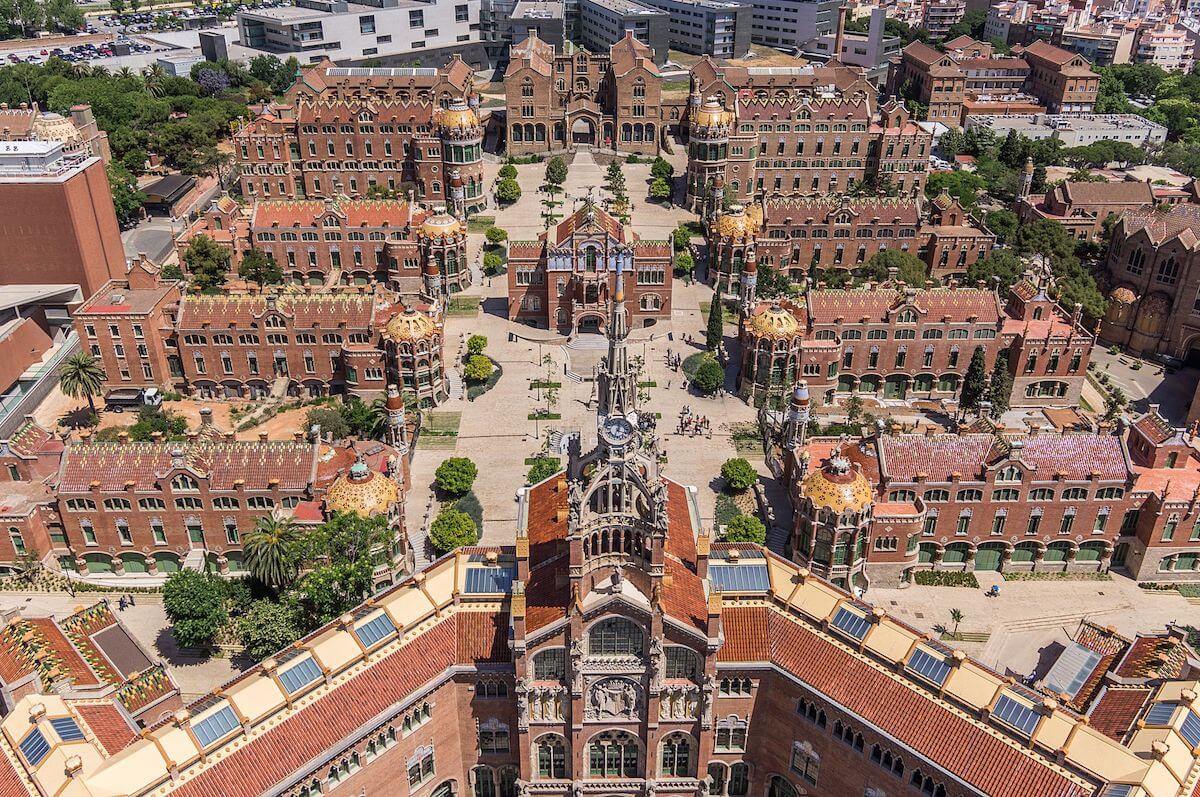
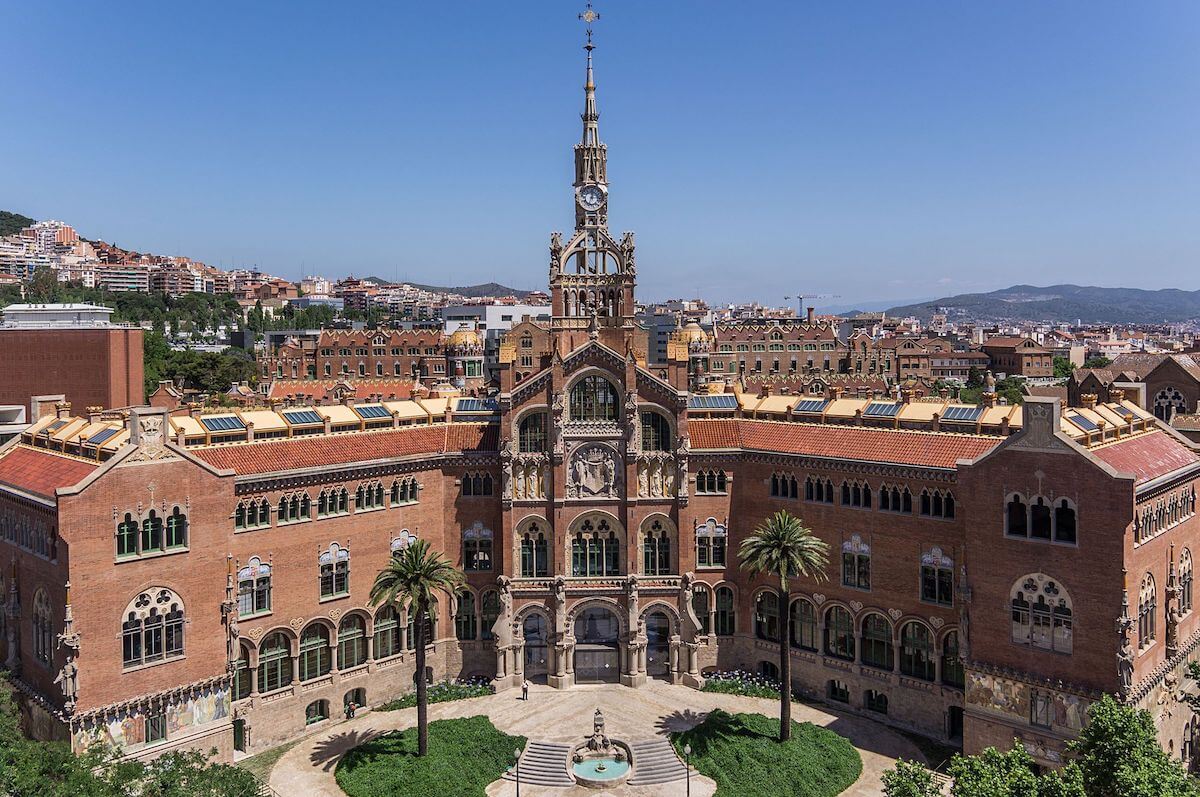
The complex occupies the equivalent of nine blocks of the Eixample. It consists of a majestic main building that housed the hospital's administrative tasks and 27 pavilions for the various medical and nursing specialties, connected by underground galleries through which patients were transported. A large part of the complex is built in exposed brick, perfectly combined with ceramic elements, and decorated with stone sculptural ensembles. Domènech i Montaner incorporates Gothic, Neo-Gothic, Byzantine elements... The Sant Pau has great heritage and artistic value that UNESCO recognized in 1997 as a World Heritage Site.
For me, Sant Pau also has therapeutic properties. If after looking at Twitter for a while you lose faith in Humanity or walking through the streets of Barcelona, repainted with outlandish colors and shapes, you think the city has lost its way, I recommend you go to Sant Pau. It will make you regain confidence in the city and the people who live in it. Now that we talk about vaccines all day, we could say it's an injection of Barcelona self-esteem.
For me, Sant Pau also has therapeutic properties. Now that we talk about vaccines all day, we could say it's an injection of Barcelona self-esteemSince it no longer functions as a hospital, Sant Pau has been opening up to the city. Currently, very interesting guided tours are offered there for the whole family that allow discovering what life was like in this hospital environment at the beginning of the 20th century and also learning about the work of Domènech i Montaner. From the Hypostyle Hall ---which housed the emergencies of the old hospital---, one descends to the tunnels to access the Sant Salvador Pavilion ---the first one to become operational in the entire complex---, then one accesses the gardens and from there to the Operating House and the Sant Rafael Pavilion. The tour ends in the wonderful Administration Pavilion, which alone justifies the visit.
In the same way that, a few years ago, the Glòries Tower ---formerly, Agbar Tower--- became the new icon of Barcelona, it is as if now it were the time of the Sant Pau Modernist ComplexThe Sant Pau Modernist Complex also hosts a good number of national and international organizations working in fields such as rights and democracy, sustainability, and educationand, periodically, it is the scene of events such as 080 Barcelona Fashion. In fact, in recent weeks it has hosted everything from events for La Marató de TV3 and Catalunya Ràdio to the presentation of Joan Laporta as a candidate for the presidency of Barça, as well as events for the 14F pre-campaign.
Just as, a few years ago, the Glòries Tower ---formerly, Agbar Tower--- became the new icon of Barcelona, it is as if now it is the time for the Sant Pau Modernist Site. For some time now, everyone wants to celebrate their events and be photographed there. Perhaps it is a coincidence, but it is nice that, in the midst of a pandemic, this space, which is increasingly a reference for the city, is neither a bank nor a hotel nor a monument that commemorates past battles, but a hospital.
Add The New Barcelona Post as your preferred Google source for free
Stay informed with the latest news.