
A mirror welcomes visitors to the exhibition The Human Image. Art, Identities and Symbolism to warn that everything that will be seen next is no more objective than the image reflected in it, always affected by how each person sees it. It is followed by a video installation by Colombian artist Óscar Muñoz in which his self-portrait is in permanent creation and destruction. Painted with water, the face reveals itself as ephemeral and fragile, surviving only the time it takes to dry.
Under these preambles, the exhibition gathers more than 150 works that reflect on the representation of the human face throughout history and around the world, heterogeneously addressing different ideals of beauty and expressions of divinity and power. Paintings, drawings, sculptures, photographs, and films are superimposed throughout the CaixaForum tour, breaking chronological order and grouping works by artists such as Henri Matisse, Francisco de Goya, Édouard Manet, Luis de Madrazo, and Antoni Tàpies. Bringing together for the first time the British Museum's collection with the contemporary art collection of Fundació La Caixa, the exhibition can be seen until next Sunday, October 22.
Although the periods are mixed throughout the exhibition, one of the first pieces is considered the oldest portrait in history. It represents the skull of a man who lived about 9,500 years ago, completed with plaster to imitate the flesh of the face and accompanied by small shells to cover the eyes. The intention of this piece, one of the jewels of the British Museum, is not clear: it may have been to honor the deceased, but it is also considered that it served to symbolize some ancestral figure.
After this first known representation, it is shown how humanity has wanted to represent the body in its most ideal form, according to the standards of each moment. There are the perfect figures of Adam and Eve made by Albrecht Dürer in the 16th century, engraved following the mathematical proportions established during the Renaissance. But before it had been different, as demonstrated by older female figurines, made with very minimalist or completely voluptuous forms, but in both cases with the aim of speaking of fertility.
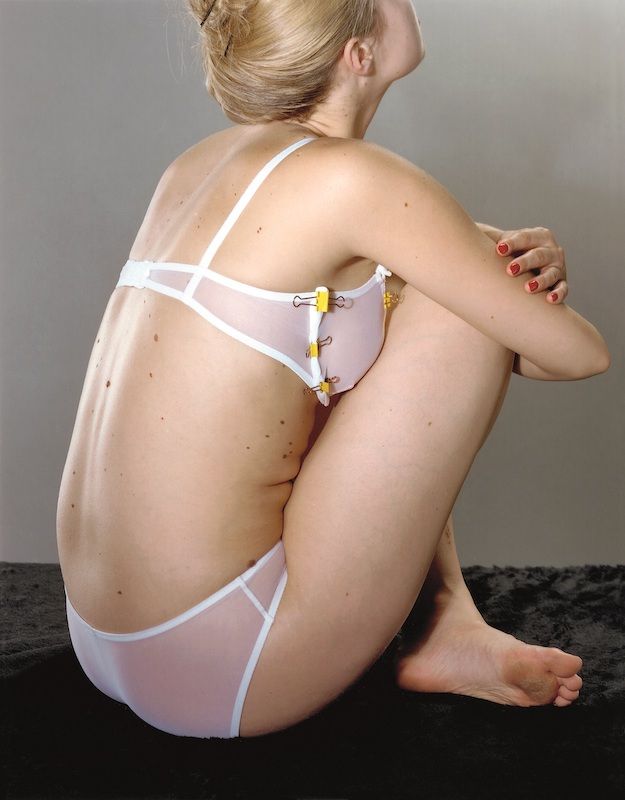
The sensuality traditionally related to the female nude has been contested over time, as in the case of photographer Christopher Williams, showing what remains behind lingerie ads, with a model full of clips to display a fake product. Craigie Horsfield also does it in Eva Saumell, carrer Mansó, Barcelona febrer 1996 with a completely simple and realistic nude, devoid of eroticism. Goya, much earlier, shows in one of his Caprichos an old woman looking absorbed in the mirror, oblivious to the mockery dedicated to her by her surroundings.
Beauty intertwines with power and religion, granting its leaders the most exquisite features, but also humble if necessary, always in an exercise of propaganda. Curious is the portrait of Isabella the Catholic made by Luis de Madrazo centuries later to highlight the then Queen Isabella II and link her to tradition, given the weakness of her throne. But propaganda was already being done in the Roman Empire, with Emperor Marcus Aurelius placing his sculptures throughout his domains to remind of his power, a formula followed much later by Mao Tse Tung in China. The modern version is not missing, with badges of US presidents Barack Obama and Donald Trump.
If it happens with politics, it is also done with religion. Among many traditional images, though no less surprising, such as footprints representing Buddha, stands out Black Madonna with twins by Vanessa Beercroft. It is an adaptation of the typical Christian iconography for believers in South Sudan. In it, a Virgin Mary is represented by a local woman dressed in red, leaving behind the white madonnas dressed in blue.
Prejudices, the result of enslaving standards, are an intrinsic element in any representation. Challenging the precepts that a woman has to be sensual or that the Virgin Mary has to be white, the CaixaForum exhibition delves a little deeper to continue dismantling them. It does so by questioning the ideal of power through medals with Napoleon's death mask, his greatness already lost, relegated to being, simply, another mortal. It also highlights the shame of a racist society, with eight low-resolution photographs of blurry and unrecognizable faces in which only beards and veils can be distinguished. The piece by Iranian Taraneh Hemami, Most Wanted, is based on images from the United States Government of people suspected of terrorism.
Add The New Barcelona Post as your preferred Google source for free
Stay informed with the latest news.
