
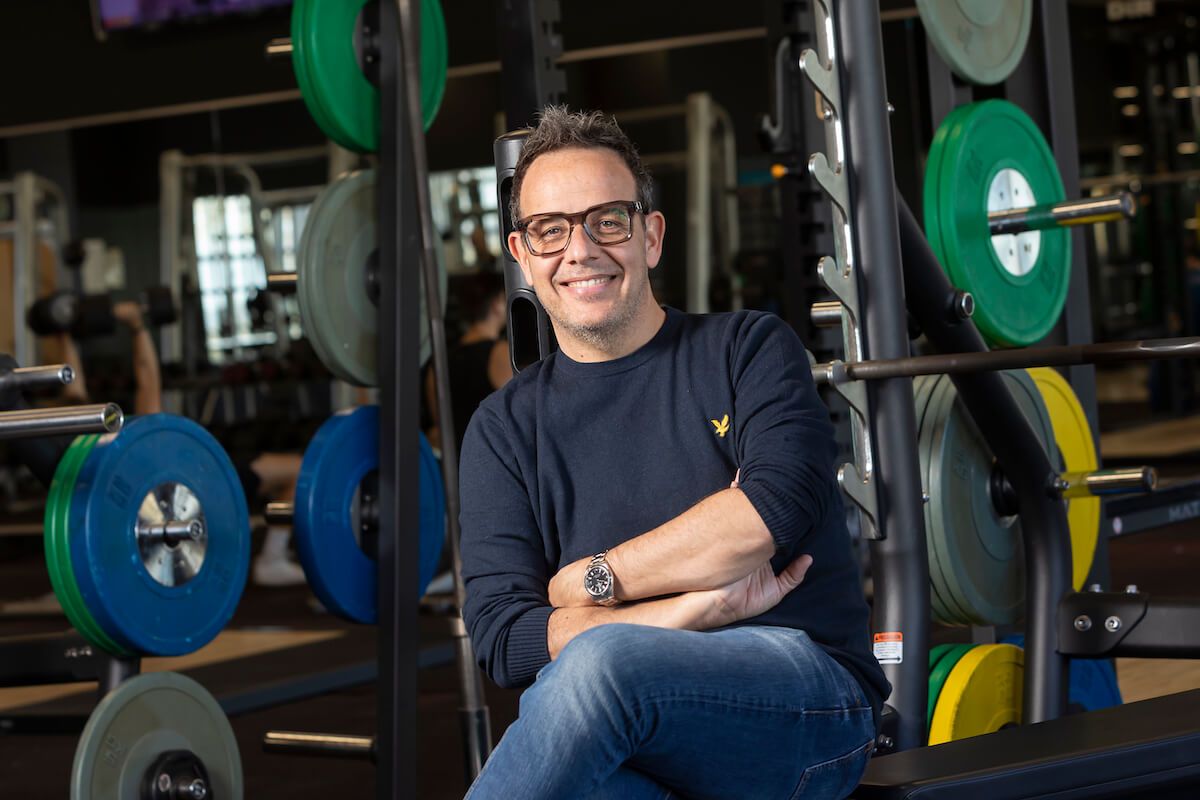
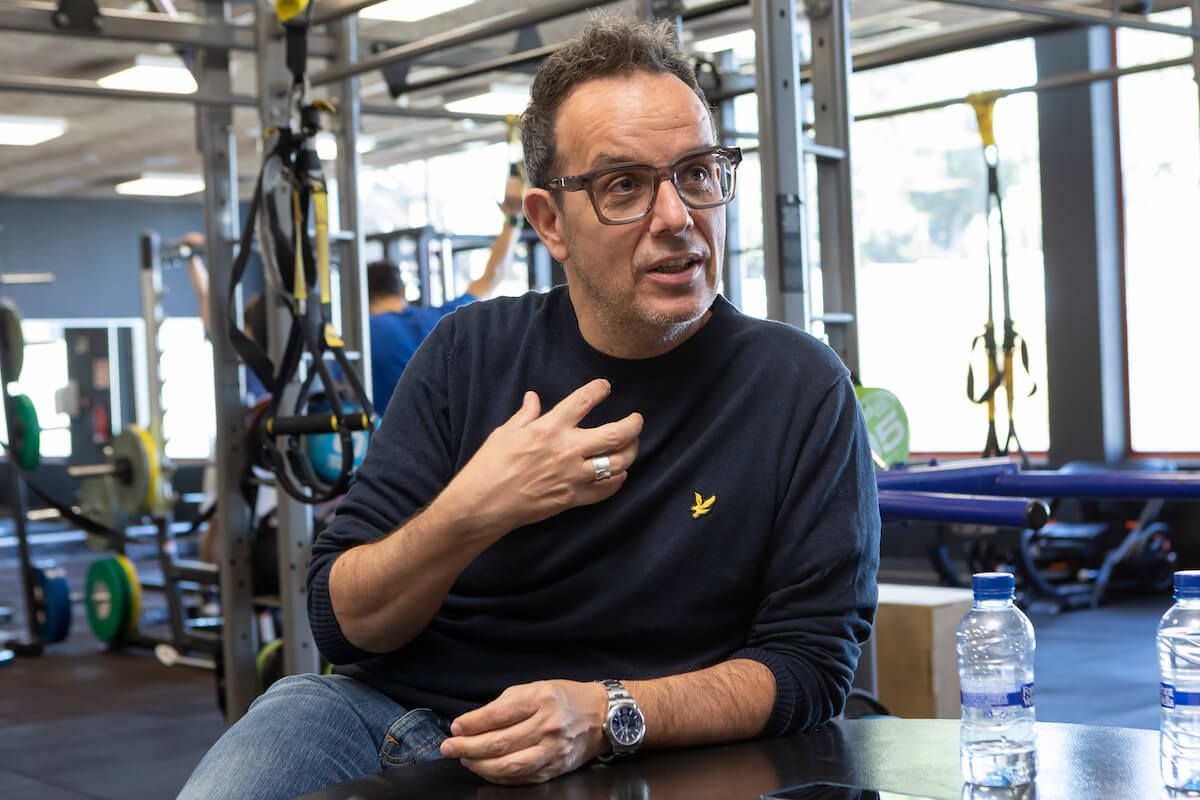
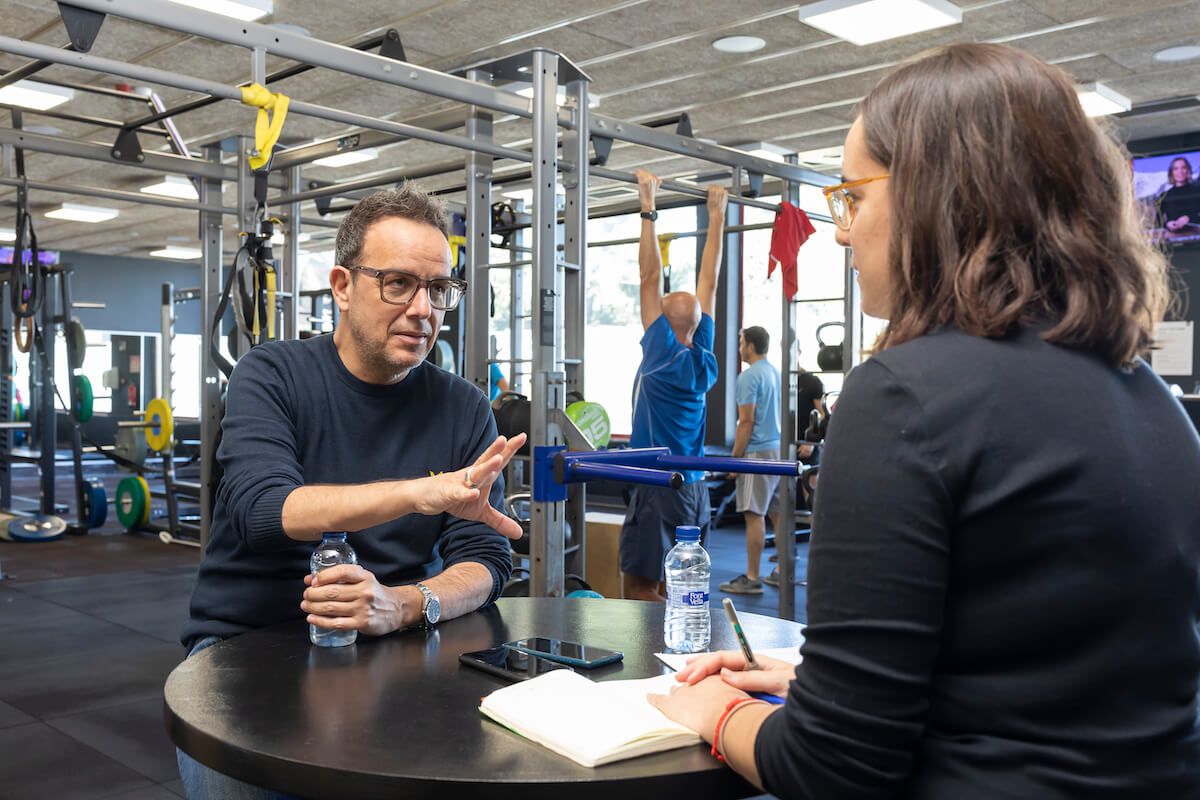
Àngel Llàcer (Barcelona, 1974) speaks at a thousand revolutions per minute. While linking one idea to another and another, he makes jokes and, if necessary, throws himself on the floor to do sit-ups. He fires off jokes, but without the intention of offending anyone, only to provoke laughter. "To be a comedian, you have to be very empathetic," he defends in an interview with The New Barcelona Post from his gym, DIR Sant Cugat. This is the first installment of a series of interviews with fit personalities from Barcelona's civil society that we will publish with the support of DIR, the leading gym chain in Catalonia.
The theater director and actor is now immersed in his latest musical, The Producers, which can be seen at the Tivolí Theater until February 2024. A Broadway classic that lands in Barcelona with a production of an unusual magnitude in the city, with a budget of 2.7 million euros, a cast of more than 20 actors and dancers, a live orchestra and a large-format set design. To all this, starting this week, El Petit Príncep (The Little Prince) is added to the billboard at Sala Paral·lel 62, the former BARTS.
He is a well-known face who cannot stand queuing or "all the things that society establishes." Oh, and he always has trouble remembering three words: civil servant, conservative, and Meryl Streep. Over the years, he says he has become shy, "before I talked to everyone, I went to a restaurant and ended up in the kitchen right away; at a party, on stage singing...". Now, in addition, he has encountered the 50s crisis: "It's sadder than the 40s or 30s because it's about old age, it's the body, how my neck hangs, what elephant skin I have." With all this, he feels that people reject and criticize him for the image that has been built around the name of Àngel Llàcer. "Àngel Llàcer has nothing to do with me. I am Àngel. There's no point in being Àngel Llàcer," he points out.
--- Before going on stage, do you follow any kind of ritual?
--- Basically, what I do is warm up for twenty minutes, with stretches, sit-ups and push-ups, that is, toning up. Once the body is warm, it's time to warm up the voice for ten minutes. Then, you are ready. Afterwards, I put on some lively music and gather the whole company before going on stage, we do the tuna, as I call it.
--- The tuna?
--- This is creating positive energy. After all, I always think musicals are a party. When you get dressed up because you're going to a dinner or going out, you have this attitude. It's doing a bit of the same, putting yourself in a mood of fun.
--- Chenoa and Mónica Naranjo must be playing.
--- Yes, yes, everything, as long as they are lively songs. When I'm in the dressing room and they're putting on my makeup, if María Dolores Pradera is playing, that's bad.
--- Hold on tight, curves are coming.
--- I have to say that I am very dangerous because on stage I always make people happy, but not only the audience, but also my colleagues. When I'm tired is when they fear me the most. When I arrive and say, "oh, today I'm dead, I'm exhausted," everyone goes "uh oh, uh oh, uh oh." That's when I lose my head the most. Tiredness helps me.

--- How?
--- I play jokes on them. And then I direct them. Many times I move them, I tell them: "What are you doing now? Did I direct this for you? I never told you to do it like that." All this, while they are talking to me in the scene and, then, it's my turn and I say my text.
--- And the audience doesn't even notice.
--- Nobody notices, it's very strong. But they are large-format shows, that is, if it were a small play, with two characters, it couldn't be done.
--- Anything else?
--- I also like to play and investigate theatrical language. I use it to know what the limits are. That is, how long I can be silent in front of the audience. I try it until they applaud, get angry, laugh... To Armando Pita (in the role of Max Bialystock in The Producers), for example, I make him repeat a phrase about a Broadway producer's hat. At first, he didn't want to do it because he was embarrassed, of course, you're throwing yourself without a net. I told him to keep going because there comes a moment when the audience laughs at the absurdity of all this.
"I like to play and investigate theatrical language. I use it to know what the limits are. That is, how long I can be silent in front of the audience. I try it until they applaud, get angry or laugh"--- As a collective catharsis.
--- Exactly. People really like to exercise laughter. I believe the success we've had with La Jaula de las Locas, Cantando bajo la lluvia, or The Producers is that we make people happy. They go home content and having lived a joyful collective experience. Not like, "oh, I was very interested or I found that I don't know what," no, but suddenly they say, "damn, I laughed so much, my face even hurts."
--- Warming up the body and voice, doing the tuna, thinking of jokes, and directing while singing and dancing... Is doing a musical very demanding?
--- That's why you need preparation. In The Producers I have a smaller role, but in La Jaula de las Locas I had a leading role and my life was dedicated to it. It's a bit like being an athlete. I had a personal trainer who came every day, whom I hired to force me to exercise, not to guide me. You have to be toned and you have to sleep the hours you need to sleep, but you also have to eat well and not gain too much weight.
--- Time for a diet.
--- The truth is I've always had a very healthy diet. When they tell me to diet, the only thing I cut out is alcohol. I like to have a glass of wine, without overdoing it. But I have to tell you that, many times, for the voice... This is very politically incorrect... I get drunk and the next day my voice is better.
--- I'll keep that in mind.
--- I'm serious. In the end, your voice is you. I mean, it's not "I have something here, I don't know what...". How you are, your voice is. And, if you're sad, your voice is like a ballad; if you're happy, it's brilliant. So, many times you accumulate tension and, one day, you go out to party and get drunk as a skunk. The next morning, you wake up with a hangover and, as all your muscles have relaxed from the drunkenness, so has your voice.
--- All this if you haven't lost your voice from screaming so much at the party.
--- You'd be surprised, but I don't scream. I'm one of those who are at the bar and you can't tell they're drunk.
--- The ones who last longer.
--- There are those who tell you they've had two beers and are already drunk, but I can have eight gin and tonics and be the same. I have a liver... I think I've never reached the point of speaking poorly or not vocalizing, but I really like drunk people. A lot. I swear to you. Since there's so much hypocrisy in the world, when people get drunk, they shed a few layers and show themselves a bit more as they are, and I love this. Drunk people are a bit like children. I don't like small children, I detest them, but those who are a certain age, when they start to talk, I like them a lot, because they are exactly as they appear, they have no filters and tell you what's right and what's wrong... And, drunk people, the same. What happens is that there are drunk people who are really very unpleasant because they have had so much social pressure and have tried to behave in such a correct way, that afterwards they get drunk and you say "oh, look, go to hell." I, since I behave the same everywhere and flee from social pressure, try not to be ashamed and not let anything make me feel bad.
"I really like drunk people. Since there's so much hypocrisy in the world, when people get drunk, they shed a few layers and show themselves a bit more as they are"--- Not having shame must have helped you face an audience. When did you start with theater?
--- The first time I went to the theater was because I had to go out myself. It was at school, I played a baby and wore very large diapers. Like a birth. It was a play by Apollinaire. Afterwards I did Stravinsky and Molière. I went to the Lycée Français and everything was in French. I became the one who had the leading roles at school.
--- But you didn't start studying theater when you finished.
--- No, I went to study Business Administration at Esade, but I didn't last long, very little. I left after three months and started at the Institut del Teatre the following year, but I stayed directing the theater group at Esade for five years, every Tuesday and Thursday. There I tried plays that I later did professionally. That's why I met so many people from Esade and I keep in touch with them. I would see them there and they would tell me, "oh, you, how unfortunate." They thought I wasn't right in the head for having left, going to Esade was like learning to make money, right? I thought that if I had to make money, I would do it later. Over the years, I think it can become fun, it's like playing a big Monopoly in life. The ambition to make money can stimulate you. There are people who say I want to be rich and others who want to make the best croissant in the world or theater. Now, they laugh because I've ended up earning more money than many of those who studied at Esade. This is another matter. People think I'm super-rich and it's not true. I mean, I've made money, but I'm not super-rich, that's another level.
--- Otherwise, you wouldn't be doing a musical every week.
--- That's exactly what I tell them. If I were rich, I wouldn't be doing this interview nor would I have to go to the theater now to do the show.
--- How did they take it at home when you left Esade?
--- Terribly. My grandmother wouldn't speak to me and my mother, super angry, was crying and saying "my son, what a misfortune." Well, horrible, disastrous support. It changed when I did El somni de Mozart, which was a resounding success on the Barcelona billboard and I received awards and they gave me my first interviews.
--- A grand entrance.
--- Then I was very well-liked, and mind you, I did the same thing as now. I am like when I was 23, but back then, people took this impertinence as funny. And now they don't because they start to dump their frustrations, social desires on me... Success is not liked. For them, I am a winner, and this bothers them a lot, and they develop an absurd aversion to me. I try to always have virtues, and when I have a defect, I try to polish it immediately or not have it. Just as people take care of their bodies, I take care of my way of being. I don't shout, I avoid conflict, I always prefer dialogue, I am affectionate, friendly, generous... I have Twitter, but I never go on it. My friends read it to me, and I see that they insult me. And I think, "damn, how intense," they are capable of creating a character that doesn't exist, and they really dislike me and attribute horrible things to me.
--- Success...
--- I don't think it's that. Look, right now, success for me would be not being Àngel Llàcer. That you wouldn't have any interest in interviewing me, that is, that you would want to talk to me for my person, not because I am Àngel Llàcer. But it's not like that, I'm a failure. Àngel Llàcer has nothing to do with me. I am Àngel.
"I have Twitter, but I never go on it. My friends read it to me, and I see that they insult me. And I think, "damn, how intense," they are capable of creating a character that doesn't exist, and they really dislike me"--- Hm.
--- I'm telling you the truth. When people tell me, "you're famous," I think, "you're an idiot." Being Àngel Llàcer is useless. Useless. Last year I did El temps i els Conway at the TNC, it was the most-watched play and the audience loved it, but the reviews weren't good and we weren't nominated for any awards. It's because it's me. It's an "Àngel Llàcer does it" and that's it. The thing is, I like the work I do, I like people to leave the theater and say they had a great time. What do I do? What can I do?
--- Complicated.
--- That's why I'm in La Garrotxa. There I'm Àngel. Well, the first day I'm Àngel Llàcer, then that's it. I've found my refuge in La Garrotxa, where I can stop being Àngel Llàcer to be Àngel. And, when I come to Barcelona, I have an Àngel Llàcer clash.
--- One last question. Do you lie in interviews?
--- Always. But I think today I haven't told any lies. In shitty interviews I always lie.
Add The New Barcelona Post as your preferred Google source for free
Stay informed with the latest news.
