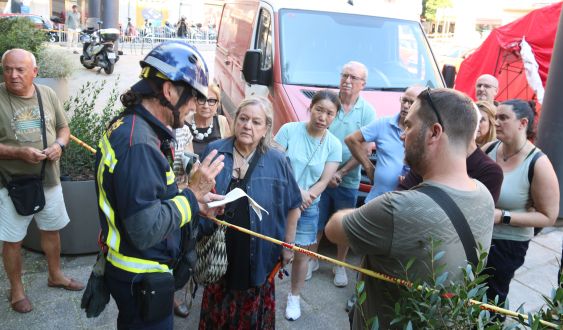
A firefighter with a notebook and pen is orderly calling people who are queuing on the other side of the police tape. They are residents and workers of the homes and premises sealed off as a result of the sinkhole that put the Putxet neighborhood on alert on Tuesday. They can access accompanied to get what they need while they are out of their homes until, at least, Saturday, five days after the owner of the Verona pizzeria found a hole eight meters in diameter and four meters deep.
The firefighter who lets residents pass in shifts is just one of hundreds of people who have mobilized to respond to the situation, derived from the works of metro line L9, which advance about 40 meters below the street. The coordination of the operation is not simple, but it arises from a perfectly structured mechanism to respond to unforeseen situations in the city.
Once the 112 alert is received, this municipal mechanism is set in motion. And it does so in a peculiar way: "We have a communication system for city emergencies via sms restricted to emergency services and relevant people. I receive all of them from the city." This is explained by the municipal manager, Laia Claverol; one minute after receiving the message through this internal alert system of the City Council, the mayor called an urgent meeting in Sant Jaume. And shortly after, the Barcelona Emergency Operational Coordination Center (Cecor) met, in charge of coordinating all necessary services in case of crisis. In parallel, the Generalitat, in charge of the L9 works, also alerted the head of works of the City Council.
From the Cecor meeting in Sant Jaume, to Putxet: shortly after the alert, the operation was deployed in the neighborhood with all the cavalry. Authorities paraded through Frederic Soler square, including Mayor Jaume Collboni, Councillor Sílvia Paneque and, also, Claverol: "We have all sent the highest authorities." There, however, "those who govern the management of the emergency are the firefighters," who took control of the incident coordinated with Guardia Urbana, the Barcelona Social Emergency and Urgency Center (Cuesb) and also the Medical Emergency Service (SEM), activated in case it was necessary (and it was not).
Meanwhile, technicians from the Generalitat, from geographers to engineers, focused on analyzing the situation and its causes, and municipal social services focused on assisting the families being evacuated by the Guardia Urbana, which number close to a hundred. Shortly after, concrete began to be injected into the large cavity opened in the inner courtyard; by 10:30 PM on Tuesday, the process was declared finished. But filling the ground is not enough: it must be ensured that it is stabilized. To do this, auscultations and checks will be carried out every hour using sensors. With the thermal contrast and the heat of these days, however, comparisons will need to be made between measurements taken at the same time, in the early morning, to ensure that nothing moves out of place.
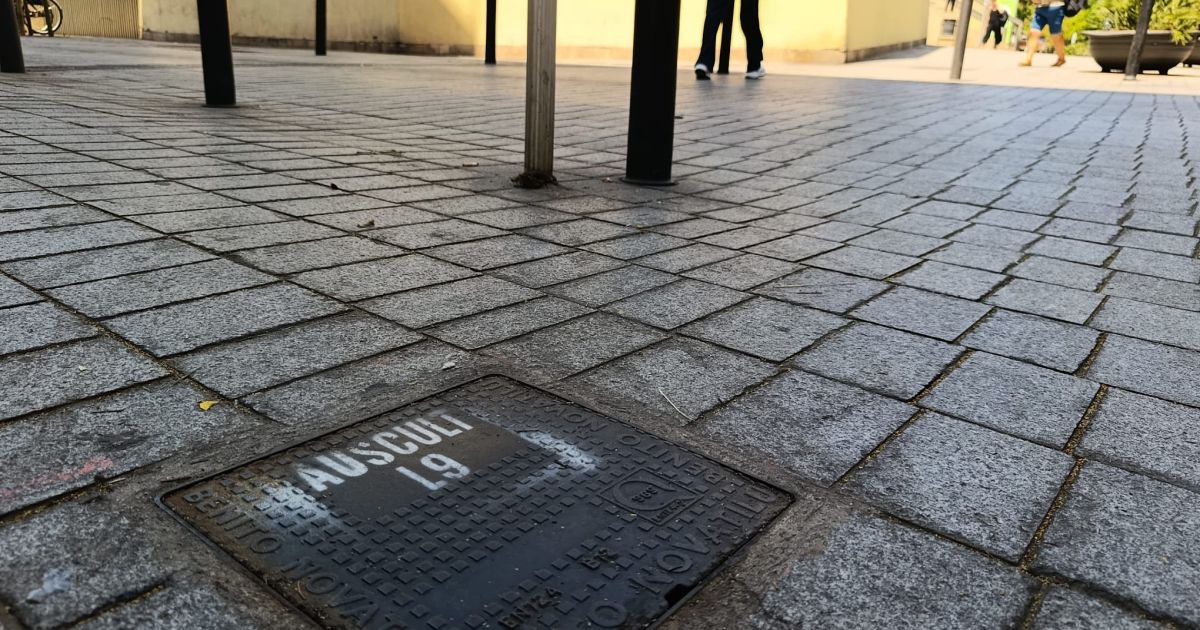
At least three measurements at the same times will be needed before residents can return home. Thus, they will have to wait until Saturday at least. Meanwhile, they have a service point at the Centre Cívic Vil·la Florida, where they are attended for issues ranging from concern about cracks in their home to the need for the City Council to provide them with accommodation, as well as questions about insurance —the derived expenses will be covered by the L9 works insurance, although in processes that are not short. Starting this Thursday, furthermore, the City Council will offer specific support for the dozen affected commercial premises, with a specialist to resolve doubts related to the incident, Claverol detailed.
Sensors, by the thousands
The response, however, began to be prepared long before anything happened. Along the entire route of what will be the L9, the Generalitat has installed thousands of sensors. They are visible to everyone, but if one does not know what they are, it is difficult to identify them as such. They emerge from the ground in the form of a metallic pole, usually accompanied by a numbering. Around the affected properties alone there are dozens, and every few meters, covers used for the auscultation of the metro works.
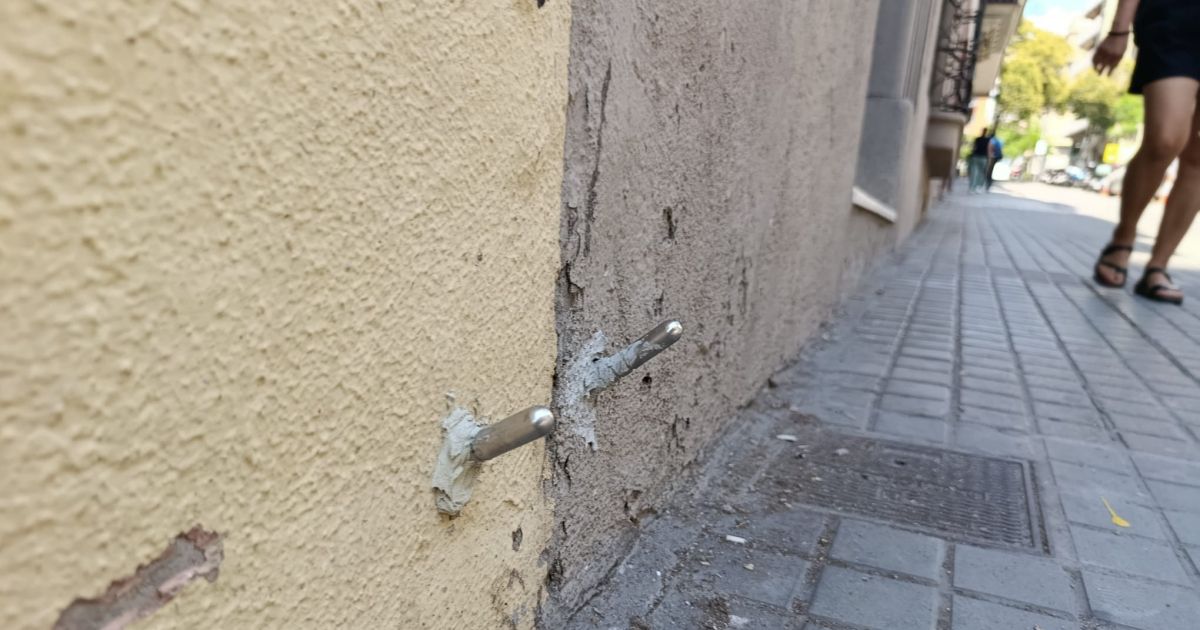
The sensors are part of a permanent monitoring system that accompanies the works long before any incident appears. They measure almost imperceptible ground movements and allow technicians to check if the subsoil remains stable. Now they will determine if the ground is in condition for residents to return home, after an incident that activated a chain that has mobilized firefighters, the Urban Guard, technicians, social services, municipal officials and those of the Generalitat. A little visible gear in the daily life of the city, but one that is prepared for unforeseen events that, this time, have taken the form of a sinkhole.
Add The New Barcelona Post as your preferred Google source for free
Stay informed with the latest news.