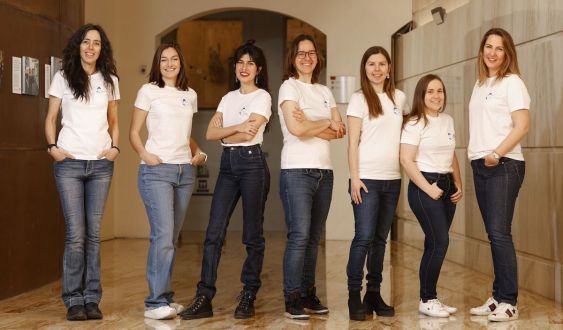
The Hypatia II crew is warming up. There are only a few days left before the second mission of women researchers goes into action. This time, the astronauts will study the effects of a mission to Mars on women's bodies. Currently, only one in 10 astronauts are women, and the lack of female crews causes a significant bias in the available data. The expedition will take place from February 2 to 15 at the Mars Research Desert Station (MDRS) in the Utah desert, in the United States, where a new all-female crew will live in isolation conditions to carry out different scientific research projects.
The Hypatia II crew will conduct experiments and test equipment to study the feasibility of a real mission to Mars, under isolation conditions with restrictions on food, water, and communications with Earth, and in an environment with an orography and conditions reminiscent of those of the red planet. The crew will analyze the impact of this context on aspects such as menstruation, nutrition, or physical activity. The effect of the mission on circadian sleep-wake rhythms and other biological variables related to stress, such as heart rate, body temperature, and blood oxygen, will also be studied.
For the first time, a Hypatia mission will incorporate a geologist into the crew, since one of the challenges of space travel is the collection of samples from other planetary bodies such as the Moon to analyze them later on Earth. On the other hand, the Hypatia II crew members will install a trihedron in the Utah desert, during extravehicular activities outside the MDRS, so that satellites can position themselves precisely and measure the elevation of the terrain, a technology already used to map oceans and glaciers.
But there will be more scientific projects to develop. One of them will test solutions to improve the energy efficiency of solar panels, with the aim of preventing the photovoltaic installation from losing performance due to the accumulation of Martian dust on its surface and endangering the lives of astronauts. In reference to outreach, another project will design a virtual tour of the MDRS to highlight sustainable and circular economy practices that the crew will implement, inspiring responsible solutions for Earth.
The crew members this time will be aerospace engineer Estel Blay, geologist Marina Martínez, telecommunications engineer and former president of the Barcelona Chamber of Commerce Mònica Roca, publicist Jennifer García, also aerospace engineer Laura González, and nanotechnologist Lucía Matamoros. Mathematician Ariadna Farrés will be the mission commander. They are between 23 and 54 years old and have been selected from about fifty candidacies. The aim was to have a diversity of profiles to configure the new crew and the representation of different scientific disciplines.
The Hypatia Mares association was born from the first Catalan expedition to the Mars Desert Research Station facilities, which took place in 2023, with a triple objective: to conduct space research, disseminate it, and create female role models for girls and young women. Different hospitals and leading research institutes in Catalonia collaborate in the project, such as the Sant Pau Research Institute, Sant Pau Hospital, the Institute for Global Health (ISGlobal), and the Germans Trias i Pujol Hospital in Badalona.
Add The New Barcelona Post as your preferred Google source for free
Stay informed with the latest news.
