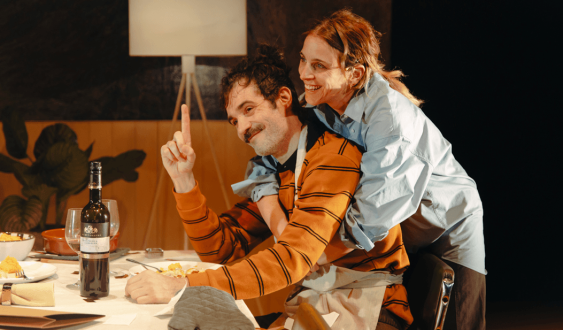
What happens when you try to burn the system from the top of a stage? Director Anna Serrano Gatell brings L'autora (The Writer), a piece full of truth and rage, signed by British writer Ella Hickson, to the Lliure de Gràcia. A text born from the gut to blow up the codes of fiction dominated by men and that puts the eternal debate on the table: does art serve to change the world or do we just come to the theater to massage our conscience?
Through the portrait of a young writer, the text launches a cry in defense of female talent against a system that usually judges women by their appearance and seductive capacity. It is a very original dramaturgical journey that shows how the system forces us to modulate our rage and indignation to be able to fit into society.
The intellectual rage of Ella Hickson
L'autora (The Writer) premiered at the Almeida Theatre in London in 2018.With this presentation, the British playwright shook the foundations of Anglo-Saxon theater and divided critics into two camps. And it is that Hickson transfers her almost mystical need to believe, but channeled throughan intellectual rage absolutely political.Before presenting this work, Hickson wrote about young adults trapped in the precariousness and uncertainty of the contemporary world. She herself joked that the collection of her early dramas should be titled Plays One: Grow up and Get a Proper Job. But with each text, her ambition grew: realism turned into lyricism and she dared to create works with a more complex structure. And that is what she proposes in The Writer: she completely breaks with the classic structure of theater to build five acts that are plays within the play.
The freedom of Serrano's staging
The staging proposed by director Anna Serrano Gatell in Barcelona arises, precisely, from the same freedom with which the original was created. The work was written in absolute isolation, a process that Serrano describes asa "very automatic, as if vomited, writing, of throwing oneself into writing without thinking and without logic."We are accustomed to closed narratives and comfortable structures, but the real world is fragmented and contradictory, and this version responds from the form: the form breaks, shifts, and becomes the content. Judit Colomer's set design helps organize this structure: each chapter of the work functions as a particular micro-universe.
https://www.youtube.com/watch?v=I7-C2DCMCCU
A structure that breaks schemes
We are facing a work that breaks you in every scene and every act. When you think you have already caught the thread or the code of the play, an absolute rupture occurs that opens a completely different path. It is a very powerful dramaturgical journey, very far from what we are used toto see on the billboard. As happens in any production of this format, there are scenes that work better than others; some breathe more easily or maintain higher interest, but the overall computation of the proposal is indisputable: it manages to create a very powerful, layered scenic piece that shakes the audience.Commodification of human emotions
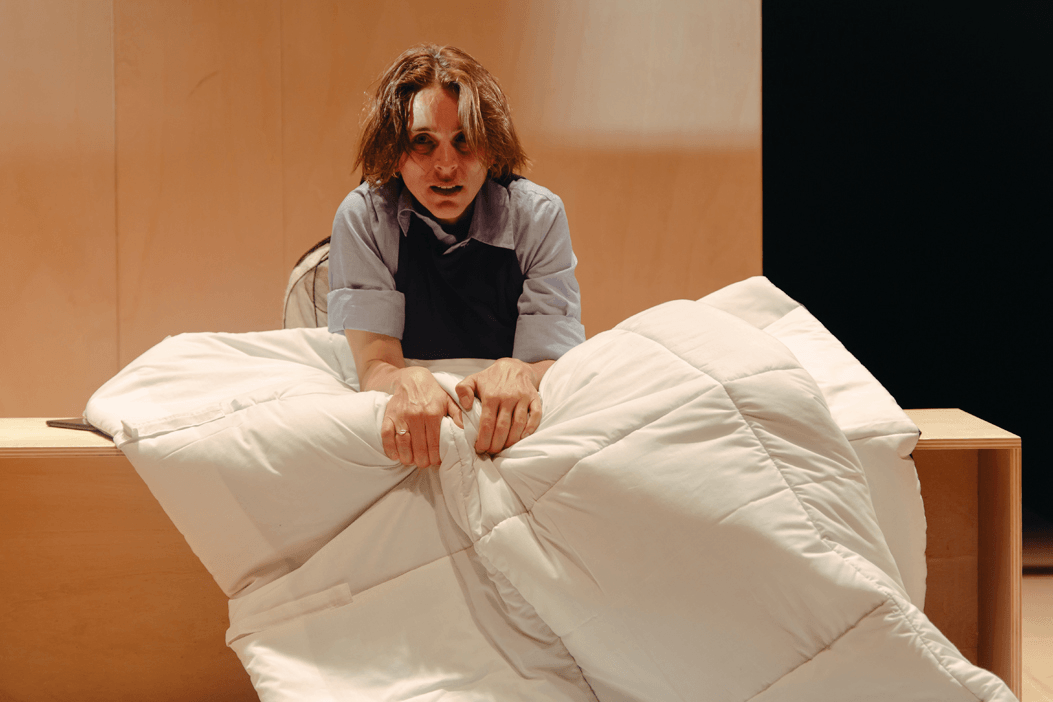
The text vindicates the act of writing as a cathartic exercise, an inner journey and an almost sacred expedition towards the essence of the human being. That is why it is so painful to see how that almost divine need has to be commercialized and debasedto be able to survive within the consumption circuit.Nausicaa Bonnín embodies this young writer with great magnetism; she wants to change the world, burn everything, convinced that art is the only real tool to make a revolution. All that indignation is presented through a very elevated and elaborate discourse. It is not a visceral and raw discourse, but a very studied and thought-out theatrical replica to fit within the scenic game. And it is at this point where the message becomes brilliant: the play uses the world of art as a mirror of capitalist society.
The author shows us how the system forces you to take your most intimate feelings, your rage and your own creative "vomit," and modulate them to be able to fit into the gears of the market. Because in the end, if you want to be heard, you have to go through a commercial dramatic structure, you have to be attractive to the public; if you don't, you are left alone on the margins, like a tribe in the forest that flees from reality but interests no one.
Women who write
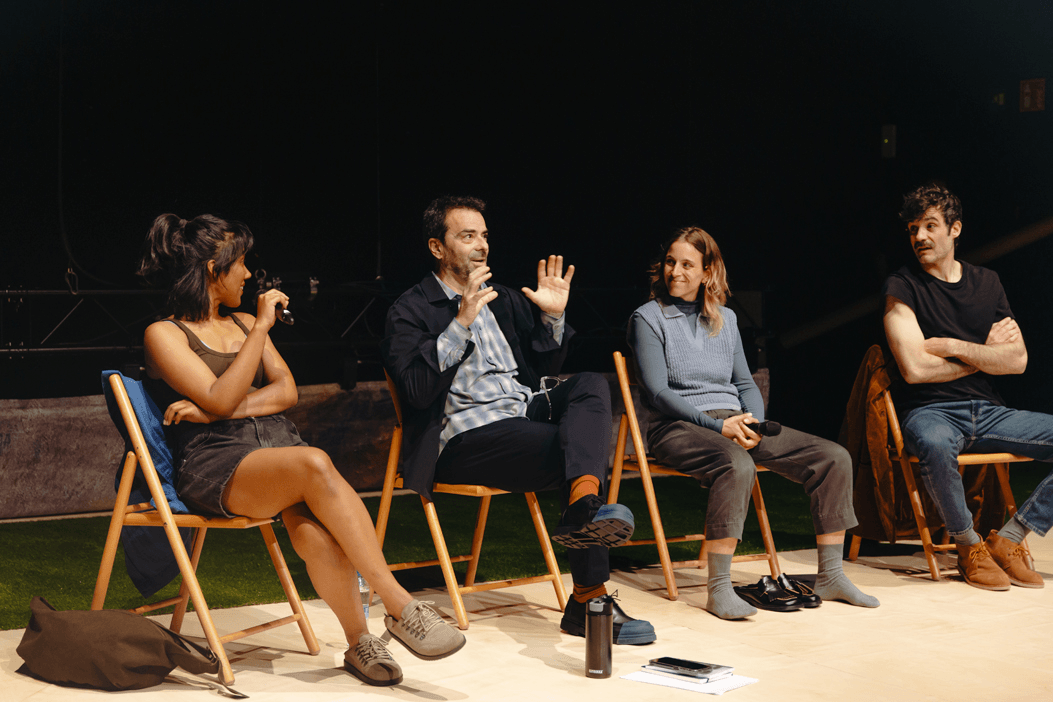
The piece puts its finger on an uncomfortable truth of the profession when one readsfrom a gender perspectiveto the writer, to the creative woman, many times she is still valued more for her physique than for her ideas. And the worst of this patriarchal violence is the seed of doubt it sows in the artist herself; even when someone values you for your talent, if they make you understand that they are also physically attracted to you, as a woman you fall squarely into the trap and doubt yourself. You no longer know if you are really good or if, simply, you are hot.In this sense, L'autora also acts as a cry in defense of the talent and passion of those who write, with which it is impossible not to feel identified.

When the discourse gets stuck
Despite all these virtues, the show begins to have some problems as it progresses.There are scenes that err on the side of being somewhat long, repetitive, and redundant.The protagonist's main message is perfectly understood in the first dialogues of the story, but the text sometimes gets stuck in a discursive loop in which the author's character adopts a tone that borders on egocentrism.The pessimistic message
However, the point where the work generates the most contradiction (and where I personally find it hardest to get into) is inyour final message.Throughout the entire performance, the play offers a breath of fresh air, opens the wings of the spectator's mind with a much-needed feminist and anti-capitalist perspective, posing theater as a sacred space that should not be perverted. But, in the last act, everything that was criticized at the beginning becomes corrupted and contradictedin an absolute way. The roles of patriarchy are fulfilled to the letter; the protagonist ends up giving in, repeating exactly the same patterns of male dominance and even adopting a sexualized attitude that she previously rejected. It seems that the work wants to tell us that the system is so ingrained in our cultural DNA that defeat is the only possible path. Thissuch a catastrophic visiontarnishes all the power and illusion we had accumulated during the performance.The play places us before the figure of the idealized artist, an intellectual in the style of Picasso painting Guernica: someone who observes the pain of the world from a position of absolute privilege, smoking and having a drink while aesthetically depicting how others bleed out in the trenches. It is true that many times the writer remains just that, a simple observer of others' misfortunes, but closing such a combative piece with such devastating pessimism leaves a bitter taste.
Do we go to the theater to change the world or to silence our conscience?
The author poses the eternal debate about whether art really serves to change thingsor if, after all, we are nothing more than a group of bourgeois people who go to the theater to be told what we want to hear and, thus, calm our conscience.Although its final stretch closes the door to hope with a slap of reality in the face, Anna Serrano Gatell's production moves us because it shows that, although the capitalist system always ends up running over us, the need to write and to combat power structures remains the only real space of resistance we have left.
Add The New Barcelona Post as your preferred Google source for free
Stay informed with the latest news.