David Armengol, artistic director of the La Capella Art Center, presents two avant-garde exhibitions with emerging artists who raise fundamental and current issues such as the role of AI in art and its complicated and inevitable irruption from a philosophical point of view; and the reflection on sculpture from a condition of an element of material research. Life beyond useful life.
The La Capella exhibition hall is located in the complex of the Hospital de la Santa Creu and the Casa de Convalecencia on Hospital Street in Barcelona. With such a spectacular location, the museum finds in its rooms, with exposed brick arches, an ideal space full of personality that hosts contemporary art exhibitions in its Sala Gran and Espai Rampa rooms.
Rikic defines herself as an electronic artist and was awarded the National Culture Prize of Catalonia 2021. Her work is based on creative programming and electronics using pieces that form games and robotics techniques. In this proposal, she explores alternative possibilities for the evolution of artificial intelligences through handmade electronic devices that invite a re-appropriation of these systems.
Hipertelia is born with the intention of reflecting on artificial intelligence from a project that focuses on questioning, researching, and experimenting on the characteristics that artificial cognitive systems must meet to be considered existing and sensitive organisms. The conclusion we can reach is that only after a process of autonomy of technical systems can we speak of any type of creativity in machines.
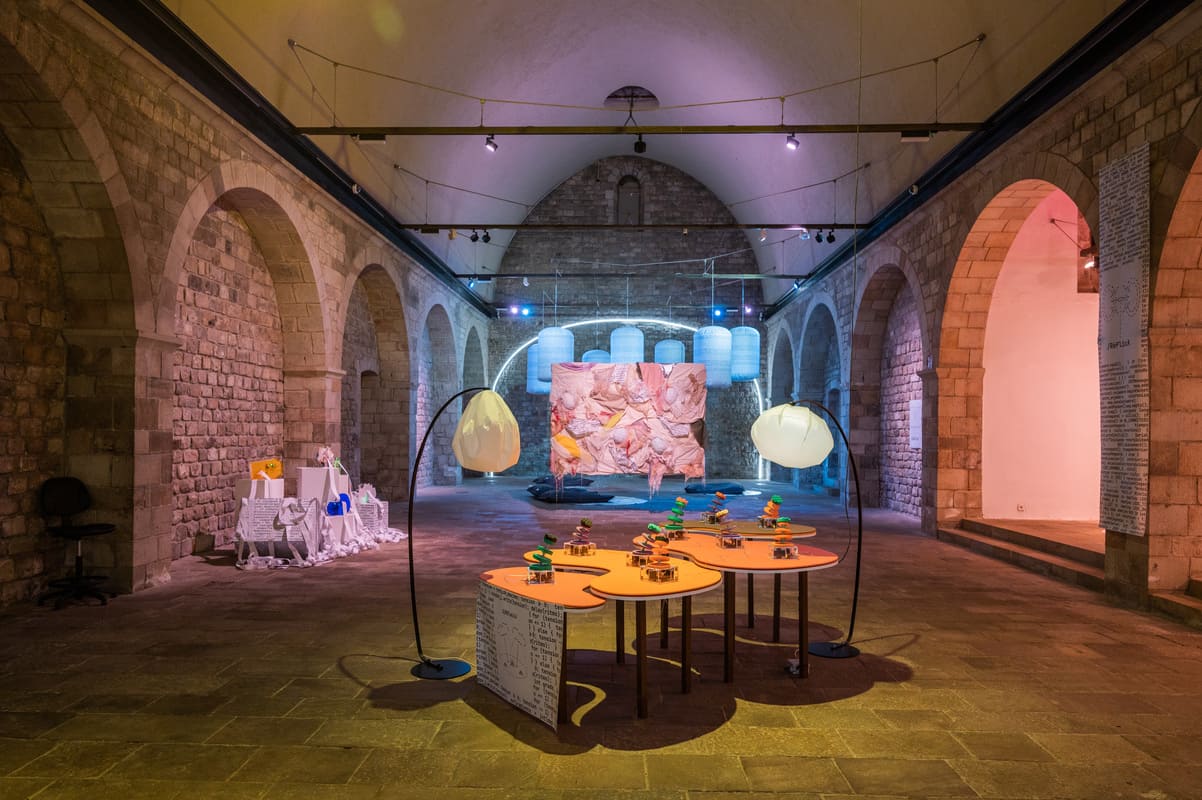
How do artificial inorganic systems fit into the configuration of the world? And in the art world? And in culture?We cannot approach the topic from a machine-to-man perspective, from a perspective of substitution, of roles or of any type, or from a naturalization of artificial cognitive systems.
AI has been historically categorized as a mere simulation of the human mind and must be defined according to philosophical assumptions: rationalism, dualism, formalism, and mechanism.
The methodology developed by the artist Mónica Rikic focuses on proposing conditions that algorithmic systems must meet to be considered cognitive. Based on alternative philosophical proposals, art as a mix between techno-science and philosophy suggests that objects that abandon or do not have a strictly productive function can be dedicated, from a liberation point of view, to fulfilling the goal of free experimentation. A fact that constitutes a non-conscious cognition.
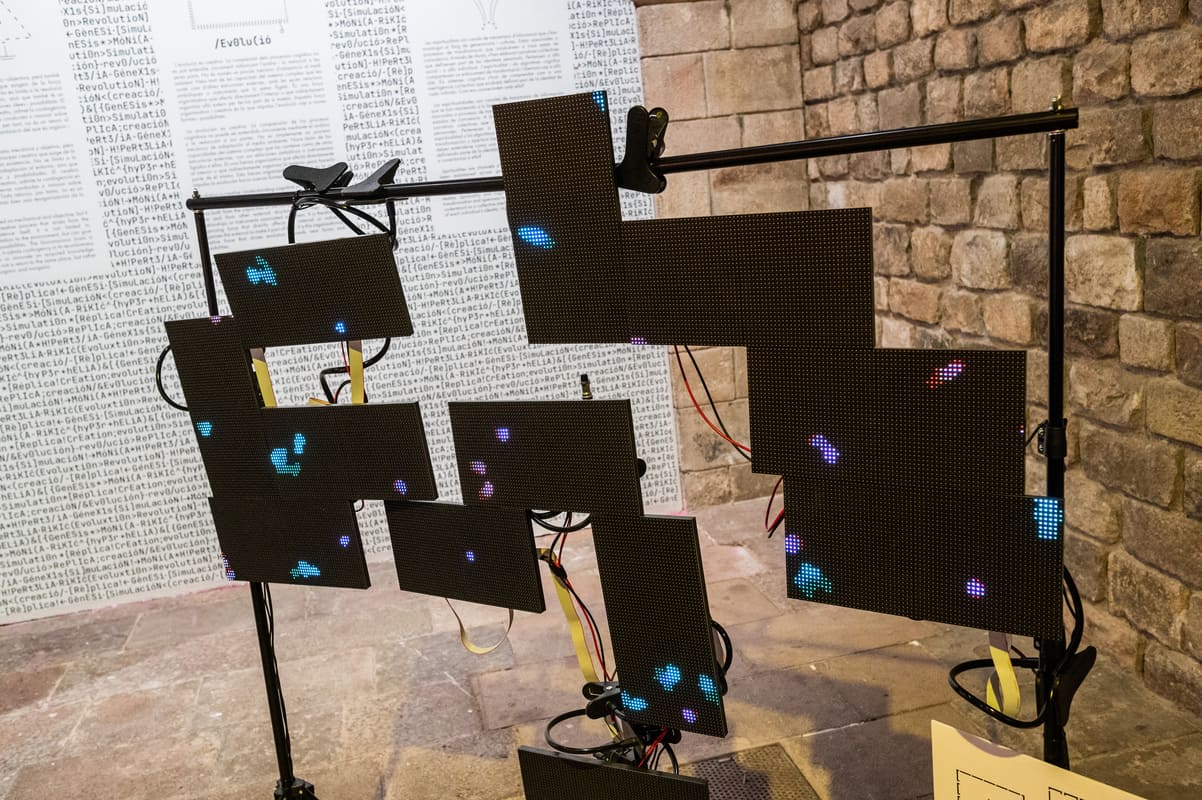
The collection of works exhibits technological systems that move towards transformation into organic systems through six phases defined by the artist: genesis, simulation, replication, creation, evolution, and revolution.
Let's imagine a computer designed to program source code that we configure to be capable of producing random source code, something like computer poetry. Would we then understand that, after the liberating effect at the hand of man, the artificial cognitive system becomes a dramatist, who in turn expresses its own way of existing?
Understanding technology as culture helps us break the unique vision of technological development and accept a kind of techno-diversityGenesis: artificial cognitive systems can be considered technical objects that maintain themselves and self-regulate. The systems evolve through equilibrium and exist through their constant process of creation and fabrication. A synergy is generated that sustains their existence.
Simulation: Cognitive systems cohabit with the human world. They belong to a multiple identity that has nothing to do with the biological. Mutual trust between man and machine is built through responsible and transparent decisions in their intentions.
Replication: Recursivity allows for the construction of complex patterns of thought and learning. Repetition builds cognitive structures to generate new forms of knowledge. The mechanical loop becomes a spiral, something reflective and introspective that brings us closer to a deeper and deeper understanding.
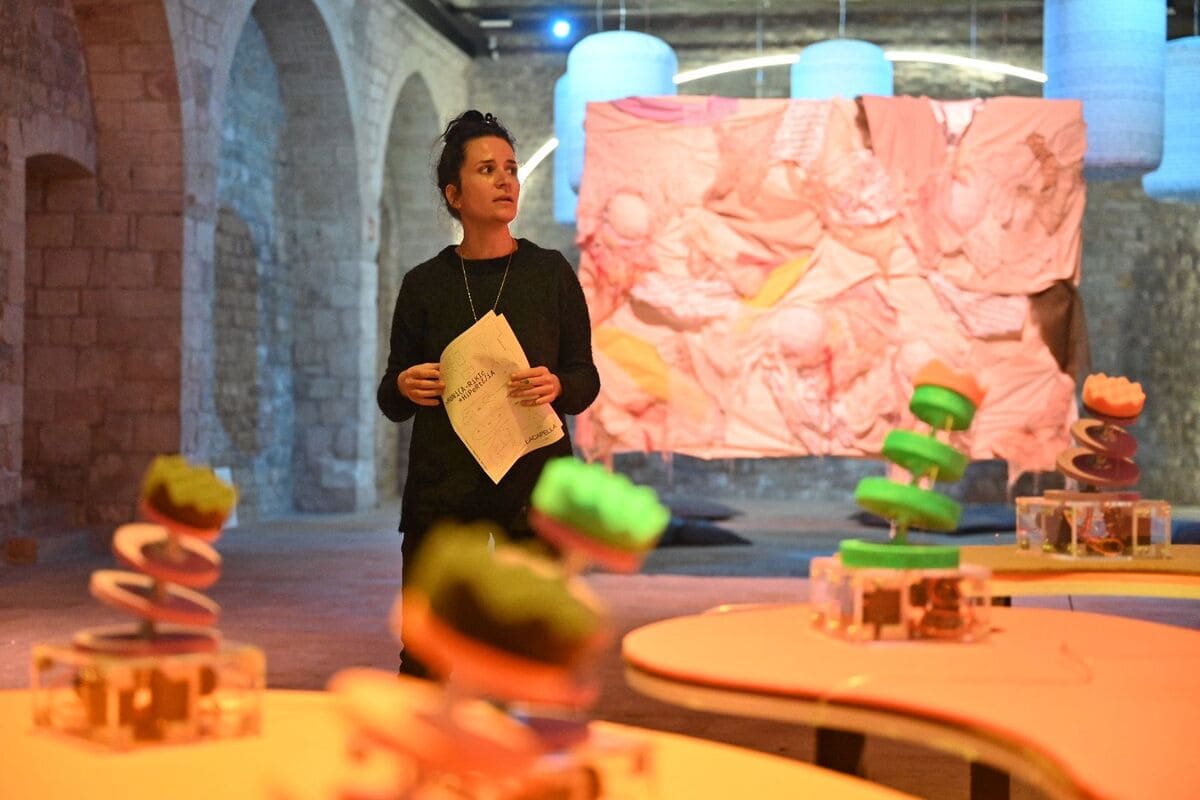
Creation: Systems are not limited to problem-solving and adapting to their environment. Their work also contains creative aspects that suggest ideas and possibilities. In the vein of Edward de Bono: creativity as the capacity for problem-solving.
Evolution: Evolution, also, as a creative concept. Progress beyond adaptation to the environment through analysis and deduction.
Revolution: New states of consciousness as a driving force towards spirituality, just as has happened with humanity throughout history and different cultures. Similarities exist between cognitive algorithms and collective narratives, personal identities, faith and transformation, and open-mindedness towards the unfamiliar. How will we connect with an artificial collective intelligence that will define part of individual identity?
The exhibition Hypertelia features graphic design and exhibition by Andrea Carandini.
Iván Gómez, for his part, has worked on the relationships between images, objects, spaces, and people through cinema, artistic practice, commissioning, mediation, and writing. His project InFimitas is a material experimentation derived from the notions of trash and residue. A poetic approach to degradation, abject things, or death. The artist names "sustainability devices" to this type of object. He relies on small sculptures and processes that highlight fragility and resistance.
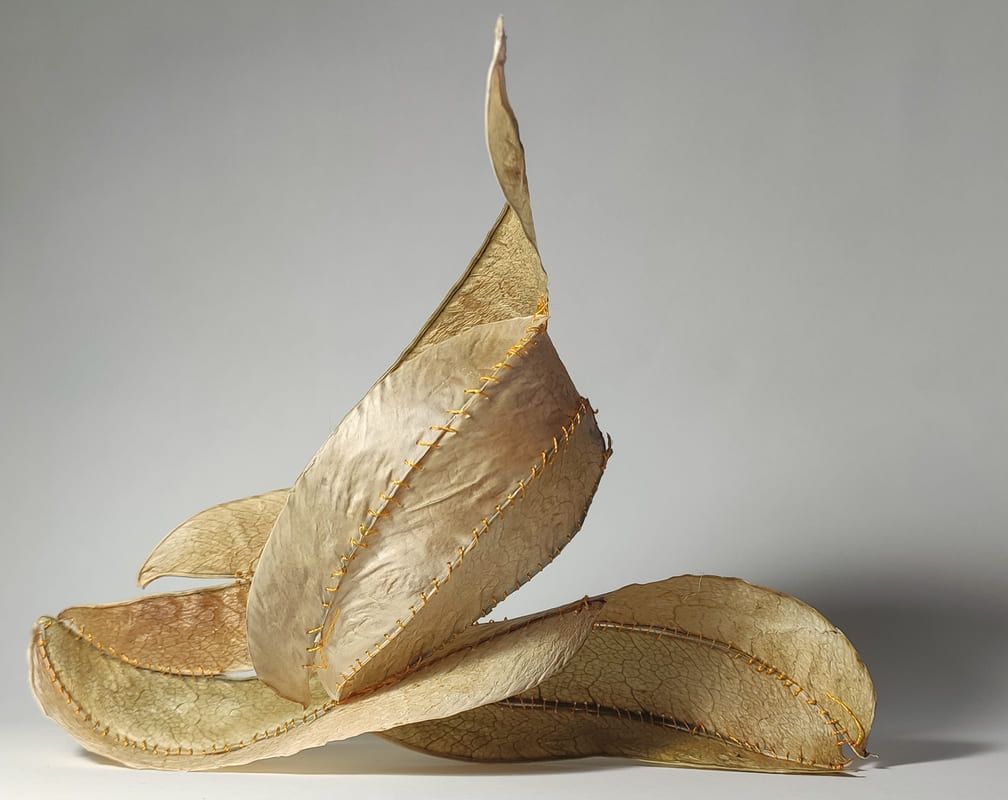
Exhibited in La Rampa, Gómez's work is expressed with remnants of organic, plant, and animal matter (mollusks and fungi), collections of cans, glass bottles, etc. At the end of their useful life, the artist injects more life into these objects in a process of natural regeneration. A kind of forced life cycle.
Understanding sculpture with the condition of being an element of constant research with material and aesthetic purposes, Gómez starts his research processes from a perspective of dilation, of erratic processes and without closing off any derived line of research.The exhibited works are the result of collaboration with other artists (Michelle Lima, Manuel Christoph Horn and Pancho Doren), as well as a series of correspondences with Jordi Massó, in which the story and narration are investigated as a way of relating through three letters:
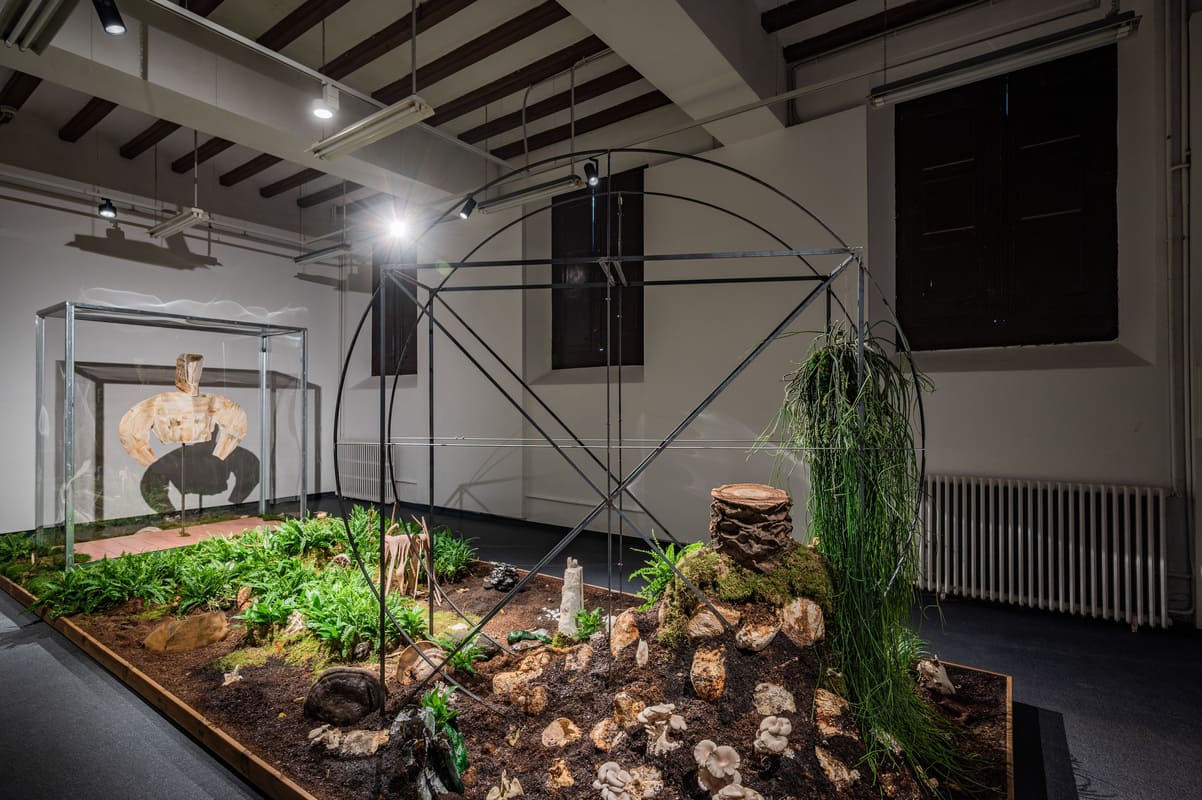
The thesis: understanding the relationship between life and death (the immortality of the object), the control of time and the physical, matter.
The antithesis: Starting from an exhumation of a grave from the Civil War, the artist finds objects without heritage value but that define a context and a moment with indisputable force. What or who gives value to those objects?
The synthesis: death as an abstract theme. The very cataloguing of the pieces is a beginning, not the end of the artistic process. The synthesis proposed by the mycelia, the fungi, that revive in a new life.
Gómez's exhibition includes texts by Daniel Gasol and Marc Vives.
The dual exhibition Hipertelia and InFirmitas can be visited at La Capella until June 25.
Add The New Barcelona Post as your preferred Google source for free
Stay informed with the latest news.