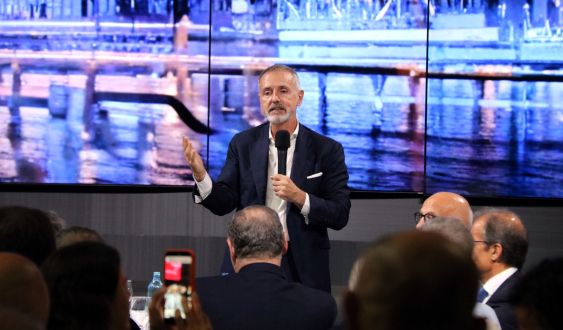
The world today is living through a time of extreme disruption, in which technology grows ever more precise, fast and intelligent. In a market where innovation sets the pace, it's difficult to stay afloat on borrowed technology — much as it ends up being "dangerous" for a country to depend on its neighbours' advances and have no capacity to defend itself with tools of its own. These are the main conclusions put forward by Telefónica's president, Marc Murtra, at his meeting with business leaders at the employers' association Foment del Treball. The telecommunications company's chief executive argues for the need for a defence industry of Catalonia's own, capable and "without any complexes," and insists that Catalan companies have an "opportunity" in this field.
Marc Murtra has been Telefónica's executive chairman since 2025, and his vision for the company is to make it big. As he puts it, the world is changing, and "large-scale" companies are increasingly needed to make the investments required in cutting-edge technology. The businessman had previously headed Indra, the well-known Spanish defence technology multinational, which is why his convictions about the defence sector within democratic countries are so clear. For him, defence has been key to democracies winning wars: "Russia has not won the war in Ukraine," he says, arguing that investment in defence must keep rising — not only because of the conflicts the world may face, but because a significant share of technological progress has its roots in defence technology research.
In Catalonia, he sees a clear opportunity for business leaders in defence and acknowledges that history has taught us that "the things built in a place tend to stay there." In this sense, the businessman makes clear that whatever industry is built in Catalonia will turn it into a major pillar of Europe's technological transformation. The Catalan executive also stresses the need for every democratic country to have a solid defence industry, noting that an effective defence policy necessarily means developing one's own technology and industrial capabilities. He therefore urges his fellow business leaders to push for growth in this sector and to help make Catalonia a key player in European, or even global, change. "This happens once every 30, 40, 50 years," Murtra says, adding that "a great deal needs to be built here." It's a view shared by Josep Sánchez Llibre, president of Foment, who laments that Catalonia has so far "turned its back" on the defence industry and is committed to reversing this through Catalan enterprise.
Greater European autonomy
Beyond his plan for Catalonia, Murtra also makes clear that his positions on defence are tied to the need for greater technological autonomy for Europe. The Telefónica executive notes that it is "very dangerous" for Europe to depend on critical technologies from the United States or China and links this dependence to fragility and a reduced ability to respond to cyberattacks and hybrid attacks — such as the one suffered at London Heathrow Airport two years ago, and the attempted attack on Leipzig Airport this past August. As Telefónica's president puts it, in a world where technology grows ever more powerful, Europe must "have its own strategy and industry."
"The things built in a place tend to stay there"
According to Murtra, meeting these demands means having very large companies with strong investment power, since developing new technology is expensive and carries "high risk." He believes Telefónica will play a key role in this new world of large companies, and thinks Europe needs to change its regulation to allow these major players — willing to take risks to achieve cutting-edge breakthroughs — to exist. This is a premise the European Commission has already taken into account, reflected in the change introduced to its merger guidelines, which will make it easier for companies to scale up. "It's a process that won't happen in the next six or twelve months, but it's under way," Murtra explains.
Telefónica's role in the world
Murtra's arrival at Telefónica in 2025 marked the start of a series of changes driven by the Catalan executive's leadership of the board. The goal is to transform the company into one of the world's great multidisciplinary leaders. In the first instance, Telefónica wants to keep operating as a telecommunications provider, but with ever greater scale and investment power to build more cutting-edge technological tools. According to Murtra, the company's direction fits perfectly with this global transformation, since telcos will be especially key in areas such as command, control and communications.
Telefónica, according to its executive chairman, is going through a comprehensive transformation to gain competitiveness, built on decisions such as exiting certain countries, workforce adjustments in Spain, in corporate services and in Germany, a new capital allocation policy, a renewed leadership team and a refreshed strategy. Murtra describes this process as a palingenesis — that is, the need to change what isn't working and strengthen what the company wants to do. He wants to be part of changing the world and acknowledges that there are two roles in any revolution: "We want to be agents, not witnesses." Telefónica's executive chairman wants to make things happen, and he calls on his fellow business leaders in the room to do the same: "We have to be part of the change," he concludes.
Add The New Barcelona Post as your preferred Google source for free
Stay informed with the latest news.