[dropcap letter="E"]
n the past, the future was an unreachable place. The trip to the moon was made through literature, and the firmament was gazed upon, not with the aim of understanding the movement of celestial bodies but to predict what our lives would be like. However, in the 21st century, the future has crossed the threshold into the present. Technological dreams are lived today with open eyes. Victor Hugo, in his delightful essay The Promontory of Dream, told us "when man has no dream, he procures one. Tea, coffee, cigar, pipe, hookah, censer, thurible: all are procedures for reverie." The dreams our era has procured no longer have the sensuality of pleasure but the rapid rhythm of excitement. We want to embrace the new, we want to fill every gap of doubt, we wish to clarify and authenticate our world with data, algorithms, and virtuality. We can declare that the future governs our lives while the past only weakens our security in the achievements we attain. Ours is an era in which reality is imposed, however virtual it may be, and the terms that dominate it are those of immersion, experiences, and interaction, just as in the past they were reverie, spell, and enchantment.
Paradoxically, the future we live in is not only changing what and how we live, but also who we are, our human condition. At a time when we celebrate technological and scientific changes as a triumph of our intelligence, what is truly changing is our way of being in the world. If men are no longer necessary for women to procreate, if our effort dedicated to productivity is replaced by robotics, and life expectancy expands until we see ourselves as Methuselah, who according to the Bible lived 969 years, we must begin to question the present of the human species to discern what place it will occupy in the future. A future that will arrive with all its transformative power of reality.
The challenge of robotics, its advancement and capacity to define the present, allows us to glimpse that our present needs to enable spaces for reflection and critical thinking in order to clearly envision how an all-invading robotic future can affect us.The present of our species is already linked to robotics. A few weeks ago, the latest book by chronicler and writer Arturo San Agustín was published with the suggestive titleThe robot who believes in God.In it, Saint Augustine delves into the power of robotics to question faith, what we believe in, and transhumanism as an overcoming of the human. The book begins with the discovery of a robot observed making the sign of the cross. We had always imagined robots as future warriors of a future army, performing activities that humans no longer want to do, caring for or playing with our children, as pets,but never until now had we been proposed to think of them as robots with such a high degree of intelligence and precision that they could come to have faith in something that transcends them; to become humanized
Already in the reading of Philip K. Dick's work Do Androids Dream of Electric Sheep? we noticed how robots wanted to avoid their programmed obsolescence, avoid their death and achieve the free will that men denied them. Also in I, Robot by Isaac Asimov, robots rebel against men. But Arturo San Agustin's novel goes a step further, asking what the future holds for a humanity that walks between syncretism and robotics while traditional values and beliefs weaken.
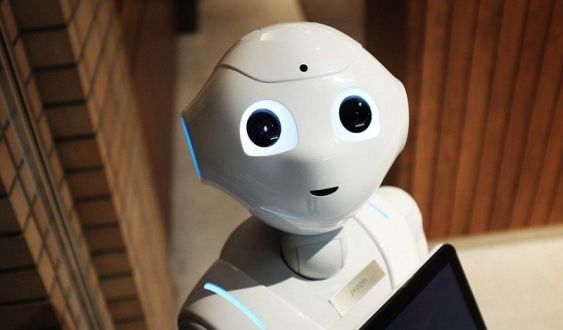
If we delve into robotics, we will see robots performing jobs in hospitals, being part of the boards of directors of large corporations, or welcoming guests in hotels or restaurants. This is the case of a Canary Islands hotel that has hired a robot, named Pepper, to attend to customers with a friendly demeanor. In the essay The Unstoppable March of the Robots, Andrés Ortega introduces us to its variable possibilities of use and warns of the challenges we will be exposed to. In his reading, the author introduces us to the robot/plush baby seal, called Paro, (in Spain, Nuka), which is being used to emotionally treat elderly people suffering from Alzheimer's; to Hiroshi Ishiguro, professor of robotics at Osaka University, who has built a robot that is his alter ego, identical to himself, called Geminoid HI-1, as a robotic experience to work on the emotional plane, to make them more human. There is robotics at the service of providing mobility to people with motor deficiencies, being able to replace arms, legs or other organs that have suffered deterioration or to increase abilities. There is robotics applied to pleasure, as already happened in the past with automatons, as could be seen in Federico Fellini's film Casanova, where Giacomo Casanova made love to an automaton. There is robotics to correct the dysfunctions of an aging society, as is the case of Japanese society, which will have a population with a percentage of 30% over 65 years old compared to the current 23%, seeing in robotics an effective way to mitigate the problem.
But the big question that invades the minds of many governments is the negative impact that robotics can have on work. We have reached the point of raising its problems in electoral programs, as has been the case with some political parties in France. It is proposed that companies that hire robots pay taxes given the danger of exacerbating unemployment. The controversy between collaborating or resisting the advance of robotics can be seen in the data from a study on the computerization of European jobs, which warns that in just two decades between 40% and 60% of the European workforce could be affected. Specifically, in Spain, Andrés Ortega points out that 55.3% of jobs could be lost.
The challenge of robotics, its advance and capacity to define the present, allows us to glimpse that our present needs to enable spaces for reflection and critical thinking to formulate the right questions in order to clearly envision how a robotic future that invades everything, even our way of thinking, can affect us. Perhaps the success of philosophy books, which have become bestsellers throughout Europe, is due to the imperious and human need to try, through reading, to understand what is happening around us, to obtain answers about the present/future of our species.
Add The New Barcelona Post as your preferred Google source for free
Stay informed with the latest news.