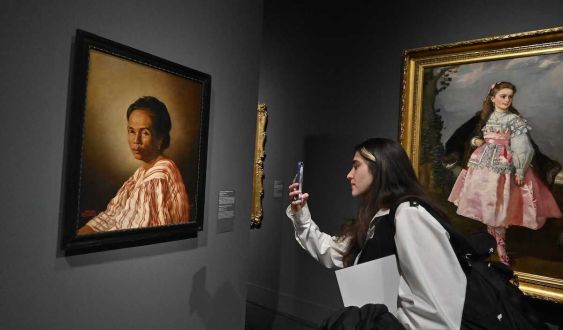
In the era of selfies, CaixaForum and the Museo Nacional del Prado focus on their ancestor in their latest joint exhibition, reclaiming the past as a way to question the present time. Portraits exploded in the 19th century, when full-body mirrors became popular and personal image awareness grew, as well as when capitalism and its individualism took hold. Faces served, and serve, as an element to express concepts such as power and identity, but they were also used to make death visible, before it became taboo to portray it.
Curated by Javier Barón, the exhibition XIX. The Century of Portraiture. Collections of the Museo del Prado. From the Enlightenment to Modernity is made up of more than 170 pieces from the collections of the Madrid art gallery, including paintings, drawings, sculptures, engravings, medals, miniatures, and photographs. Only four come from the Museo Reina Sofia and one from a private individual, the only daguerreotype in the exhibition, Portrait of a character in traditional Andalusian costume.
The exhibition has allowed some seventy works to leave the Prado for the first time, such as the bust of Francisco de Goya on which the Goya statuette was based, recalling its original color, which this year has been replaced in the awards by recycled bronze. Also doing so are paintings such as Esteban Villanueva's India del campo and the portrait made by Philip Alexius Laszlo de Lombos of what is considered the first it-girl in history, the British writer Elionor Glyn. And, half of the exhibited works have taken advantage of the trip to be restored.
"When one is told 173 portraits, it may seem too many, but, when one walks through the exhibition, it is quite the opposite. The variety of messages and contents that these works gather is extraordinary, so much so that it transforms into something more complex and rich in the history of the 19th century in Spain," says the director of the Prado, Miguel Falomir. "Portraiture is the artistic manifestation where the artist has his freedom most limited: a closer and more conflictive relationship is established between who commissions the work and who executes it," he continued, "the client has a more authoritative opinion, one can know about painting and may find a landscape more or less successful, but what everyone is clear about is how they want to be portrayed."
Despite the tension established between the sitter and the painter, the artist manages to make each work his own, as evidenced in the seven included in the Francisco de Goya exhibition: "Although the artist has his hands tied, he is capable of leaving his mark: whoever sees a Goya portrait knows it can only be by Goya." The Prado has brought some of his most famous portraits, with protagonists such as Fernando VII and Gaspar Melchor de Jovellanos. There is also a self-portrait of his from 1815. One can even see the tests he did with two members of The Family of Charles IV, emerging from the reddish preparation with which the Aragonese painter executed the portrait.
Goya is not the only big name visiting CaixaForum; he is also accompanied by Joaquín Sorolla, Raimundo Madrazo, Eduardo Rosales, Ignacio Pinazo, Miquel Blay, and Marià Fortuny. From the latter, the exhibition includes Fantasy on Faust, his only painting where his handwriting can be read. The exhibition can be visited from this Thursday until June 4 and will then travel to Zaragoza, Seville, Valencia, and Palma. A documentary will also be dedicated to it, which can be seen on the CaixaForum+ platform.
Add The New Barcelona Post as your preferred Google source for free
Stay informed with the latest news.
