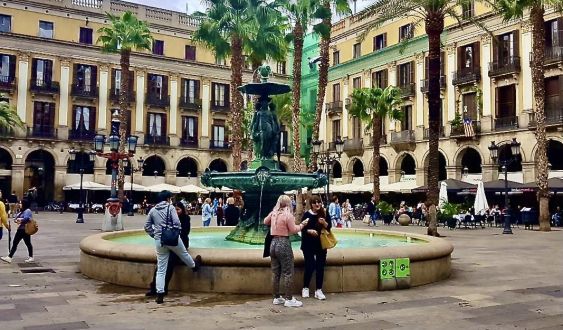
The Plaça Reial has launched an initiative to revitalize this iconic space in Barcelona. It consists of a set of free recreational activities, from music, workshops, and sports, organized by the Associació d'Amics i Comerciants de la Plaça Reial. The objective is to attract citizens back to the square and reactivate it from an economic point of view after the standstill caused by the health crisis.
This appendix to La Rambla has gone through various stages throughout history. From a leisure spot, let's say alternative, to a drug market and stages in which insecurity took over the space at certain times of the day. In my case, it was the scene of initiation into adulthood. During high school, in the early 80s, a group of friends and I would go to Plaça Reial every Friday to have some beers without anyone caring if we were of legal age.
Plaça Reial opened us up to a world we found fascinating and that allowed us to tell war stories to our classmates afterward. At that time, it was an ecosystem where drug dealers, bohemians of all kinds, pre-Olympic tourists, underground people ---among whom artists Ocaña and Nazario stood out--- and a whole world of characters who wandered along La Rambla and whom today we would call freaks coexisted. There we saw the first transvestites. It was a lot of fun and I must emphasize that never, in those incursions, were we involved in any incident.

The association was born in 1999 to promote the square from a cultural, commercial, and civic point of view. Because Plaça Reial is all of this. There, the crazy party nights in punk discos coexisted with philatelic mornings. This space, similar to Madrid's Plaza Mayor but on a smaller scale, is the result of the ecclesiastical disentailment process of 1835. The Capuchin convent of Santa Madrona stood there. The square was the work of architect Daniel Molina, to whom much of the urbanization of old Barcelona in the mid-19th century is owed. It was built in 1848, a year after the inauguration of the Gran Teatre del Liceu. In fact, the square was a kind of complement to the bourgeois lyrical theater.
One of its most special characteristics is that, although it seems rectangular, the square is actually trapezoidal and one of the few arcaded squares in Barcelona. In the center, you will find the Font de les Tres Gràcies, a work by the French sculptor Antoine Durenne. We also find lampposts by Antoni Gaudí.
It is perhaps due to its urbanistic origin with various contributions and its strategic location that the square has become a meeting point for a heterogeneous public. That is one of its graces and that is why the initiative of the Associació d'Amics i Comerciants is successful in combining activities that generate economic, cultural, and civic attraction, the three axes in which the square has always positioned itself, albeit with varying intensities and successes over the last few decades.
Plaza Reial will never die. It will always be an emblematic space where different sensibilities have coexisted, coexist, and must continue to coexist, giving it personality through its different offerings: gastronomic, musical, collector's... On the last Diada de Sant Jordi, it was one of the new book selling spaces and one of the most popular among the public. It was a success that deserves continuity.
Plaza Reial forever.
Add The New Barcelona Post as your preferred Google source for free
Stay informed with the latest news.
