Establishing a direct dialogue with the Spanish Museum of Abstract Art in Cuenca, the exhibition The Paths of Abstraction (1957 – 1978) contains more than seventy works that reflect the different forms of abstract art throughout the second half of the 20th century. The exhibition reviews the characteristic elements of informalism, abstract expressionism, lyrical and gestural abstraction, geometric abstraction, kinetic art and color field painting.
Abstract painting was born with this name in 1945 as a formal response to the figurative canons established until then. Aspects such as pain, passion, loneliness, anguish, etc. find new forms of expression that try to break with all ties to the past. The severe consequences of the Second World War present a problem regarding the representation of the figure and specifically of the human figure after the discovery of the horrors perpetrated in concentration camps throughout Europe. The images of bodies piled up, filmed, one with another, the story of the mistreatment of the figure and the dehumanization of man, push the idea that everything has already been expressed about the body, that nothing can impact as much as those images, that there is nothing more to say or it is impossible to say it with the means existing until now.
At the same time, the need to promote a uniquely American and distinct art, a modern and new way of thinking and understanding art, pushes to support artists like Pollock and Rothko to turn them into a national economic engine.
Although the first notion of abstract art is attributed to the critic and historian Alfred Barr (founder and first director of MoMA), when, in the midst of the 1929 crash, he refers to Kandinsky's geometries as the culmination of the evolution of Matisse's fauvism and the result of some of the theories on color and composition indicated by Gauguin, today we know of the existence of the works of Hilma af Klint (1821 - 1944), the true pioneer of abstract art around 1906. Despite everything, it will not be until almost two decades later that the popularity of its most relevant artists will begin.
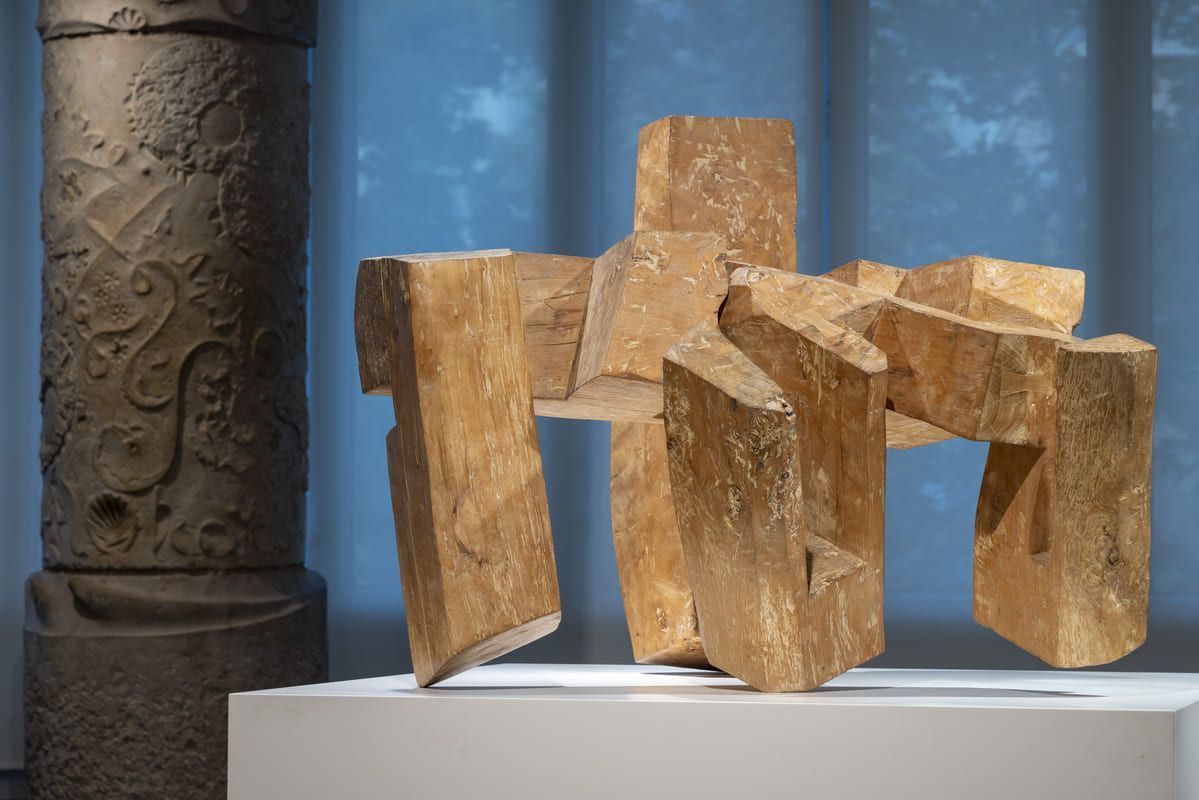
"The Paths of Abstraction (1957 – 1978). Dialogues with the Spanish Museum of Abstract Art in Cuenca" begins with Chillida's Abesti Gogorra IV and continues with a set of evocative and imposing works.Later currents of thought and art criticism in a psychoanalytic key will say that the path every painter undertakes, inevitably leads to abstraction. This idea is based on the theory of freedom linked to the blank canvas and the certainty of the infinite possibilities that open up to the artist in front of that "window" which, unlike the physical space occupied by sculpture and its limited trajectory, contemplates infinite paths to explore through experimentation and the opaque and hermetic work of the unconscious.
In Spain, the antecedents come from the School of Altamira in Santillana del Mar (Cantabria), founded in 1948 with the intention of recovering artistic avant-gardes in the midst of the post-war period and, almost at the same time, in Barcelona, the group Dau al Set was born, with Antoni Tàpies, Joan Brossa, Arnau Puig, Joan Ponç, Modest Cuixart and Joan-Josep Tharrats. The informalism of the 50s in the hands of Tàpies and the creation, in 1957, of the group El Paso and the Equipo 57.
The exhibition focuses on the origin and crucial role of the Museum of Spanish Abstract Art in Cuenca, inaugurated in the Casas Colgadas and founded by Fernando Zóbel in 1966, currently in the hands of the Juan March Foundation. A peculiar museum, which Alfred Barr himself defined as "the most beautiful small museum in the world" and which was a pioneer in every sense and a true refuge of freedom at the time for national and international artists who exhibited there. The exhibition contains numerous original materials from the museum such as photographs, sketches, drawings, letters, books and press releases.
The museum had a retrospective in 1967 by the critic Rafael Santos Torroella, the painter Joan Hernández Pijoan and the sculptor Marcel Martí at the College of Architects of Catalonia and the Balearic Islands.
La Pedrera commemorates this event following the spirit of the Cuenca Museum, exhibiting the works so that they dialogue with each other. Thus, relationships are established between the works of Antoni Tàpies with those of Jean Dubuffet, those of Manolo Millares with those of Alberto Burri, those of Antonio Saura with those of Emilio Vedova, those of Antonio Lorenzo with those of Nicolas de Staël, those of Eusebio Sampere with those of Alexander Calder or those of Albert Ràfols-Casamada with those of Mark Rothko.
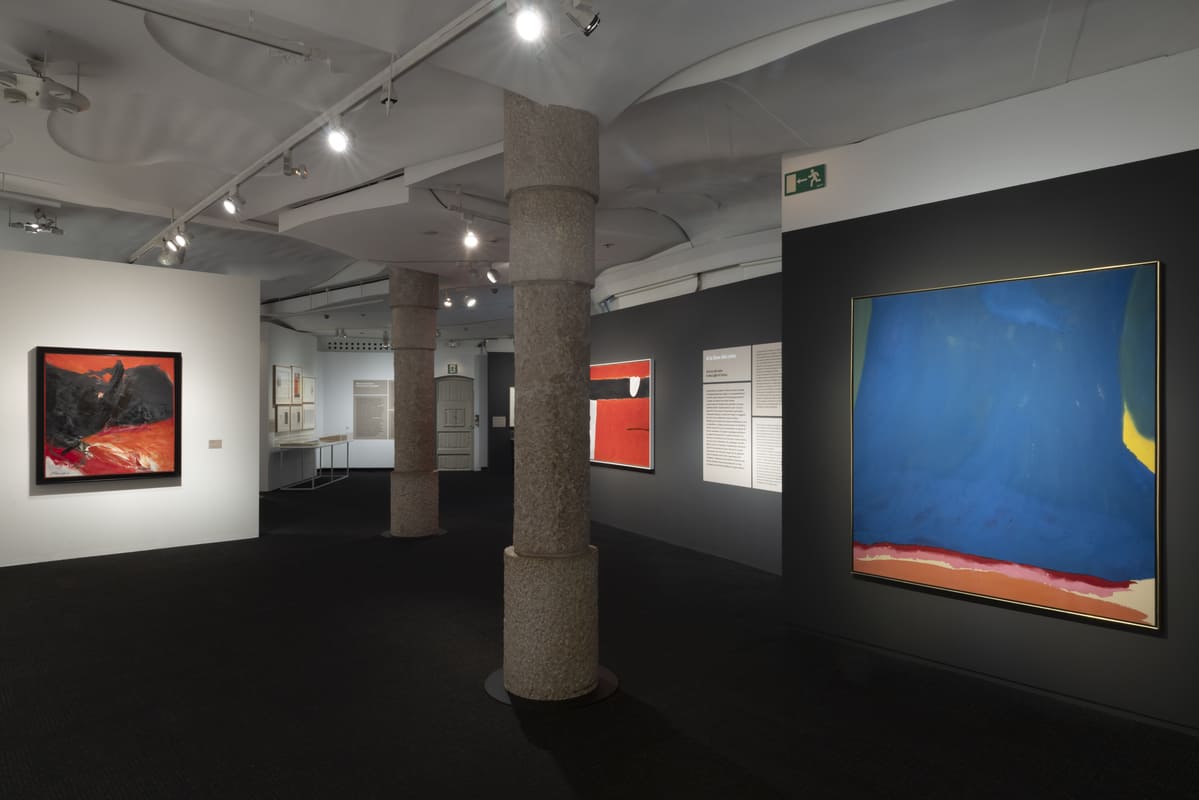
We are talking about the Dream Team of abstract art. Names like Elena Asins, Sara Grilo, José Guerrero, Eva Lootz, Manuel Millares, Pablo Palazuelo, Antonio Saura, Soledad Sevilla, Antoni Tàpies, Jordi Teixidor, Gustavo Torner, Fernando Zóbel and José María Yturralde, among others, or sculptors like Jorge Oteiza, Eduardo Chillida and Martín Chirino. An exceptional group of artists who refused to be categorized under the prism of abstract expressionism or any other label.
But the truth is that there were common aspects marked among all of them such as spirituality, the expression of pure feelings, the deep and pure expression of emotions and the need for a kind of automatic writing in their work process. Work was done outside of reason and consciousness.
The exhibition impresses with its space. We cannot imagine a better setting to accompany the transgressive spirit and the inspiration of the unconscious than the exhibition hall of La Pedrera.
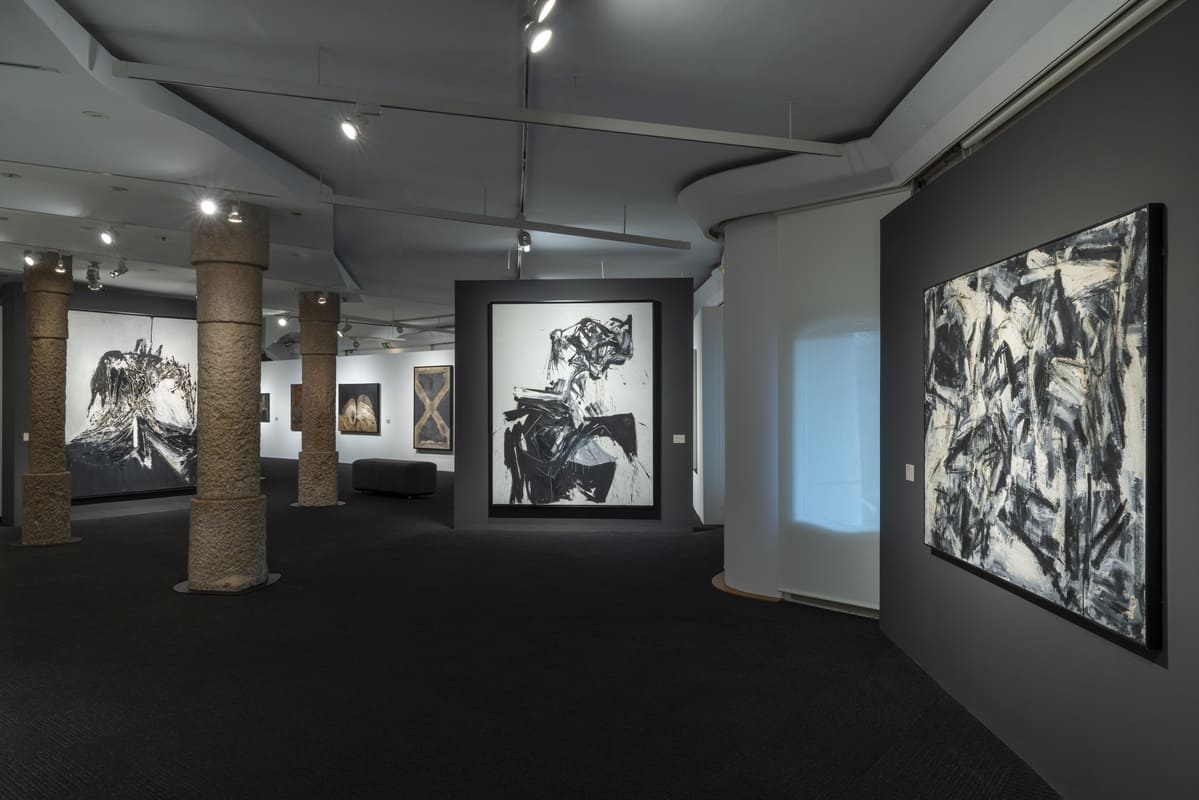
The visitor is overwhelmed by the colossal Portrait of Brigitte Bardot (1959) by Antonio Saura, in black and white and grays, on a white background, with acrylic impasto over oil and precise, incisive strokes that leave symmetrical traces resulting from the violent passage of the palette. Saura was a master of gesture painting.
Within Catalan informalism, Blau Profund (1959) by Ràfols-Casamada stands out, playing masterfully with color to give depth to the piece. A turquoise over navy blue and a white rectangle in the lower right margin evoke solitude, desolation, sadness...
Gran Barroco (1959) by Modest Cuixart also stands out in the same room, texture on a burgundy background, dripping of impasto and a vertical that blends with ocher give violence and elegance to the work.
Marrón y Ocre (1959) by Tàpies, a mass of impasto (clay or acrylic) shares prominence with Tabla Nu by Dubuffet, a beige figure reminiscent of an elephant with short legs on ochres.
The Número 148 (1959) by Luis Feito, shows us a magnificent work with texture. Burnt cotton on a white background in the lower part of a kind of fog.
The work with different materials, sometimes waste, or industrial material that has nothing to do with artistic production, marks a characteristic line in some artists. The material diverted from its initial purpose, re-imagined, taken out of context and used by the artist. In Dubuffet's words: "Art must be born from the material. Spirituality must adopt the language of the material. Each material has a language. We are not talking about giving a language to the material, nor about making the material serve a language."
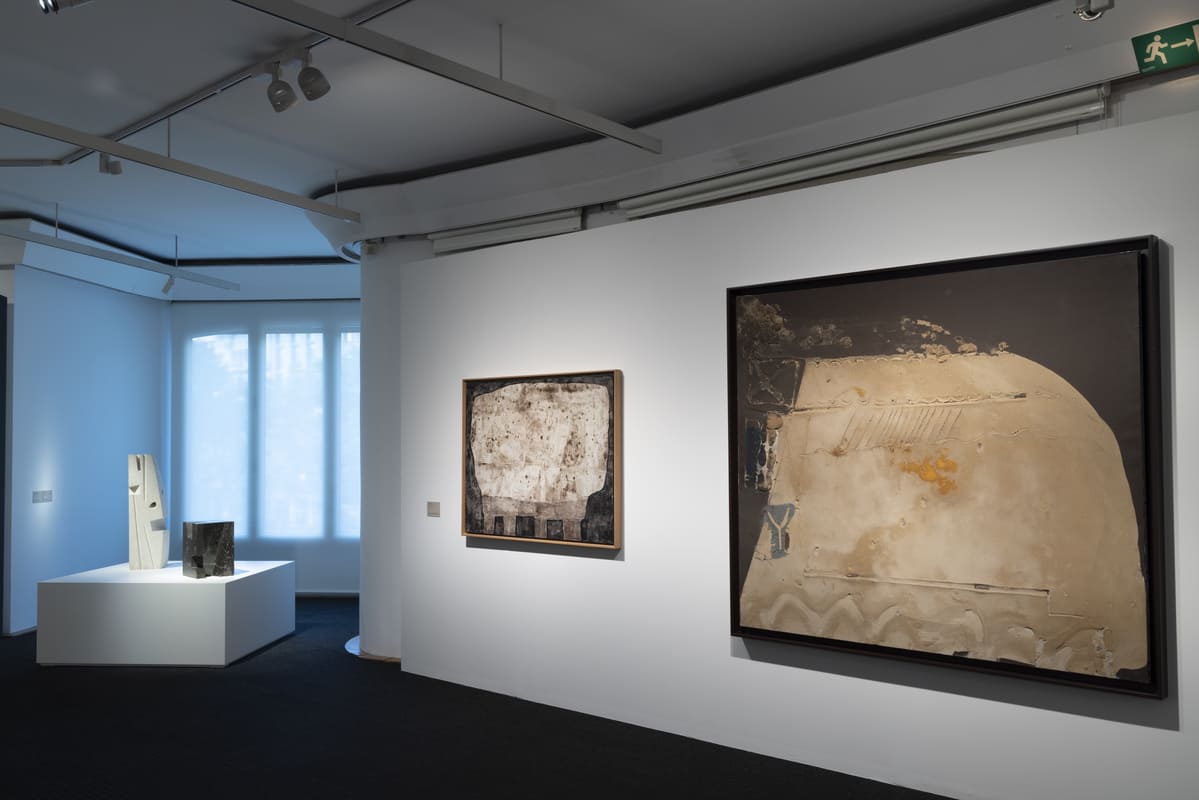
Lucio Muñoz with his Green and Black Structure (1961), presents cut wood on ocher pieces that form a construction. In the nooks, it presents a depth in blood red color. It seems there is something organic inside the canvas.
The manipulation of metal sculpture in the hands of Martín Chirino opens up previously unimaginable paths in representation.
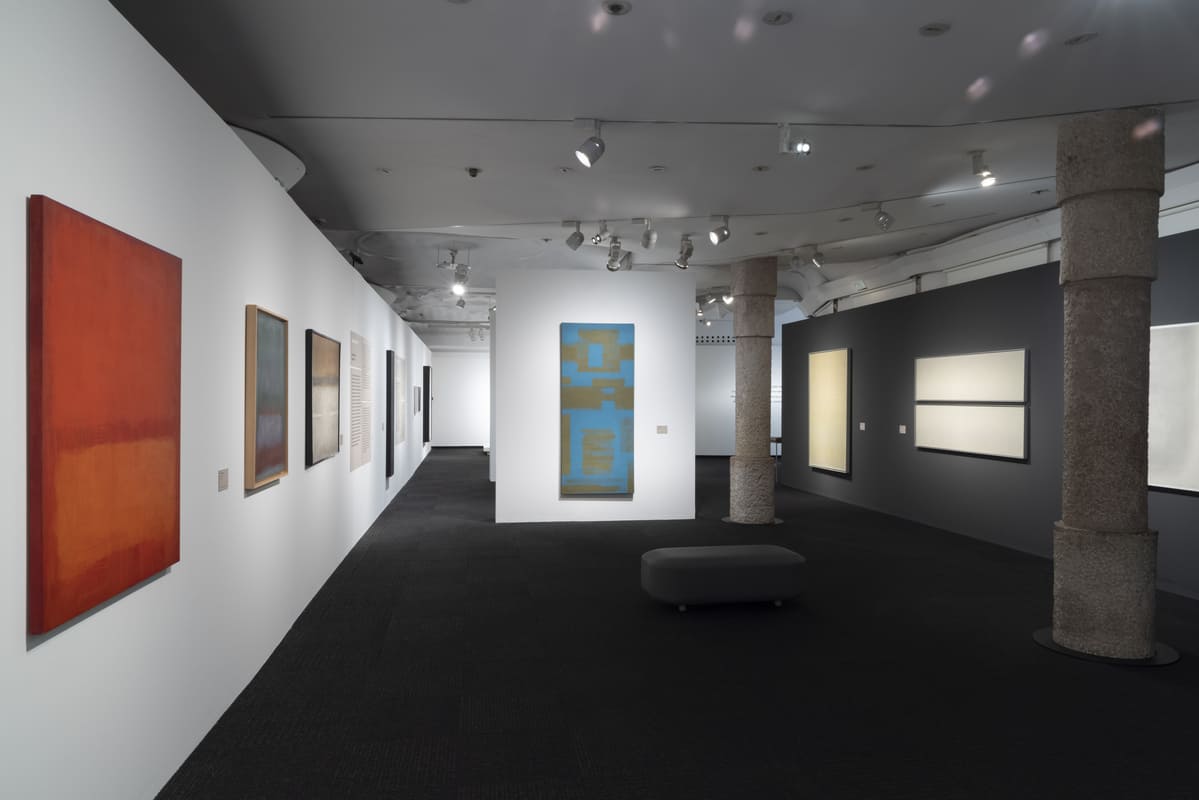
In another room, geometric forms confront existentialism, informalism, and abstract expressionism with pure, saturated colors and flat forms. There are group works by Equipo 57 in the constructivist line.
Optical-kinetic abstraction, where movement is the main concept of the works. Eusebio Sempere's work stands out, which the visitor can touch to make it move.
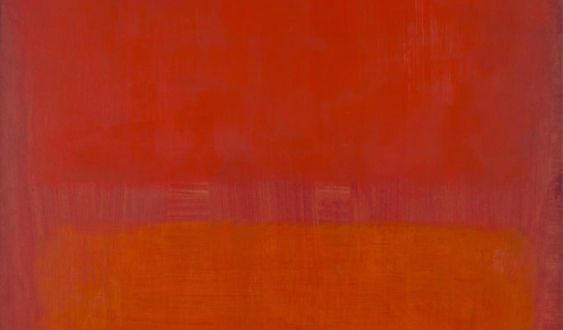
The color fields. Pollock and De Kooning, the gesture and the act of painting, experimentation with color becomes the only relevant thing and the very process of painting is the sole end and purpose of the work. A Rothko rivals. Untitled (1969), red and orange, with Untitled No.5 (1964) by Esteban Vicente, a brown and burgundy work that stands out, and strongly, in what constitutes a true magnetic challenge to the gaze.
The exhibition, organized by La Fundación Catalunya La Pedrera and the Fundación Juan March, and curated by Manuel Fontán del Junco, Sergi Plans and Marga Viza, has an itinerant character distinguished in five series ranging from Granada in 2022 to the Meadows Museum SMU center in Dallas, Texas (USA) in 2023. In such a special enclave in Barcelona, it can be visited until January 15, 2023, in what will be the new exhibition program of La Pedrera under the direction of Marta Lacambra. Until 2025, it is planned to exhibit such important names as Miquel Barceló, Jaume Plensa, Barbara Hepworth or Antonio López.
In addition, it features an expanded exhibition. It is a series of cultural proposals that attempts to offer new perspectives and also, establish dialogues with other artistic disciplines. The exhibition "Abstraction in Catalonia (1948 – 1969): From Dau al Set to the Salons de Maig" at the Biblioteca Nacional de Catalunya, as well as events at the Gran Teatre del Liceu, with a recital by Pierre-Laurent Aimard, proposals at the Fundació Tàpies and the Fundació Suñol, with works by Elena Asins, Pablo Palazuelo and Fernando Zóbel alongside works by artists from their collection, Susana Solano and Josep Guinovart, also inviting a selection of artists to dialogue directly with them and with the library, the collection and the spaces of the Museo de Arte Abstracto Español. The current artists are Asunción Molinos, Joana Moll, Antònia del Río, Arnau Sala, Julia Spínola, Pep Vidal and Oriol Vilanova, in a project curated by Glòria Picazo. Events will also be organized at Foto Colectania, La Filmoteca de Catalunya and ESMUC.
In short, a must-see exhibition for art lovers in general and followers of avant-garde movements due to the quality of the works it contains. An ideal place to enjoy the architecture of our city in such an exceptional modernist building and a guarantee of suggestive images of great quality, and vibrant colors and shapes, as only the best art can provide to the viewer.
Add The New Barcelona Post as your preferred Google source for free
Stay informed with the latest news.