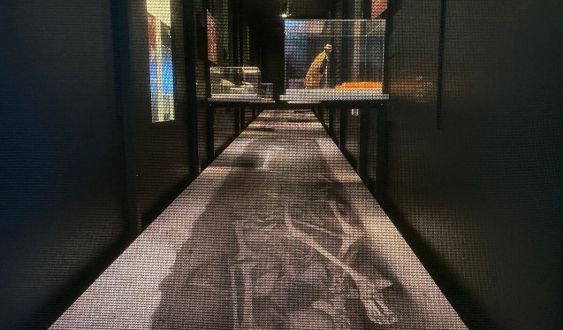
In a small room at Palau Robert, a mass grave has been excavated that could be that of many. The exhibition Where are they? 85 years of mass graves from the Civil War in Catalonia aims to recreate the conditions in which thousands of disappeared individuals are found, to highlight the wound that society still carries, but also to make known the process that families follow to find them.
The proposal was curated by historian and professor at the University of Barcelona (UB) Queralt Solé. The grave, into which one leans as if it were a black hole, is accompanied by objects found alongside exhumed remains, such as a canteen. All of this, with testimonies from soldiers explaining how they experienced the war and the thirst they endured at the front.
Starting from this central element of the exhibition, a historical review of mass graves in Catalonia is presented. Although exhumation seems a very recent reparation, it was carried out during the Civil War itself, according to Solé, by the Republican Generalitat. The Francoist dictatorship then continued to do so, opening graves where there were victims from the victorious side and condemning those from the other side to oblivion and silence.
With Franco's death, Solé explains, relatives of disappeared Republicans armed themselves with picks and shovels to unearth their loved ones, in places like Catalonia, Andalusia, and northern Spain. Here, it was in Balaguer, when in 1982 descendants of combatants from the "Quinta del Biberón" went to unearth remains in a place where they knew there were bodies. Without being able to perform DNA tests to confirm identity, solely as an exercise in dignity, they buried them in Camarasa.
After specific reparations like these, the opening of graves reached a turning point, both in Catalonia and in the rest of Spain, when remains were exhumed in Priaranza del Bierzo in 2000. It was the moment when society became aware that there were still too many disappeared individuals and many grieving families, so institutions took over. In Catalonia, a Census of disappeared persons was created, followed by a law in 2009 that determined the process for exhuming a mass grave. Then, in 2017, this line was reinforced with the Grave Plan and the Genetic Identification Program, especially used, Solé indicates, by the third generation of descendants.
The exhibition at Palau Robert also gathers different testimonies from families, both those who have been able to find their disappeared and those who never will due to lack of information. Cases such as that of Marcos Andrés Latorre are also shown: his family searched for him and found that his remains were transferred to the Valley of the Fallen. Unable to recover them, they paid him their small tribute at the Memorial de les Camposines, in La Fatarella.
The exhibition Where are they? 85 years of mass graves from the Civil War in Catalonia can be visited until February 26. When its stay at Palau Robert ends, it will go on tour.
Add The New Barcelona Post as your preferred Google source for free
Stay informed with the latest news.
