The MOCO Museum has become a benchmark in contemporary art in the city since the opening of its Barcelona branch in October of last year. Its magnificent facilities, located in the old Cervelló Palace, at number 25 Montcada Street, host the most famous and prestigious international artists. Currently, alongside a work by Damian Hirst, one by Yayoi Kusama, several Basquiat, Bansky and names like Kaws, Kays, La Chapelle, Murakami, Haring, Thom or Warhol, we find the work of Guillermo Lorca, one of the most relevant artists in current figurative painting. Guillermo Lorca was born in Santiago, Chile in 1984 and is the son of writer Beatriz García Huidobro.
He considers himself a self-taught painter; he started painting at the age of eight, amazed by the works of Gustave Doré. According to his own words, he started from an old Velázquez book with enlarged photographs of his works. Trained with the Chilean painter Sergio Montero (also close to Doré's style), he enrolled in the Catholic University of Chile and left it to go to Norway in 2006 to apprentice with painter Odd Nerdrum, a controversial figure in the art world due to his teaching methods and dogmas, and for being strongly influenced by Rembrandt and Caravaggio.
In 2007, Guillermo Lorca returned to Santiago, Chile where he exhibited his first solo show, Debushka, at the Matthei Gallery, and painted mural portraits for the Baquedano subway station (2009-2010), becoming the youngest painter to do so. Interested in street art, in 2013 he participated in Art Spot Miami and appeared playing himself in the film Summer of Flying Fish, by director Marcela Said, a film that was presented at the Cannes Film Festival that same year. With the rise of social media, and Instagram in particular, his works gained a lot of visibility and began to become tremendously popular.
With a neo-baroque style, almost with Renaissance references, Lorca's works propose a particular universe between magic and realism. They believe in the classicism and composition of Rubens, with the mixture of images from advertising and digital environments. With characters from fairy tales, dreamlike, naïf sequences are established, which flee from kitsch aesthetics and hyperrealism, due to their high doses of tension, thus configuring a personal violent mythology, which sometimes becomes bleeding.
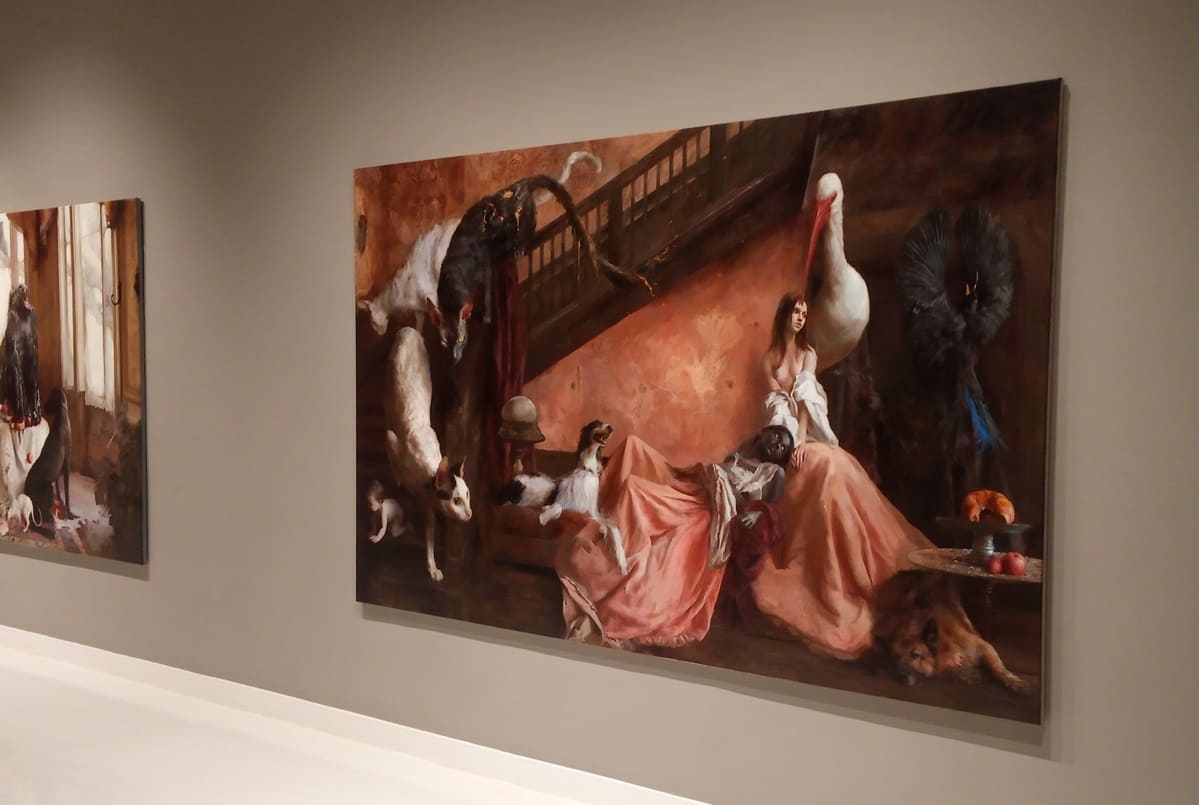
The canvas The Healer and Bird of Paradise can also be seen in Splendor in the Night.
Guillermo Lorca's canvases are monumental and depict the struggle between nature and humanity, between danger and innocence. With limited production, the painter admits to painting from photographs and using collage and new technologies to construct his images through editing programs. He paints in oil and uses small patches to emphasize the disparate proportion of the figures and play with perspectives. Likewise, he uses diluted paint to let the liquid, viscous, and unstable aspects of the painting flow. He flees from reality to construct his own and rejects the idea of explicit eroticism, at least in his most recent works.
The use of the female image is the reflection of his soul, which is female, and he uses portraits of his nieces, the childhood memory of his sister, or the image of his ex-girlfriend to construct the characters.
He starts from an idea of landscape, a kind of conflict to which he adds images as if from a photo bank, until he finds the perfectly designed image. Thus, the figure of the girl with colored hair is the influence of Japanese animated series, the representation of a valuable part of the human spirit, childhood, something beautiful, idyllic, which is endangered by its fragility and is worth treasuring.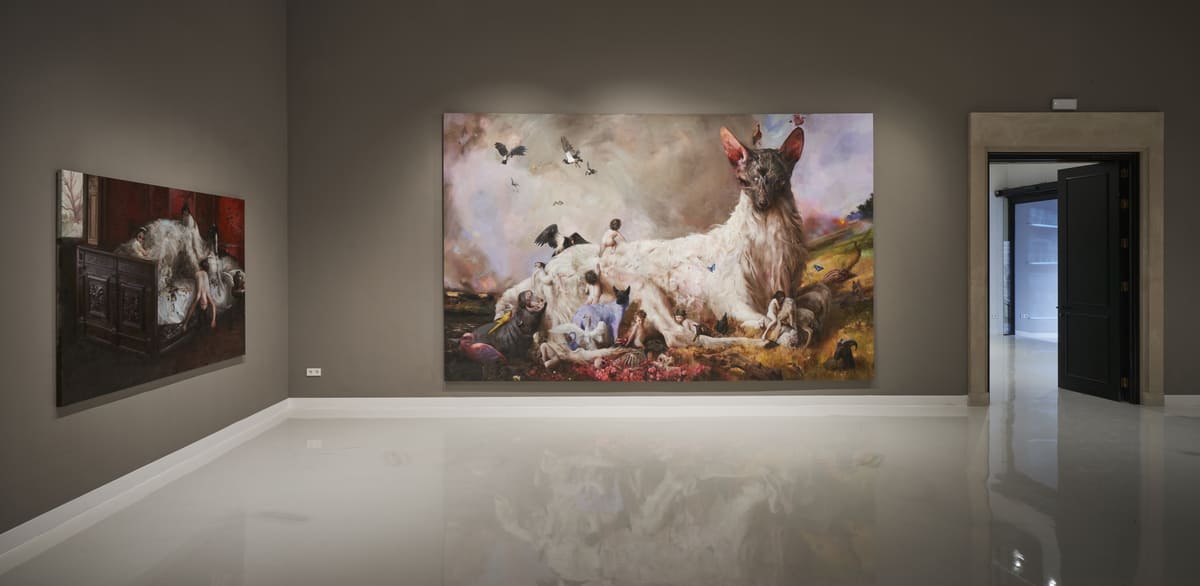
The work The Empress is one of the essential pieces in Guillermo Lorca's exhibition at the MOCO Museum.
Fleeting childhood is where we find the first impact with fear, hostility and rejection and death. Animals, real or fictitious, are oversized; it is the power of nature over man. These are shown as affable and protective, or dangerous and threatening. Sometimes, they are just mere docile spectators of the scene. The colors, with a mix between real color and light and unreal color and light, are mostly pastel tones, with an emphasis on light blue that identifies with innocence and a bubblegum pink with which we see blood, violence and wounded and naked flesh.
Often, a liquid, free, whitish element remains latent, showing echoes of spilled milk, the first food we take as children; or it could be a sexual element, the sperm that fertilizes and gives life to all the beings that appear on stage. The same happens with blood. The exhibition, commissioned by Simon de Pury, one of the most relevant names in the art world, consists of six pieces, two of which can be enjoyed with augmented reality technology, an immersive experience through MOCO Play, an application designed by Studio Irma by artist Irma Vriers, who already collaborates with the museum in the exhibition Diamond Matrix.
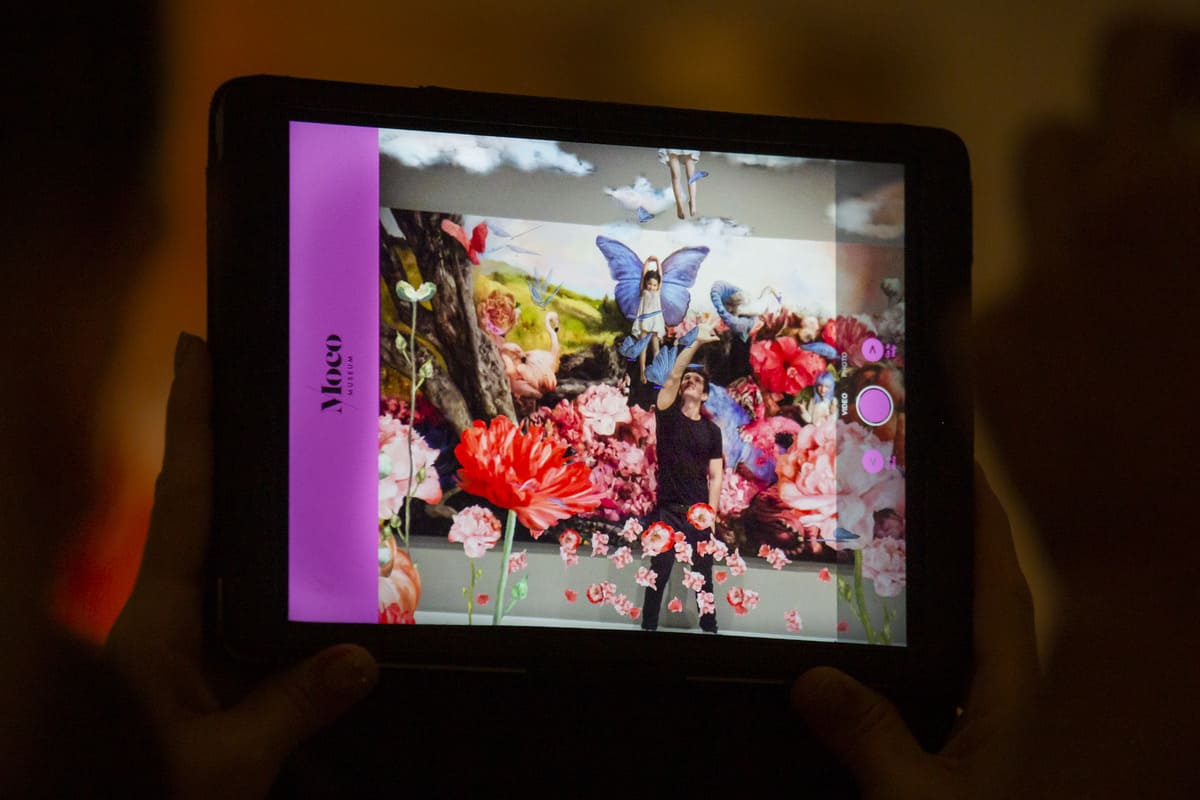
Guillermo Lorca and augmented reality in The Little Gardeners.
With this application, the visitor feels invaded by the painting and the canvas seems to come to life: the foliage sways, the curtains move, the gorilla moves its jaws, a bird flies over the canvas and the figures seem to approach, some, in a threatening way. Everything in the painting becomes organic, as if the painter's imaginary became real, enveloping the viewer in a unique experience. The works in the exhibition The Little Gardeners (2021). A canvas endowed with MOCO Play technology where fairies gather amidst a hunt for tigers and gigantic flowers. The girls display the blood with solemnity. Sky blue and pink are the protagonists of such a bloody scene. The Healer (2020), (MOCO Play). A girl washes a gorilla's wounds in a Victorian-looking interior. A game in which the author replaces stuffed animals with real animals. Echoes of Beauty and the Beast, in the author's words. Bird of Paradise (2019). Tranquility and mystery, stillness and movement are masterfully mixed in this work: girls look off-camera accompanied by a huge stork and a dog. On the other side, a pair of giant cats rush down the stairs, next to a baby. Burning lava seems to slide down the steps. The Big Bear (2018). A giant dog sleeps on a bed of white sheets, staining them with its paws. Three girls respond differently to its presence: indifference, fear, serenity...
The Empress (2020). The largest work in the exhibition. A wounded animal, a deity, protects girls and animals from the fire in the background. Fire, also, as something purifying.
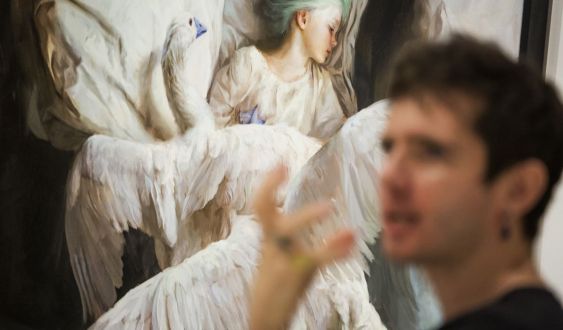
The Landing (2019). A blue-haired girl sleeps among a mantle of geese with beautiful plumage.
The Encounter (2018-19). Another large format showing a low staircase filled with a white liquid and whose image was his partner (Javiera Gaeta) walking on the author's head and guarded by two beasts. Image based on the myth of Judith and Holofernes.
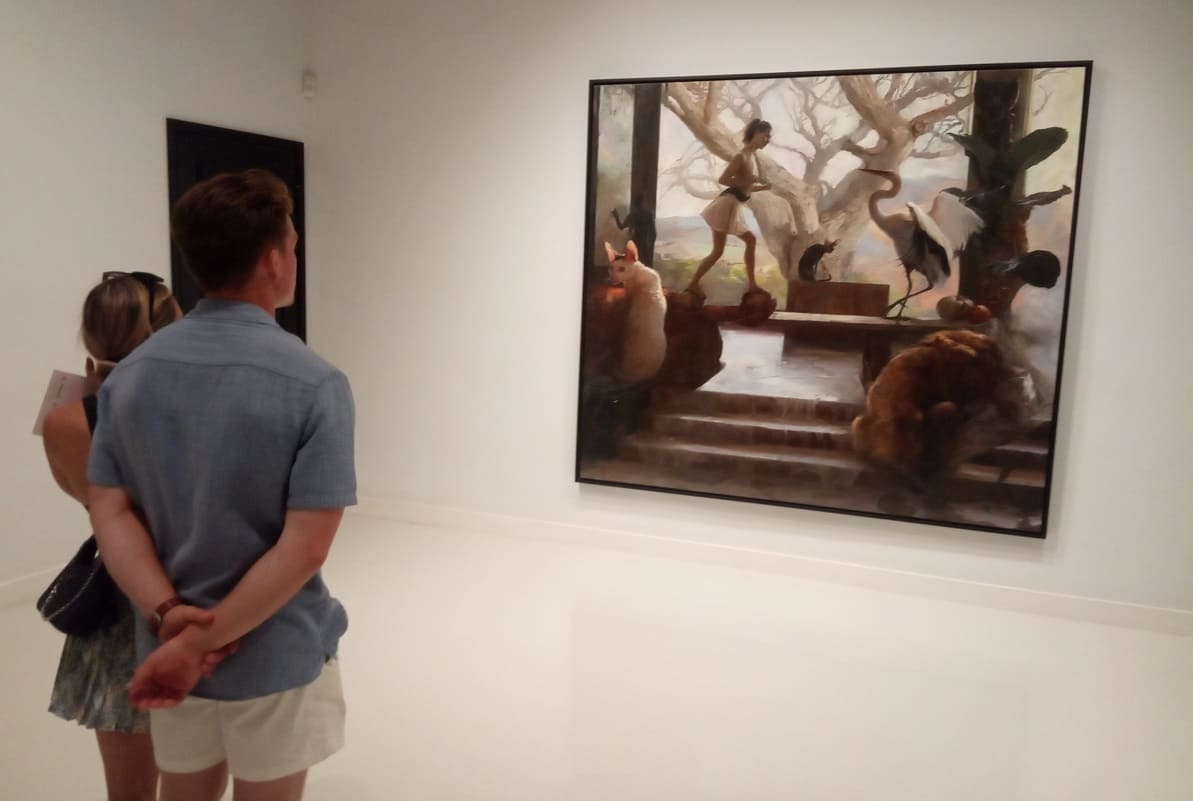
Some visitors to the exhibition observing the painting The Encounter.
Ultimately, we are looking at a painter with a classical appearance but who perfectly fits into postmodernity. He is an emerging figure to watch and who, in a recent interview with the famous art YouTuber, Antonio García-Villarán, has admitted that his works have reached figures above 150,000 euros in the secondary market; a growing, changing market, immersed in NFTs, a market in which the MOCO Museum is also a pioneer.
Splendor in the Night is a must-see exhibition for art lovers, especially painting lovers, and even more so for lovers, like me, of figurative painting. It is necessary to celebrate that the works of "new masters" like Guillermo Lorca can be visited in our city in such an exceptional setting as the MOCO Museum, which offers a truly unique experience to each and every one of its visitors.
Add The New Barcelona Post as your preferred Google source for free
Stay informed with the latest news.