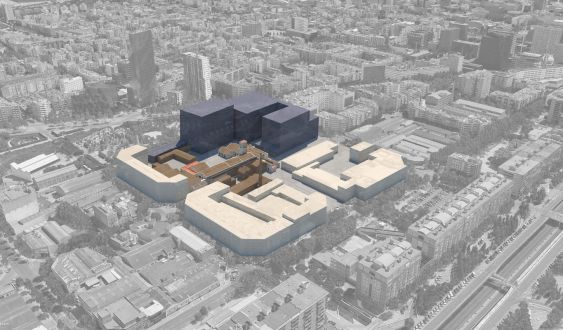
The Generalitat, the Barcelona City Council, seven universities and higher artistic education centers have signed this Friday the framework agreement to make the Campus de les Arts de Can Ricart a reality in 2026. The project, which will be initially financed with resources from the Next Generation Fund, aims to strengthen the artistic education system in two branches: research, development and innovation, as well as teacher training.
The Universitat de Barcelona (UB), the Universitat Autònoma de Barcelona (UAB), the Universitat Oberta de Catalunya (UOC), the Universitat de Girona (UdG), the Universitat Politècnica de Catalunya (UPC), the Universitat Pompeu Fabra (UPF) and the Universitat de Vic - Universitat Central de Catalunya (UVic) participate in this initiative. They are accompanied by the Facultat de Belles Arts de la UB, Estudis d'Arts i Humanitats de la UOC, Elisava, the Escola Superior de Cinema i Audiovisuals de Catalunya (ESCAC), EINA, the Escola Massana, BAU, the Escola Universitària ERAM-UdG, the Escola Superior de Disseny (ESDi) and the Conservatori Superior de Música del Liceu.
The UB, which leads the planning of the Campus, has launched all procedures to request funding for the rehabilitation works within the framework of the European Next Generation funds, for an amount ranging from 14 million euros to 18 million euros, depending on the degree of architectural efficiency achieved by the new facilities.
Depending on budget execution and investment availability, between 2022 and 2025, the bidding and execution of the projects and the rehabilitation and urbanization works of the entire space of the old Can Ricart factory complex will proceed, declared a cultural asset of national interest, located in Barcelona's 22@ District, and covering an area of 6,800 square meters.
Specifically, the rehabilitation and adaptation works of Can Ricart are the responsibility of the UB and the development of the urbanization of the space depends on the Barcelona City Council, according to the preliminary project that accompanies the comprehensive Special Plan for the regulation of the Campus de les Arts equipment in Can Ricart, definitively approved by the consistory in 2019.
The Campus de les Arts, a "unique project in Catalonia," according to the Minister of Research and Universities, Gemma Geis, and which was born from an initiative of the National Council of Culture and Arts (CoNCA), will provide a counterpoint to the fragmentation of the current offer that exists in these disciplines in Catalonia. Currently, there are nineteen centers of very different types (university, university-affiliated, public higher, and private higher) that provide this training, and this means that the diversity of higher education degrees or university degrees is very small (one per center on average) and that master's level studies are still minority (less than 6% of the total students), according to the UB.
It is also mentioned that this situation hinders the development of third-cycle studies, master's and doctorate degrees, and the R&D&i capacity in the academic field. Thus, the activity of the Campus de les Arts will encompass research projects, third-cycle courses, continuing education, and also knowledge transfer actions in the city and the country.
Currently, in Catalonia, there are nineteen centers of very different types that offer artistic trainingWith this educational offer, in Catalonia the number of students in higher artistic education is more than 8,000, with about 2,000 new students and more than 1,500 graduates per academic year. With the launch of the Campus de les Arts, a network will be created among all universities and university or higher artistic education centers to address these challenges, contributing to energizing the cultural hub of District 22@.
Built in 1853, Can Ricart was once intended for the manufacture of prints and was active until the last quarter of the 20th century. It is a representative building of the industrial heritage of Barcelona and Catalonia. The City Council, owner of the site, ceded the use of the main industrial building and some annexed buildings to the UB in 2015.
Add The New Barcelona Post as your preferred Google source for free
Stay informed with the latest news.
