Aurora Bertrana. Polyhedral. Living and writing with knowledge of cause is the new exhibition in the series dedicated to relevant personalities of Catalan culture displayed in the lobby of Palau Robert, in a mural structure, with large-format photographs and display cases. With free admission, it explores the different artistic facets of the writer from a perspective of remembrance, vindication, and discovery for new generations.
Writer, journalist, traveler, cellist, cultural activist, politician, feminist, lecturer... who, moreover, was daring, modern, ahead of her time, extravagant, exotic, and always, always, committed to her convictions, eventually becoming, also, an exile.
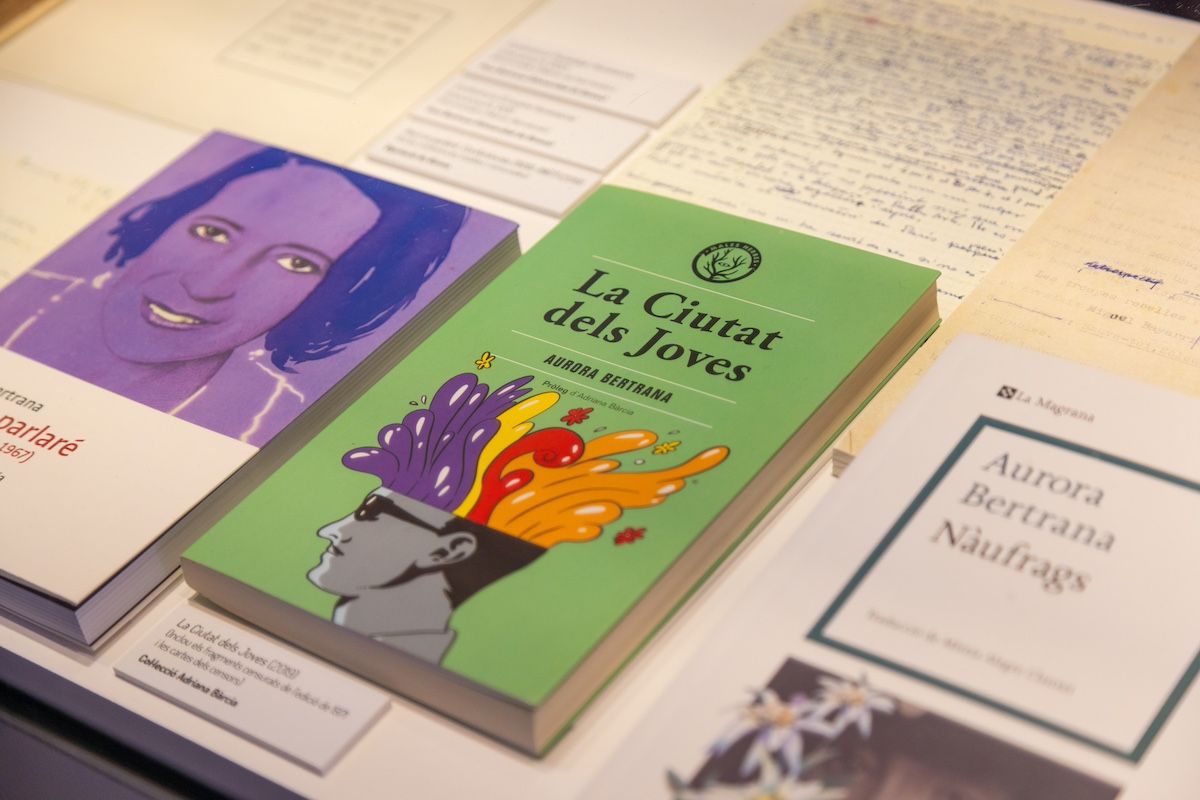
Popularly known for her travel literature, the exhibition also includes correspondence with celebrities such as Pau Casals, Pompeu Fabra, Josep Tarradellas, Caterina Albert, Carles Rahola, Ventura Gassol, Lluís Nicolau Olwer, or Salvador Espriu; as well as unpublished manuscripts edited by the exhibition's curator herself, Adriana Bàrcia, such as La ciutat dels joves (2019), Avui us parlaré. Conferències (1930-1967) (2019), Cendres (2022) or Nàufrags (2022); along with Vent de grop, Edelweiss or Álbum Bertrana. It collects interviews by Anna Martínez-Sagí with relevant women in Catalan culture such as Caterina Albert, Carme Monturiol, Teresa Vernet, and Aurora Bertrana herself.
Connected with the 20th century, she is an author with infinite connections, also, with the 21st century. She defended multiculturalism, and could be defined as a true ideological pioneer in terms of miscegenation, discovery, globality, and respect for other nationalities, customs, religions, etc.
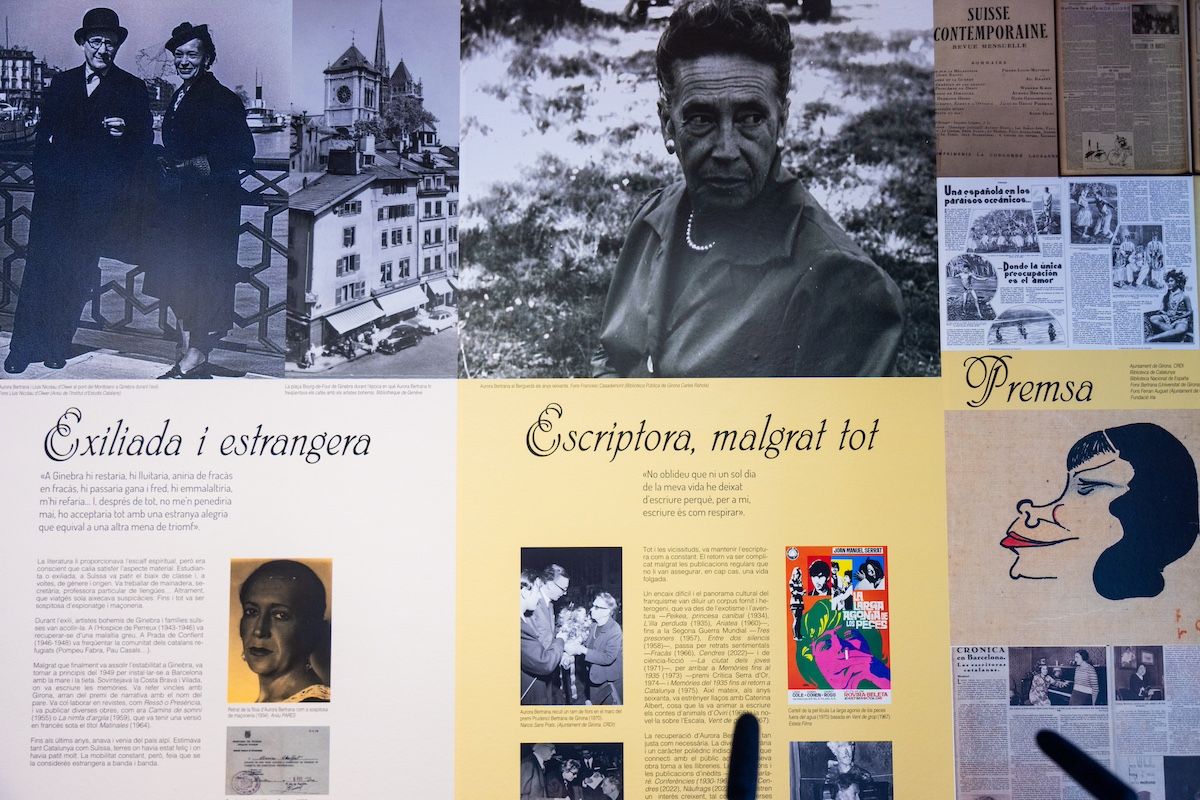
The exhibition is structured in blocks to offer a polyhedral perspective of her figure, both personal and intellectual. Headed by a phrase from the author, we find events from her private life mixed with those of her professional life and linked to culture and art in almost all its expressions. One more example of that overwhelming interconnectivity that stands out in her personality and makes her close and warm, while at the same time unattainable in her full dimension.
Aurora Bertrana i Salazar had a passionate biography. Daughter of Prudenci Bertrana and Neus Salazar, she was born in Girona on October 29, 1892. She debuted in literature with articles in La veu de Catalunya (1923), where she spoke of her experiences as a music student in Geneva. From French Polynesia, she wrote Paradisos oceànics (1930), embodying, for that era, the image of a modern, independent, cosmopolitan, progressive, and innovative woman for the clichés of the pre-war period. Always advocating for the role of the modern woman and her condition, she participated in press and radio, becoming a relevant voice committed to the ideals of the Republic. She published El Marroc sensual i fanàtic (1936), texts and chronicles of publicity about Muslim women. Against her father's will, she continued writing until collaborating on the novel L'illa perduda (1935). In 1938, her Swiss husband, Denys Choffat, returned to the nationalist side and her family forced her into exile. During this period, she worked precariously and helped many Catalans in the concentration camps in France, and went on a humanitarian mission to Étobon (Haute-Savoie), a place heavily affected by World War II.
Aurora Bertrana had a passionate biography: she wrote Paradisos oceànics from French Polynesia and published El Marroc sensual i fanàtic about Muslim womenIn 1949, finally, she managed to return to Catalonia, where she felt like a stranger.They were, in his words: gray years... where, and despite everything, he continued writing. From that era, stand out:Between two silences(1958), Vent de grop(1967), which would become a film directed by Francesc Rovira-Beleta with the titleThe long agony of fish out of water(1970). With the recognition of her father Prudenci's figure, came also the recognition of her work, and, settled between Barcelona and Berga, where she passed away on September 3, 1974, she wrote her memoirs.
In the exhibition, the block Sargantaneta exploradora refers to her childhood and the affectionate nickname her father gave her in relation to her adventurous and intrepid spirit. Aurora Bertrana reflects on her dreams of traveling to unexplored lands, a fascination with the unknown, and the ambition to have the world in the palm of her hand. It also narrates her time as a student in Barcelona and later, at the Jacques-Dalcroze Institute in Geneva (1922-24), where she studied cello and made a decisive contact with the European cultural environment that led her to become a writer and publish her Impressions d'una estudianta. Thanks to her husband, engineer Choffat's contracts, she was able to travel to Polynesia, where she worked as a music teacher and studied indigenous culture. Afterwards, she went to Morocco as a reporter to document in situ the lives of Muslim women.
She was exotic and pioneering, as the exhibition shows us, with a strong will to make immersive journeys around the world, to defend an unconventional stance and a globalized and cultured vision of it. She fled conventional tourism and believed that mixing in the societies she visited gave her a real perspective of events and that these deserved to be narrated and shown to the world from her point of view, a modern point of view; and especially, also, from a woman's point of view, with all that this entails; with a sensitivity and empathy different from those that prevailed in her time. All, with a personal vision as an initiatory and intimate journey, and at the same time, analytical and as a chronicler.
Her works, at that time, generated great controversy and were rejected by publishers, as they did not conform to the usual canons of women's literature. She was modern and cosmopolitan, defended universal suffrage, divorce, prostitution, free love, polygamy... her revolutionary ideas led her to collaborate with the Associació Protectora de l'Ensenyança Catalana and to teach at the Institut de Cultura i Biblioteca Popular de la Dona. She was one of the founders of the Lyceum Club (1931), which she left due to its unpopular nature, and always demanded a Universitat Obrera Femenina.
She was also an intellectual, an author committed to Catalonia and its language, but at the same time, international and open to the world. She was a candidate for the Cortes for Esquerra Republicana (1933), gave lectures in favor of the Catalan language in Switzerland and won the Serra Húnter prizes of the Jocs Florals de Caracas (1966) and supported the Jocs Florals de Zurich, the clandestinely declared ones of Castellar del Vallès and won those of l'Alguer.
In her exile, she worked as a nanny, secretary, private language teacher and was suspected of espionage and Freemasonry. She lived in hospices hosted by bohemian artists and fell seriously ill.
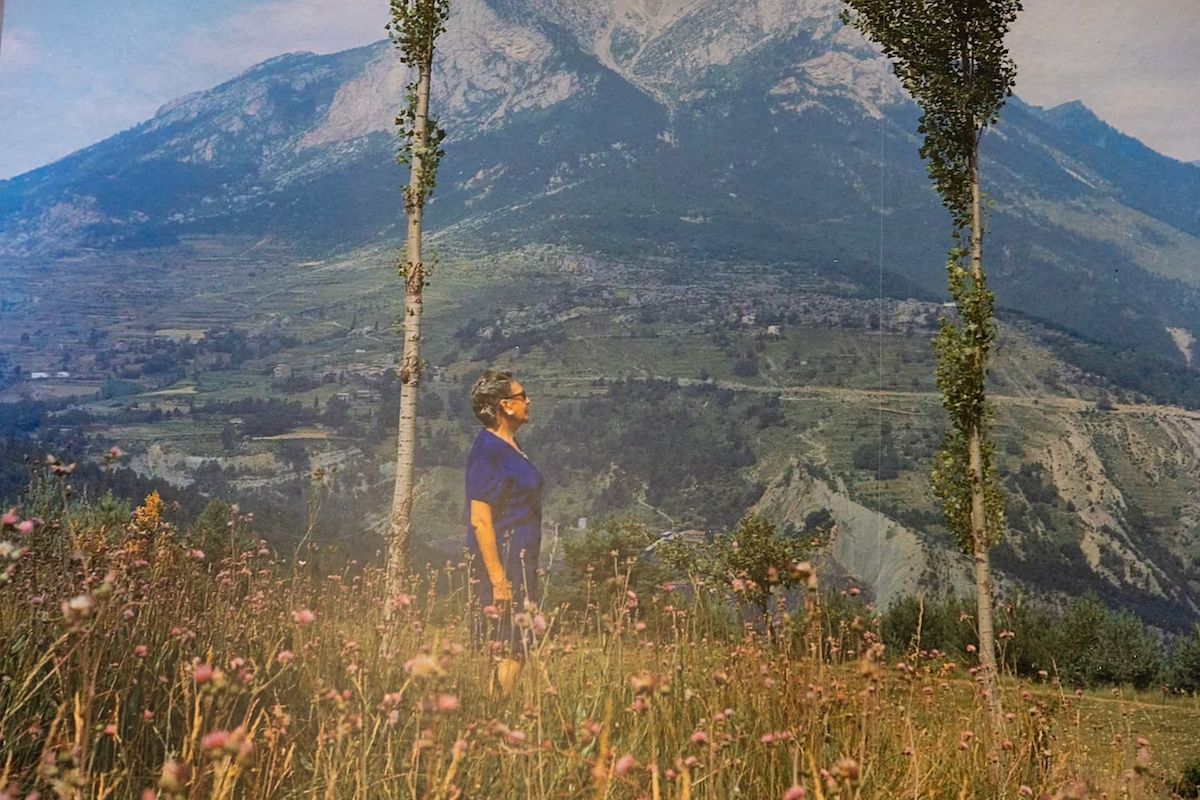
In short, an author with multiple layers of interpretation that allows for readings and re-readings with a gaze beyond the contemporary. She defined herself thus: "I am almost always two. We argue. We never agree, but we tolerate each other and have fun together. It seems that, sometimes, one of us two is passionate, sensual, pessimistic and cynical, and the other, also at times, equanimous, austere, optimistic and reserved: one a mystic, the other incredulous, both, hardworking and anticlerical."
Aurora Bertrana felt literature as a medicine for the soul and faced vicissitudes with a restless spirit and an irreducible valor and courage. She leaves us an eclectic life and a multilingual work (Catalan, Spanish and French), which form a personal journey through the eyes of a woman ahead of her time, and with ideas that, even today, retain all their strength and are more relevant than ever.
Aurora Bertrana leaves us a multilingual work (Catalan, Spanish and French), which form a personal journey through the eyes of an advanced womanThe exhibition is curated by the expert in Aurora Bertrana's work, Adriana Bàrcia (Girona, 1975), also a writer and philologist, who has a thesis on the unpublished conferences on feminism and the author's travels. She currently lives in Switzerland and is working on the re-edition of theMemories until 1935and the Memories from 1935 until the return to Catalonia
In 2017, the Department of Culture commemorated the Bertrana year, on the occasion of the 150th anniversary of her father's birth and the 125th anniversary of Aurora's birth. Now, an indispensable and necessary exhibition to reclaim the figure of an author with a groundbreaking, transgressive, and visionary personality.
Add The New Barcelona Post as your preferred Google source for free
Stay informed with the latest news.