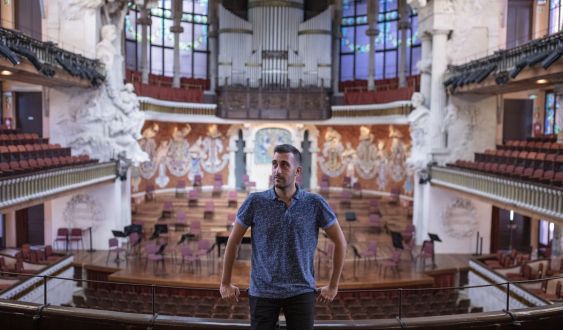
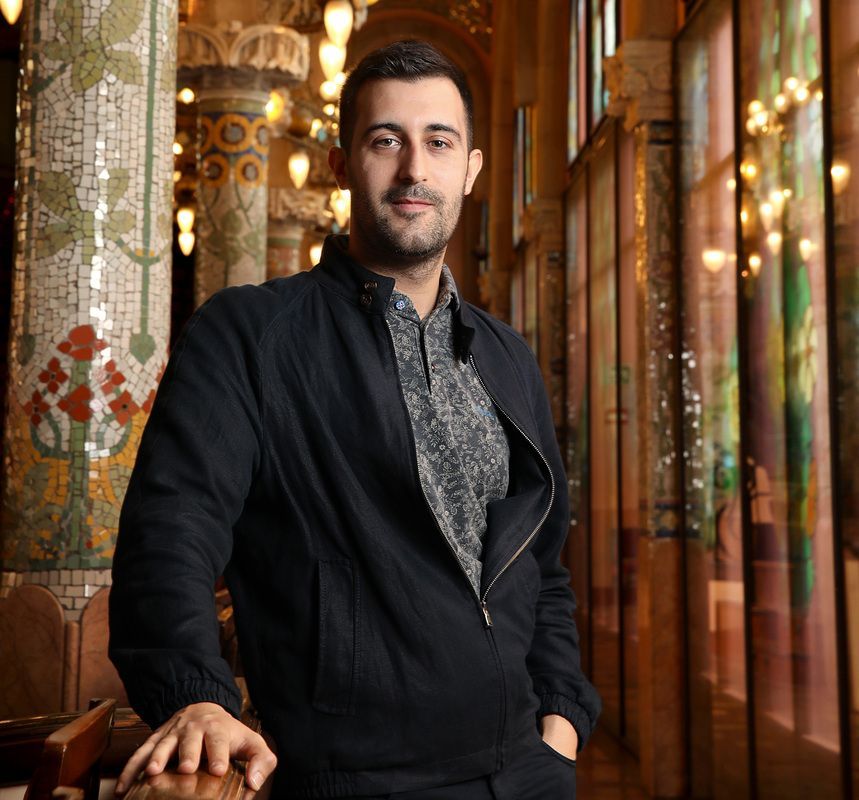
Joan Magrané Figuera is the younger of two artist brothers. Born in 1988 in the same city as the genius Antoni Gaudí, Reus, he is considered one of the most talented and promising composers in the field of classical music, not only in our territory but throughout Europe. Trained by great names in composition such as Beat Furrer and Stefano Gervasoni, he received the XXXI Reina Sofía Composition Prize at just 26 years old, and was also lauréat at the Villa Medici in Rome.
He has been a member of the Casa Velázquez in Madrid, resident composer at the Palau de la Música Catalana in the 2019-2020 season, and at l'Auditori last year. And, in addition, this 2022 he has published his book Antologia Sentimental de la Música Catalana (Peu de Mosca), where he highlights some of the great classical music composers of Catalonia, who are part of his imaginary.
Youth and talent for creation, his work is characterized by being expressive, lyrical and, almost, physical: it sings and breathes like a body. He flees from concept and seeks tradition, drinking from the past to project a future. The new interpreters of classical music want to play him and, Joan, like a farmer who works the land, plants the notes on the lines of the staves. In fact, he came to the interview wearing canvas espadrilles, and his natural humility reminds one of country men.
--- What is the first musical memory you have?
--- The first thing I remember is already making music. I have loved it very much since I was little. And we just went to live in Selva del Camp, a town where there was a music school, and they saw that I wanted to go and they signed me up. So I have always made music, both playing and writing. Ever since I knew the notes, around six or seven years old, I liked to write and I had as much fun writing as playing. There has never been a difference, that's why it was natural in the end to be a composer, because I had always written. I have no memories without music.
--- At what point do you realize that you want to dedicate yourself, not to music, but to musical composition?
--- Finding the right teacher always. As I was telling you, I had been writing, but in a very self-taught way, for friends. And it was when I was studying at the Vilaseca conservatory, in the last years, when a person who was a composer, Ramon Humet, also joined as a teacher. He taught me more things, he opened doors by making me listen to new music, and he was the one who told me "now, when you finish the intermediate degree, you have to go to Esmuc and you have to be a composer." I was perhaps thinking of being a musicologist, because I was also interested in history and reading, but he insisted, he was really the one who pushed me to push myself to the maximum, to see what could come out. And he also guided me towards Agustin Charles, at Esmuc.
---And from Barcelona to Europe.
--- First an Erasmus in Austria for a year, and then the master's in Paris, where I did two years and where I have been until last year.
--- Therefore, this composing thing has nothing to do with having had a divine revelation.
--- (Laughs) Quite the opposite. For me it would be a natural thing, it has always been part of my existence. Like a lifelong farmer, whose son ends up being a farmer, well, I don't know why it has been like that. There are no musicians at home, but we have always had support to develop artistically.
--- Then the awards arrive. How does this work?
--- The awards are induced because teachers encourage you, and in a composition career, if you don't make a living you don't hear anything, you're just doing papers, but that's not music. So you have to go to competitions no matter what because, in general, there's money, which is great, but there are also premieres, which is the way to hear what you write with professional musicians and advance. To give you an idea, a composer or, even worse, an orchestra conductor, throughout their career perhaps only sees their instrument three times, unlike a violinist who is always with their instrument. So, quickly, I started writing. The first one I won was a chamber music award, and then, in Austria, since it was very cold, I had time to do an orchestra piece that I presented years later, and for which I was given the Reina Sofía, but which I wrote when I was 20.
---The Reina Sofía, no less! But what did this imply for you?
--- This recognition was very good, because it was like a scholarship. It was my first year in Paris, and it meant not having any more financial worries for the next two or three years. Also, it allowed me to premiere an orchestral piece, something that, normally, you can't do until you are older and can afford it, because it's a lot of money. It was like jumping into the professional world very early, and that's very good.
--- I understand that composing is very complex, because you have to know how each instrument sounds, and I suppose it doesn't sound the same in your head as in reality.
--- And also knowing how the mixes sound. A good part of it is about taking the plunge, and that's the beauty of it, that's why it's artistic. There are many people who work with computers and sequencers, who have libraries that sound exactly like a real instrument, but I've never found it interesting. I like that kind of risk, of jumping into the abyss, and until the moment you confront the performer, you don't truly discover the work, it has a more artistically exciting point. Having control every second of everything that will sound has never attracted me. And of course, with an orchestra it's much stronger.
---And much more magical.
--- Yes. The only thing is that you also end up discovering that, since everything is further away, more blurred and with more performers, it's also harder for anything to sound bad. Really, if something doesn't sound good, it's because you have no idea (laughs). In an orchestra, there's like a constant sfumato of sounds if you work well. On the other hand, in chamber music or solo music is where there's real risk, because the score is always much more exposed. And of course, discovering it very early thanks to the Reina Sofía piece, is very good, because you see that composing for orchestra is where you can have the most fun. Everything is possible, because in general, everything will sound good, but you run the risk of adding too much and you can saturate. No matter how complex you want it to be, the clearer and cleaner it is, the more powerful the musical result. Then the performer can add much more of their own expression. If you give them everything millimetered, they get trapped in the text and not in the music. They don't have to transmit a score, they have to transmit an expressive idea.
--- When you start working with top-level interpreters and you are at the concert, even though you have rehearsed and know how it will go and you are calm, it happens that, suddenly, thanks to the great artists, you have that feeling of saying: "I didn't write this! It's a thousand times better!". But this only happens with good interpreters, who make it their own. Your job, perhaps, is to propose something, but with enough space for the interpreter's personality, who is finally the one who speaks with the public, to add to it. It's an almost physical sensation, where you see the work rise and become strong. And of course, it moves away from you at the same time. I didn't do this anymore, this is something else.
--- Is the act of composing music a dialogue with the soul?
--- Yes, but I am more of the belief that one cannot dissociate the soul and the body. I even believe that the body is more important. There is a fantastic verse by Carles Riba that I always repeat that says Per servir-se de l'ànima, que ha estat subtil el cos! It is here where the world of music is found, between those two points, trying to unite that. That it moves you inside, but in the same way it incites you to move outside. I cannot go to a concert and not get into it, stay still, especially because of the phrasing, which for me is the most important thing. To say something abstract, but to say it. Music is vibration. The grace of going to a concert is that it keeps you in tension, that's why when a space of relaxation arrives it is much more powerful. Either you are extreme or you are not in any way, when it comes to art.
--- Do you look for references in the world of art?
--- I have a strong connection with everything visual. They are not direct references, but yes. Lately, I'm always with Miró, thinking about this idea of lines that mark very well, the colors and how they vibrate, the light... And Miró is a landscape painter, which is perhaps what has interested me most, placing ourselves in a space. The individual always exists, but is in a context. In ...secreta desolación... ---despite being a student piece--- the idea was that, to create a type of landscape from Jose Angel Valente's verse, Cruzo un desierto y su secreta desolación sin nombre (I cross a desert and its secret nameless desolation), to represent with music that desert where nothing happens. To make a horizon, but of course, it's not just a line, but it swells. I had always been very concerned with form, I have a great time imagining the work beforehand. In Paris, Professor Stefano Gervasoni, who is someone who plays a lot with this, gave me many tools by saying that once you have it thought out (the form) it's also good to surprise yourself by changing it.
--- The word, poetry, is also present in your music. What does that imply when composing?
--- There are two aspects. The first is more musical, more technical, which is all the imagery it brings me to give meaning to the music, which has to do with madrigalism, which is what was done in the Renaissance and Baroque, where the lyrics, the word, was what gave you the musical idea. Monteverdi is the composer from whom I have learned the most, and who also moves me the most when I listen to him. And then there is the other part, which is the word as an appeal to the voice, to the person, therefore, to the human being. The vibration of the voice, as the basis of everything, this is another characteristic of my music, and that is that it is very vocal. Even with instruments I ask for things that are imitations of singing, very related to Renaissance polyphony. Small laments of voice, of falling intonation at the end, or the messa di voce, which is something that has been lost and I like to recover.
--- And ending the pieces with ellipses.
--- It's to try to abolish applause. I am generally very against it. I understand it as recognition of the performer and their work, but applauding as it is done now, to say "I know that the work ends here and, therefore, I applaud," is totally egocentric. I am very much against this modernity of applauding at any time. The more silence we make in a concert hall, for me, the more revolutionary it is.
--- Can you elaborate on that idea?
--- Classical music is, right now, one of the most revolutionary types of music there is (and some others). First, because it doesn't move much money since it's a very limited market, those of us who participate are much freer than any of these musicians who make modern music, who seem to be doing something totally personal, but who, in reality, are following very clear dictates of trends and money. No one pressures us anywhere. And, furthermore, there is this other appeal of being able to be silent with your phone for the entire duration of the concert, without looking at it, with other people in community, listening to something that ends up belonging to everyone, in silence, without being connected to these ego machines. Going to a classical concert is the most revolutionary thing we can do right now.
--- What is creative freedom for an artist?
--- I don't really share the idea of creatio ex nihilo. It's good to express what is yours, but it will always be full of experiences one has behind them. Even when you want to break it, you are having a dialogue with what you want to break. There's an idea by Perejaume that I find much more accurate, which is the inverse: the artist's problem is that they have a black page, and they have to try to find their white within that page, which would be a bit like that game with black crayons, where you uncover them and find the colors underneath. I think creation is much more about this, trying to find your colors in the black of everyday life, much more than in the white, which is impossible today. I understand art and creation as a dialogue.
--- Who would you like to collaborate with?
--- I just composed a violin concerto for Joel Bardolet, who is an interpreter I get along with very well. But my music also has a lot of physicality, so I wouldn't mind doing a ballet. Or if it were music for film, I could collaborate with someone like Albert Serra, because he is someone who seeks that freedom we were talking about. His way of working connects a lot, not only with me, but with these interpreters I like to work with, and with whom we have reflected a lot on the value of the moment as well. Of course, I would really like to do a big opera.
Add The New Barcelona Post as your preferred Google source for free
Stay informed with the latest news.
