"It has been a long journey in distance, but short in time. Fluid. Without interruptions. And without windows, because it is a fast journey, and on a fast journey there is nothing to contemplate outside. Instead of windows, the vehicle has informative and advertising screens. And also the holograms of a saxophonist wearing a wool hat who has performed a Coleman Hawkins piece live, and that of a contemporary dancer who has accompanied her. Before getting off, Joan has made a financial contribution through an application".
Utopian Barcelona is the result of conversations held with 5 municipal architects. Each of the conversations has revolved around a specific theme, although the result, a consequence of an integral vision of the city, incorporates transversal ideas. The idea for this series of 5 articles about a utopian Barcelona was born to give wings to these architects who maintain close contact with the city, some for many years and, moreover, daily. The creative scope of municipal architects is often limited by budget allocations, by execution deadlines, by the policies of the government in power… So, without getting into partisanship, they have ventured into the exercise of speculating about a Barcelona that will never exist, but that we can imagine.
The articles have a futuristic slant. However, not all of them delve into science fiction. The readings invite imagined locations and corners. To invented forms of the city. To projections of a Barcelona society far removed from the current one and, above all, they seek to give the reader a good time. With the exception of the text in italics, which is a transcription of part of the conversation or a research process, the rest is the fruit of imagination.
*Guest architect: Joan Sansa Hurtado, municipal architect of the Barcelona City Council.
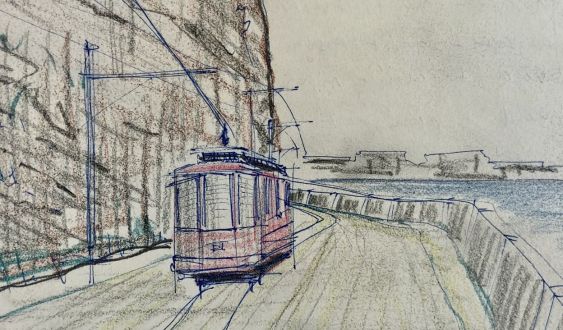
Joan tells me to meet at a cafe at the foot of Montjuïc cemetery, at the end of the bottleneck of the Ronda Litoral, between the morrot and the sea. Barcelona had no choice but to reclaim the space it had ceded to the industrial and road zone, says Joan Sansa. To get here from Badalona, he came in an articulated, autonomous vehicle reminiscent of old trams, specifically number 48, which connected La Rambla with Can Tunis. And although he has a valid integrated transport pass, he hasn't needed to insert any ticket into any machine or scan any card. The articulated vehicle arrived on time. And the route was the one indicated by the virtual assistant, in the style of Her, Spike Jonze's film. There were no surprises. It was a long journey in distance, but short in time. Fluid. Without interruptions. And without windows, because it's a fast journey, and on a fast journey there's nothing to contemplate outside. Instead of windows, the vehicle has informative and advertising screens. And also holograms of a saxophonist wearing a wool hat who performed a Coleman Hawkins piece live, and a contemporary dancer who accompanied her. Before getting off, Joan made a financial contribution to them through an application.
On the way to the establishment, Joan dispatched a couple of emails and ordered an American coffee with a pinch of cinnamon. Once at the doors of the establishment, an android accompanied him to the table he had also previously chosen and we shared. He sits down and we talk about the different focuses of the city's evolution throughout history. From the Eixample that never was, through the housing emergency during Francoism, the urban planning paradigm coinciding with the '92 Olympics and, recently, the collapse as a consequence of the massification of tourism and the immediate restructuring of a city model based on the disappearance of rigid structures such as the old Ronda de Dalt and Ronda Litoral.
This last project, that of the Rondas, raised controversy. Few imagined that the pile of junk we used to call cars would end up being replaced by this intelligent network of interrelated vehicles, emancipated by intercom technology, guided by the coordinates of a jungle of sensors throughout the city that also makes up the citizenry. And so we live free from distractions, accidents and common breakdowns, and, therefore, without the usual traffic jams, despite having only one lane for private vehicles. The rest of the lanes have been replaced by an area restricted to emergency services such as the police, ambulances and firefighters, and space has also been allocated for wheeled mobility for bicycles, scooters and others, as well as constant displacement belts for pedestrians. All this in an exuberant environment and atmosphere of nature open to the sea. A miscellany of Mediterranean and tropical vegetation and the ghostly and punctual agitation of African fauna, like a zoo without walls.
The recovery and transformation of the Rondas meant a rebirth of the coastline. The engine of this transformation was the need to relocate the city's educational centers to offer open space to students, fleeing from interior patios and hard squares. And alongside the educational centers, other complementary services such as libraries, sports centers, meditation and spirituality spaces, and leisure.
The result of this Barcelona is not something random. It is the sum of a change in relationship with the environment. We realized that we had crossed some red lines. The 2019 pandemic led to an increase in teleworking and a significant reduction in emissions, factors that led to a plausible improvement in environmental indicators. And over the years we have seen that either we returned to that way of doing things, or the city would enter a point of no return. The reference for that change, for Barcelona and other European cities, was Copenhagen. According to a Deloitte study in 2017, the Danish capital notably topped the lowest nitrogen dioxide indices ---although at that time it still exceeded the limits set by the EU---. In large part, because more than 45% of its population commuted to work, university, or school by bicycle. And 85% of the vehicles circulating in the city were electric, hybrid, or hydrogen-powered, with a network of more than 500 supply points. As for public transport, it then had a driverless metro service that allowed operation twenty-four hours a day, seven days a week, as well as an integrated ticket system from the city center to the airport. In this way, only 4% of its road network was affected by traffic jams.
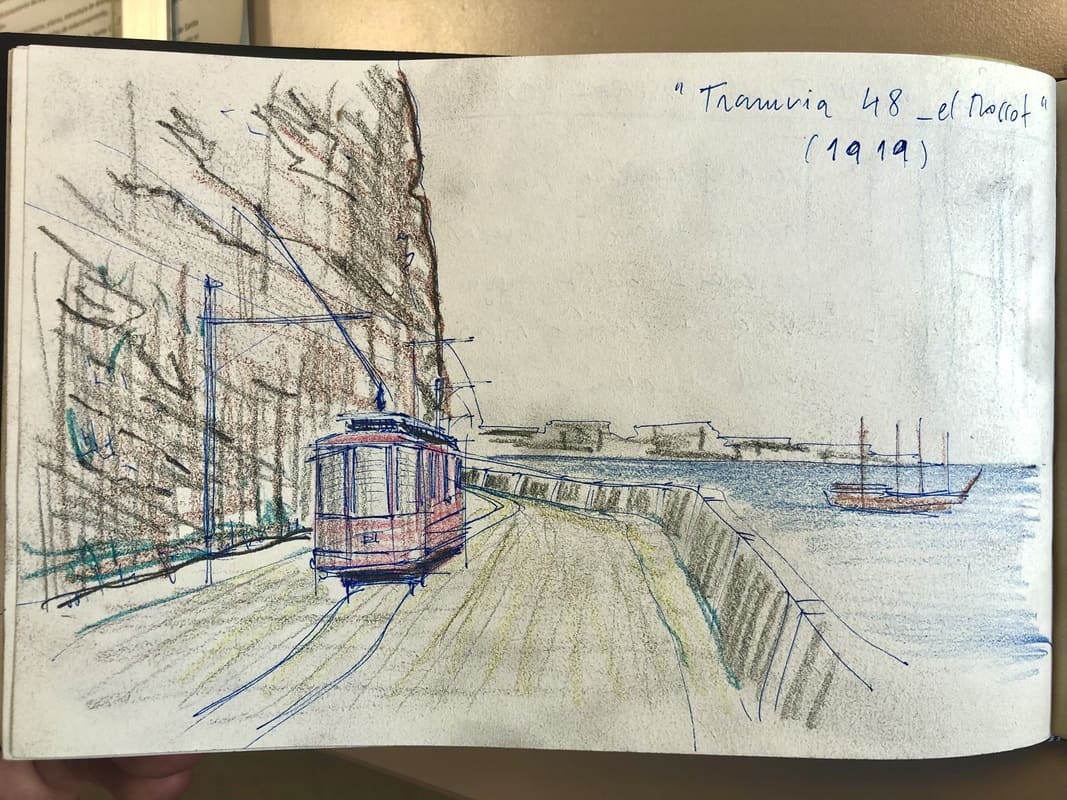
After the conversation, Joan retraced his steps with the articulated vehicle reminiscent of trams and asked the virtual assistant for Andrés Calamaro's concert at Luna Park in Buenos Aires in 2005. Before going up to his house, he stopped at a parcel pick-up point, an establishment that had been a bank branch years ago. He entered the corresponding code. A locker opened, he picked up the package and unwrapped it as he walked. He threw the wrapping into the tilted bin (tilted to encourage cyclists to hit it).
I have also used the articulated vehicle. But to go to Gràcia, where I had lived. The first impression was that it hadn't changed too much. The squares are still in their place. Also the terraces. Of course, the job of waiter is done by androids and that of living by people, now that we work less and the universal basic income is a right. The last words of the conversation with Joan still resonate: the change in tangible Barcelona over the last two decades is exponential if we contrast it with the transformation throughout history, but probably the difference is even more notable in intangible Barcelona: that we have gone from measuring distances in metric units to consolidating them in units of time is a revolution. Don't tell me in meters or kilometers, tell me in units of time: that only shows that time has ended up winning the game against money.
In Plaça del Diamant, Mercè Rodoreda is sitting on a bench and narrates a book she never wrote in life and that no longer needs to be read: ---do you remember when they said they would fill our sky with drones?--- she says. When finished, Rodoreda falls silent, looks at the sky and marvels that so many stars can be seen. Then the hologram turns off and, after a while, starts again from the beginning.
Add The New Barcelona Post as your preferred Google source for free
Stay informed with the latest news.