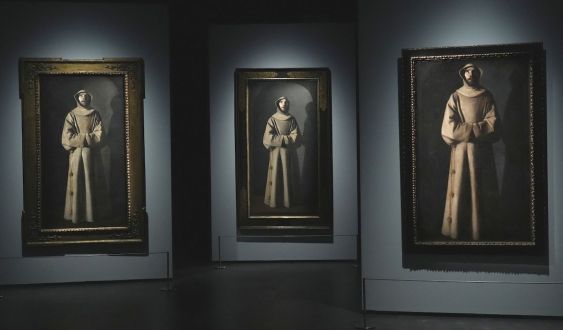
With darkness imposing itself in every corner, the Museu Nacional d'Art de Catalunya (MNAC) delves into the work of Francisco de Zurbarán, one of the great masters of the Spanish Golden Age. The exhibition Zurbarán (super)natural. The mystery of reality brings together for the first time, and who knows if the only time, the three versions that the baroque painter made of Saint Francis of Assisi according to the vision of Pope Nicholas V, a suggestive image about a legendary event reported in the mid-16th century, with a pope and his entourage glimpsing, almost by touch, a corpse that seems to have come back to life.
The replicas have traveled from Boston and Lyon to meet their Barcelona counterpart, a milestone with even more value if one considers that the American one had never been lent before. A long-standing encounter, as recalled by the director of the MNAC, Pepe Serra, who had it in mind since his arrival at the institution in 2013. It is not known which of the three was the first, but each of them is different, as can be seen by going from one to another at the MNAC. Historically, the version preserved in Barcelona had been considered very different, with an imposing dark background that replaced the forms around the central figure present in the other two. The foot of Saint Francis of Assisi, a key detail for the story present in the other two paintings, could not be seen either.
On the occasion of the exhibition, which can be visited until the end of June, the Saint Francis of Assisi according to the vision of Pope Nicholas V from the MNAC has undergone a deep restoration that has allowed discovering that it was not so different from its counterparts. Before it became part of the museum's collection 120 years ago, a layer of black paint and varnishes was added that substantially modified it. It is not known why or when it was done, who knows if to disguise the wear and tear it was accumulating or for a matter of fashion.
"We did not see all the elements that helped to read what Zurbarán was explaining to us," says the head of Restoration, Carme Ramells, who is used to touching a hundred pieces a year, but it is not so common for her to have a work like this in her hands. In order to rescue the original painting and respect the stroke of the artist from Extremadura, the museum's restorers have been isolating the black added later. They have done it in a curious way, seeing that iron predominated in this one and not in Zurbarán's, which has allowed them to differentiate which one had to be removed and which one did not.
Facing Zurbarán's Saint Francis of Assisi, there is Antoni Tàpies, although, with the mystical fascination aroused by Zurbarán's three paintings, he goes very unnoticed until one turns around. The exhibition mixes the painter's works, known for their intimate religious themes, with contemporary artists such as Tàpies, but also Antoni Llena, who was a Franciscan monk before becoming an artist, Aurèlia Muñoz and Eulàlia Valldosera. About thirty creations, half of them by the artist from Extremadura, coexist in a room full of "analog immersive art," in the words of the MNAC's contemporary art conservator, Àlex Mitrani. This highlights the museum's collection, with almost 80 works from the Spanish Golden Age and Zurbarán being one of the most represented painters, and new pieces are commissioned from today's artists to dialogue with the past and point out timeless concerns. "All of them multiply and offer a total experience," emphasizes Mitrani.
To make all this deployment, complicities have been woven with other institutions, not only with the Musée des Beaux-Arts de Lyon, where the three versions of Saint Francis of Assisi according to the vision of Pope Nicholas V were first seen, and the Museum of Fine Arts of Boston, but also, and above all, with the Prado. The Madrid museum has lent a recently purchased work to be exhibited in the Catalan capital, even before in its home (The Virgin of Mercy with two Mercedarians), in addition to lending Still Life with Pottery to be able to confront it for the first time in the city with its replica based in the MNAC. "Everything we do has a meaning, it is part of a deeper work," adds its director, always thinking about collaborations to be able to go further. That is why they are already pointing to the expansion of the museum, about to reveal the winners of the international architecture competition that will give it shape.
Add The New Barcelona Post as your preferred Google source for free
Stay informed with the latest news.
